



Fine choice: Medical Manufacturing
How moldmakers select the right cutting tools, toolholders and machine tools.
How moldmakers select the right cutting tools, toolholders and machine tools.
In the mold manufacturing business, lead times are becoming far more critical than other factors—even price. Several plastic-injection mold and mold base making company owners and managers told Cutting Tool Engineering that faster delivery times are pressuring them to shorten lead times and possibly even operate 24/7 to meet customers’ demands.
Consequently, the choice of machine tools and the equipment needed to optimize moldmaking operations—such as toolholders and cutting tools—is critical to meeting these abbreviated lead times. Good machines are key, said the moldmakers interviewed for this article. They need to be rigid with minimal vibration to get consistent, repeatable results.
Chase is On
Tim Roth, shop supervisor for Craftsman Tool & Mold Co., Aurora, Ill., noted that machine tool builders and cutting tool manufacturers are constantly playing a game of catch-up with each other. Craftsman is currently installing the last machines in a $1 million, multiple-machine investment the company made over the past year to expand capacity, upgrade equipment and shorten lead times to handle a growing volume of orders. One machine is a Mitsubishi MV15-20 bridge-type vertical machining center with a 160 ” X-axis travel and 80 ” Y-axis travel. “It has a much larger work area than our other equipment,” Roth said.
Courtesy of Industrial Molds
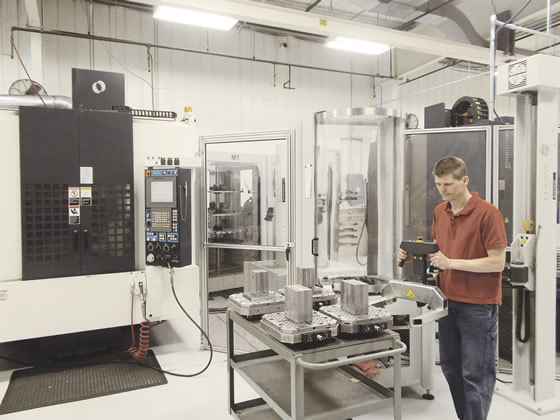
Mark Hastings, HSM department manager at Industrial Molds, monitors a work cell that includes a Makino S-56 vertical machining center (left), an Erowa robot/pallet changer (middle) and a Makino F-5 VMC (right, behind enclosure).
With a 30 ‘×60 ‘ footprint, the MV15-20’s pallet system has two tables, which allows Craftsman to set up on one while the other is operating. Craftsman also added two Kuraki boring mills. The KBT-13 has 118 ” of X-axis travel, 78 ” of Y-axis travel and a 63 “×73 ” full rotational turntable, and the KBM-11 has a 39-sq.-in. table.
“Machine and cutter technology bounce back and forth,” Roth said. “The cutters catch up with the machine capabilities, then the machines surpass cutter capabilities. A lot of the newest cutters exceed the machines’ capabilities due to their stronger coatings. Better toolholders provide superior balance, allowing the tools to be run at speeds faster than some machines are capable of.”
Lights-Out Capability
Improvements in cutting tools—and in toolholders and machine tools—have also enabled many moldmakers to run “lights out” without worrying about destroying the workpiece or making “junk.”
Dennis Nord, supervisor for the EDM department at Industrial Molds Group, a Rockford, Ill.-based mold manufacturer that has won awards for its complex automotive molds, commented that extended cutter life is “a real gain” for Industrial Molds. “When cutting graphite electrodes, we use diamond-coated tools to get more cutter life so we can run overnight and over weekends,” he said.
Courtesy of Craftsman Tool & Mold
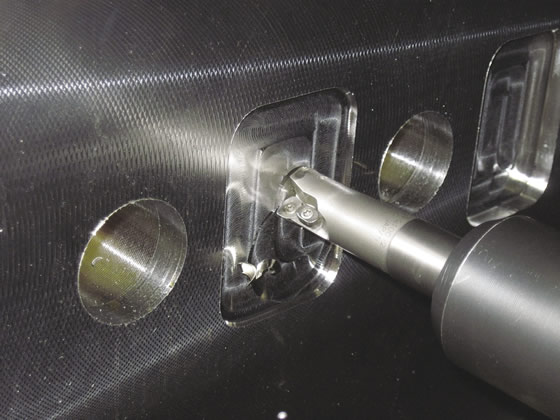
Craftsman Tool & Mold uses this 1 ” high-feed mill for achieving high metal-removal rates when machining mold bases.
These are primarily endmills from Preferred Tooling Supply and other sources, such as Crystallume, Leading Edge and GAR.
Nord continued: “If we can get three times the life out of our endmills, that’s a big advantage for us. We can run up to 20 tools in one electrode milling machine and not have to worry about the accuracy of our cuts being compromised. It may take a number of different tools to run these setups due to the different details on the parts. If we plan for a 60- to 70-hour run over a weekend, tool life becomes critical because we have such a varied array of electrodes to cut [for use in our EDMs].”
Craftsman specializes in large, tight-tolerance, custom mold bases for moldmakers. Its primary concern is quickly removing large volumes of material. Roth purchases cutting tools for the company and is impressed with the advances over the past 4 to 5 years, particularly with high-feed mills and button cutters.
Button cutters are optimal for mold pocketing and die/mold roughing in applications such as Craftsman’s that require aggressive machining. Roth added that while button cutters are not new, recent improvements, such as advanced coatings, allow the tools to cut more effectively and hold tighter tolerances at higher speeds. These coatings also help extend tool life when cutting hardened steel and milling electrodes, which has enabled more lights-out machining.
“We’re comfortable with lights-out machining because insert wear is predictable. Knowing we can get 8 hours of run time out of the inserts as we walk out the door at night is really helpful,” Roth added.
Right Tool for the Job
Moldmaking requires a variety of operations, from small, detailed core and cavity work to hogging material in a mold base. In addition, plastic-injection molds are also manufactured from a variety of metals, ranging from aluminum and soft steel (annealed or prehardened before heat treatment such as P-20) to hardened steel (such as H-13) and stainless steel.
Courtesy of Tech Mold
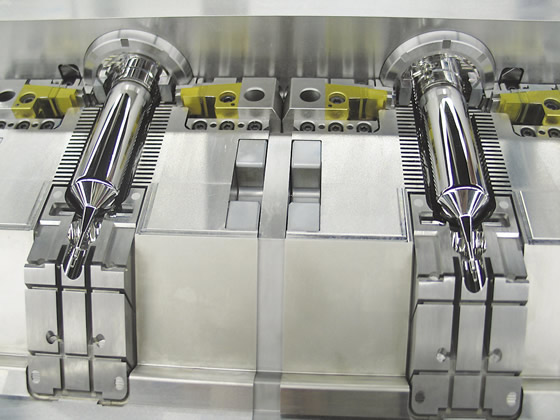
This mold, made by Tech Mold, is used to produce a housing that is part of a medical device that inflates stents.
Cutting tools used in moldmaking tend to be specific to the steels used, such as soft and hardened, which tend to cause tools to wear faster than when cutting aluminum.
Molds are built to accommodate the type of part being molded, the process being employed (such as injection molding, thermoforming and blow molding), and the useful-life requirements of the mold.
For example, high-volume, multicavity (64 to 196) molds for injection-molded components, such as medical disposable products (syringes, vials and intravenous set assemblies) and packaging (caps and closures), have volumes in the millions per year. Because these molds tend to run 24/7 year-round and require less maintenance, they generally are machined from steel mold bases with hardened steel core/cavity inserts.
Some mold manufacturers specialize in single-cavity or lower-volume multicavity injection molds, with two to 16 cavities, for lower volume production, ranging from a few thousand to a few hundred thousand per year. Many of those molds, particularly for extremely large parts for the transportation industry and industrial applications, such as gas and fluid management, are made from aluminum. Molds for low-pressure, low-heat processes, such as pressure-forming or thermoforming, are also typically aluminum.
Choosing the right machining strategy for various mold components is critical. Also, the selection of cutting tools affects the performance of the machine and material-removal rate.
Joe Crane, supervisor of the electrode department at Tech Mold Inc., a Tempe, Ariz.-based manufacturer of high-volume, multicavity molds for the medical, packaging, pharmaceutical and consumer products industries, said the quality of endmills is critical in his department because they machine the electrodes required for EDMing fine details in the mold cavity. The electrodes are typically graphite or copper-impregnated graphite.
“We test the longevity of the cutting tools we use for carbon [graphite] to see how the endmill wears and if it holds its size before we settle on a specific vendor,” Crane said. “We typically test tools for 20 to 30 electrodes and determine whether a tool is better or worse than what we’re currently using.”
When applying cutting tools to machine the molds themselves, Craftsman generally uses large, 3 “- to 4 “-dia. cutters until they get to the finishing stage of a mold base. Blocks of raw material can range from 10 “×12 ” to 48 “×65 ” to 42 “×138 “.
“A project of that size requires large cutters to remove large amounts of material,” Roth said. “We have six core brands that we’ve been with for quite some time. They compete against each other with respect to performance, and the sales reps always bring in tools they say are better, but we test all the cutters before we commit to purchase.”
Roth noted Craftsman has a few cutters that it has written programming around because the company found that between the price of the inserts, their useful life and the overall volume of material they remove, those specific cutters have set the standard. “We pretty much let them bring in their latest cutters and give them all a fair shot, but if we can’t get improvements over what they’ve been doing, we wait,” he said.
Moldmakers say there are critical differences in the performance of cutting tools that are revealed through testing. Form is critical. For example, a ball endmill must have a perfectly consistent radius. “What we cut is only as good as what we’re cutting it with,” said Chris Zoucha, supervisor in the mold base and insert department for Tech Mold. “If there’s even a slight imperfection in the radius, it compounds dimensional inaccuracies in the part. We don’t want to change the program to compensate for a bad endmill.”
Courtesy of Tech Mold
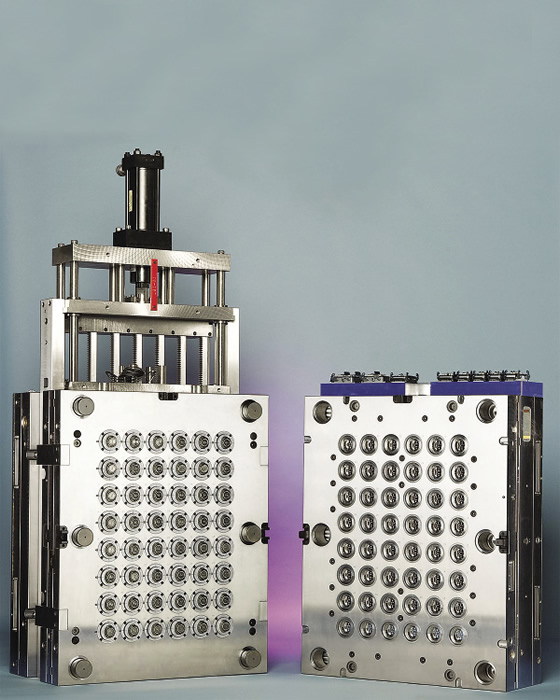
Tech Mold made this multicavity mold, which is used to produce threaded, tamper-evident pharmaceutical container closures.
Cutting tools have improved largely because of new coatings developed to reduce wear and increase tool life, according to the moldmakers interviewed. Submicrograin carbide grades also contribute to cutting longevity and greater accuracy, offer higher productivity and reduce secondary operations. For example, many cutting tools impart a fine surface finish that can eliminate the need to burn electrodes for core/cavity EDMing in the mold, even for fine details.
Industrial Molds’ Nord noted he applies 0.025 “- to 0.125 “-dia. endmills with a light diamond coating because they’re not as brittle as other tools. Also, tool life can be improved with a well-balanced toolholder, particularly in high-speed machining operations.
Another key factor in moldmaking productivity is the choice of toolholders. For example, Tech Mold typically machines electrodes and steel mold cores and cavities at 20,000 to 30,000 rpm. “We use shrink-fit toolholders in our high-speed machining department because if we don’t have good balance, it shows up in the surface finish,” Crane said.
A well-balanced toolholder that has low runout and generates minimal vibration is a particularly critical factor when high-speed machining electrodes. “We use HSK toolholders for high-speed electrode machining and they grab tools perfectly, but we use some other styles as well,” said Dan Civalier of Tech Mold’s electrode department.
Fix ‘Em Up
Mold shops try to get more tool life by refurbishing cutters toward the end of their lives, which is typically determined by checking part size. While some programming adjustments can be made to compensate for cutter wear, at some point, adjustments are no longer feasible. Some shops keep records of how many pieces they get from certain cutting tools and change the tool at that point.
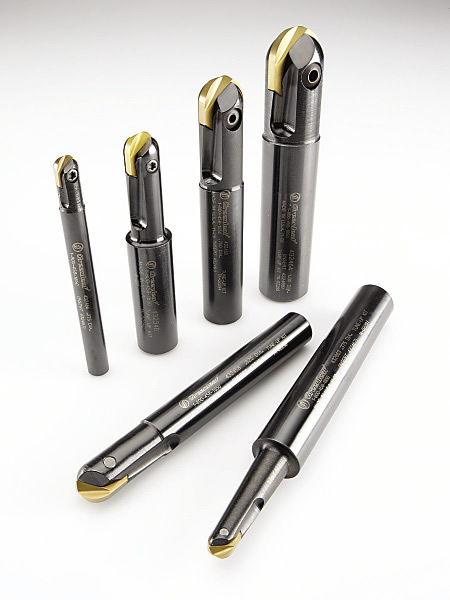
Courtesy of Greenleaf
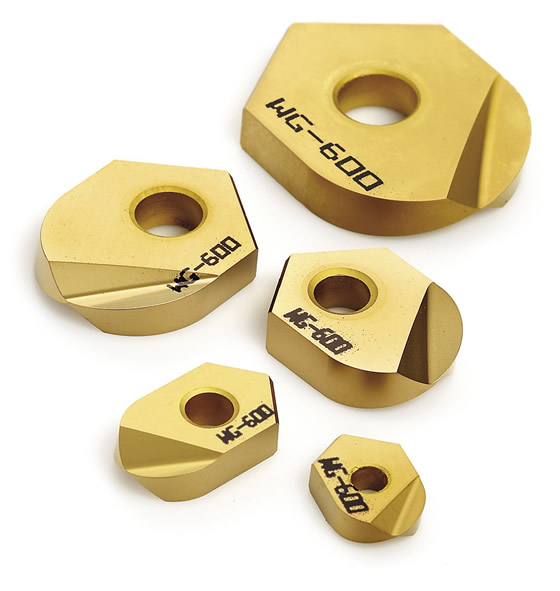
Ballnose endmills and ceramic inserts, such as these from Greenleaf Corp., Saegertown, Pa., are used to machine the hardened steel used in plastic-injection molds. Below: WG-600 coated whiskered ceramic inserts.
Tech Mold uses a service to refurbish, resharpen and recoat its endmills and drills in sizes down to ¼ ” in diameter. “Below that, the cost [of refurbishing] comes close to what these tools cost to buy new,” Zoucha said. “If a tool can’t be refurbished for the detail work, we’ll use it for roughing work as opposed to a new cutter for that purpose.”
Mark Hastings, high-speed milling department manager at Industrial Molds Group, said when HSM is required for electrodes and other mold work, the company uses ¼ “-dia. and larger tools, and they resharpen those tools to extend life. “However, most of the time we use these resharpened tools for roughing and semifinishing [rather than finishing],” he commented. “I don’t have confidence that I can be accurate with a refurbished tool in detailed work.”
Given the pressures on mold manufacturers to reduce lead times, cutting tool performance is a critical factor. Several moldmakers interviewed pointed out the importance of being able to order cutting tools online for immediate shipment. “If the cutter is not in stock in the U.S., we can’t wait for the factory to make it,” said Tech Mold’s Zoucha. “If a vendor has a detailed online catalog of their inventory, that goes a long way in helping us make the decision to do business with that company.” CTE
About the Author: Clare Goldsberry is a freelance writer who covers injection molding and the moldmaking industry. Contact her at clarewrite@aol.com.
Contributors
Craftsman Tool & Mold Co.
(630) 851-8700
www.craftsmanmold.com
Industrial Molds Group
(815) 397-2971
www.industrialmolds.com
Tech Mold Inc.
(480) 968-8691
www.techmold.com
SaveSave
Glossary terms in this article
Related




Subscribers can use MFGAxis notes, saves and discussion tools with their innoNET account.


