2 Spindles Are Better Than 1
2 Spindles Are Better Than 1
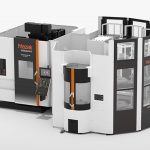
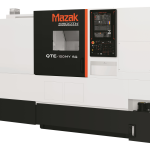
Dual-spindle turning centers allow shops to combine several processes into one setup. This article describes a typical dual-spindle turning center's configuration and capabilities. A common scenario is given showing how such a machine might be used to reduce cycle times.
Dual-spindle turning centers can turn parts in half the time that single-spindle machines can. But that's not all. This new breed of turning center also enables parts to be completely cut on one machine in one setup.
In high-production manufacturing, machine operators traditionally had to turn the front end of a part on one lathe, move the part to another lathe to turn the back end, and then move the part to a milling machine or machining center for milling or drilling. This operator intervention allowed for inaccuracy as the part was unclamped from one machine and reclamped in another and wasted manhours as the part was transported and reset.
Now, manufacturers can streamline production by using dual-spindle turning centers, which can turn most parts in half the time that lathes with just one spindle can. Dual-spindle turning centers eliminate the need to move the part from one machine to another, which reduces handling and setup time and improves accuracy from part to part. For many applications, the part can be completely machined, including secondary cutting operations, in one setup.
A Tale of Two Spindles
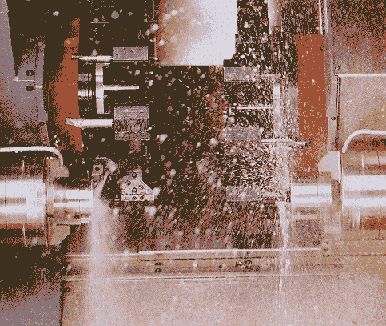
Lathes with front- and back-end turning capabilities for high-production applications are not new. Secondary, pick-up spindles have been available on older classes of non-CNC cam automatics for years. While the additional spindle allows for back-end turning, setup times range from 1 to 5 days due to the complexity of the process. Cam-controlled machines with pick-up spindles also aren't accurate enough to produce tighter tolerance parts, leading to poor repeatability and higher scrap rates.
In addition, cam automatics require the use of form tools. The spindle runs at low rpm while the cutter plunges into the workpiece to form the shape of the part. Form tools can't cut as fast as standard off-the-shelf inserts can, and they're not as cost-effective.
Dual-spindle turning centers are a logical extension of dual-spindle cam-controlled technology. The CNC allows parts to be set up in hours rather than days. Manufacturers can run small lots and respond better to just-in-time production demands, machining only enough parts to fill their immediate inventory needs. Dual-spindle machines decrease the net time and, ultimately, the net cost per part.
The CNC on a dual-spindle turning center also enables the machine to offer better repeatability than a single-spindle or multispindle cam automatic does, providing higher accuracy over a longer period of time. Once a CNC machine has been programmed to cut a part, the machine can run continuously with consistent accuracy. In addition, the CNC's accuracy enables both ends of the workpiece to be cut to ground tolerances, eliminating the need for the final grinding process on many parts.
The various types of dual-spindle turning centers range from simple machines with low-power subspindles to complex machines that turn, mill, and drill parts in one setup. Twin-spindle horizontal turning centers and subspindle turning centers are the most common types. The complexity of the part and the manufacturer's machining requirements dictate which dual-spindle machine will perform best.
Two Types for Turning
Subspindle turning centers have two coaxial spindles of unequal power facing each other. Like a pick-up spindle on a cam automatic, the subspindle on a turning center has less cutting capacity than the main spindle, because the motor driving the subspindle has less power. The main spindle generally holds and rotates the workpiece while the front end of the part is machined by tools in a turret. Then the subspindle picks up the workpiece from the main spindle to rotate the part while the back end is cut, usually by tools in the same turret. Although a subspindle and a pick-up spindle serve basically the same function, the CNC on a subspindle machine provides machining accuracy far superior to that of a cam automatic.
Subspindle turning centers are best for machining parts that aren't very complex or parts that have one end that is less complex than the other end. Most subspindle machines have one tool turret that can serve both spindles. However, a second, bidirectional turret with live tools for secondary cutting operations can be added to enhance productivity.
Twin-spindle horizontal turning centers, on the other hand, have two coaxial spindles of equal power facing each other. The left spindle generally holds and rotates the workpiece while the front end of the part is machined by tools in a turret. Then the right spindle picks up the workpiece from the left spindle to rotate the part while the back end is cut, usually by tools in a second turret.
Twin-spindle turning centers are best for machining parts with front and back ends of about the same complexity. They are also well-suited for applications involving rotary tools for secondary cutting operations. Most workpieces cut on screw machines, for example, require some type of secondary operation. These parts can be completely machined on twin-spindle turning centers with bidirectional turrets that hold turning tools as well as live tools for milling, drilling, and tapping. These live tools can be held on one or both turrets, allowing the use of rotating and stationary tools in the same setup.
Most twin-spindle turning centers are equipped with two tool turrets. Some twin-spindle machines are designed with two turrets that each hold up to 12 driven tools and with milling heads rated at up to 8 hp; these machines are as powerful as many stand-alone milling and drilling machines.
The major benefit of using a twin-spindle machine is the ease of CNC programming. Because the spindles are of equal power, the programming doesn't have to be adapted to the fact that one spindle has less power than the other. With equal power on the left and right spindles, part programs of equal speed or complexity can be run on either spindle. Therefore, twin-spindle turning centers are typically viewed as simpler to program and more versatile than subspindle turning centers. Although subspindle machines are usually less expensive, twin-spindle machines with two turrets generally produce more parts in one machining cycle.
Turning Back Time
For manufacturers producing millions of identical parts per year, reducing the cycle time can improve production by thousands of parts. Figure 1 compares the number of parts produced by a subspindle turning center with one turret to the volume produced by a twin-spindle machine with two turrets. With a 45-second cycle time, the subspindle turning center produces approximately 400,000 parts per year. The twin-spindle machine with two turrets can reduce this cycle time by at least 30%. With a 31-second cycle time, the twin-spindle turning center produces approximately 600,000 parts per year. If each part is sold for $1, a manufacturer can make nearly $200,000 more using the twin-spindle machine with two turrets than it can using the subspindle machine with one turret. By producing 200,000 more parts per year, this manufacturer can pay for its investment in a dual-spindle turning center in only 18 months. ,p>A subspindle or twin-spindle turning center with two turrets also enhances productivity by allowing two machining operations to be performed simultaneously. The machine operator can cut both ends of a part, or the front end of one part and the back end of another part, at the same time. The resulting savings in production time may convince some manufacturers to invest in an additional turret for their dual-spindle machine.
A subspindle machine with one turret, for example, may be able to cut the front end of a part on the main spindle in 60 seconds and the back end on the subspindle in 40 seconds. The workpiece will come off the machine complete in 100 seconds. A twin-spindle machine with two turrets, however, can cut both ends of the part simultaneously; therefore, the back end of the part is machined "for free," resulting in a cycle time of only 60 seconds. By performing two operations at once, the two turrets save the manufacturer time and enhance its machining flexibility.
| |||||||||||||||||||||||||||||||||||||||||||
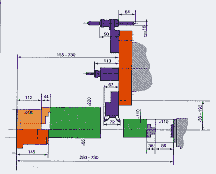
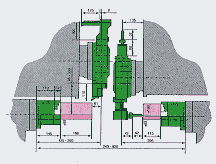
Figure 1: A manufacturer can reduce its cycle time 30% by using a twin-spindle turning center with two turrets rather than a subspindle machine with one turret.
About the Author
Charlie Carland is national sales manager for Emco Maier Corp., Columbus, OH.