ADI brings durability with less machining
When mechanical reliability is paramount for relatively complex parts that weigh less than their steel versions, part manufacturers frequently turn to austempered ductile iron, or ADI. The high-strength, abrasion-resistant ADI castings, which are processed with a special heat treatment that requires an uninterrupted quench, are produced in near-net shapes, so large quantities of parts can be machined quickly.
When mechanical reliability is paramount for relatively complex parts that weigh less than their steel versions, part manufacturers frequently turn to austempered ductile iron, or ADI. The high-strength, abrasion-resistant ADI castings, which are processed with a special heat treatment that requires an uninterrupted quench, are produced in near-net shapes, so large quantities of parts can be machined quickly.
However, holemaking involves drilling into a solid workpiece material, said Henry Rutkowski, application specialist for Fair Lawn, New Jersey-based Sandvik Coromant Co., who’s located in South Elgin, Illinois.
“They don’t put a cast hole in there,” he said. “It has to be solid to enjoy the benefits of austempered ductile iron.”
Because ADI has a high level of fatigue strength and tensile strength but is not so hard and brittle that it is prone to cracking, most ADI applications are automotive, said Salvatore DeLuca, product manager for Allied Machine & Engineering Corp. in Dover, Ohio. But those applications aren’t limited to car parts.
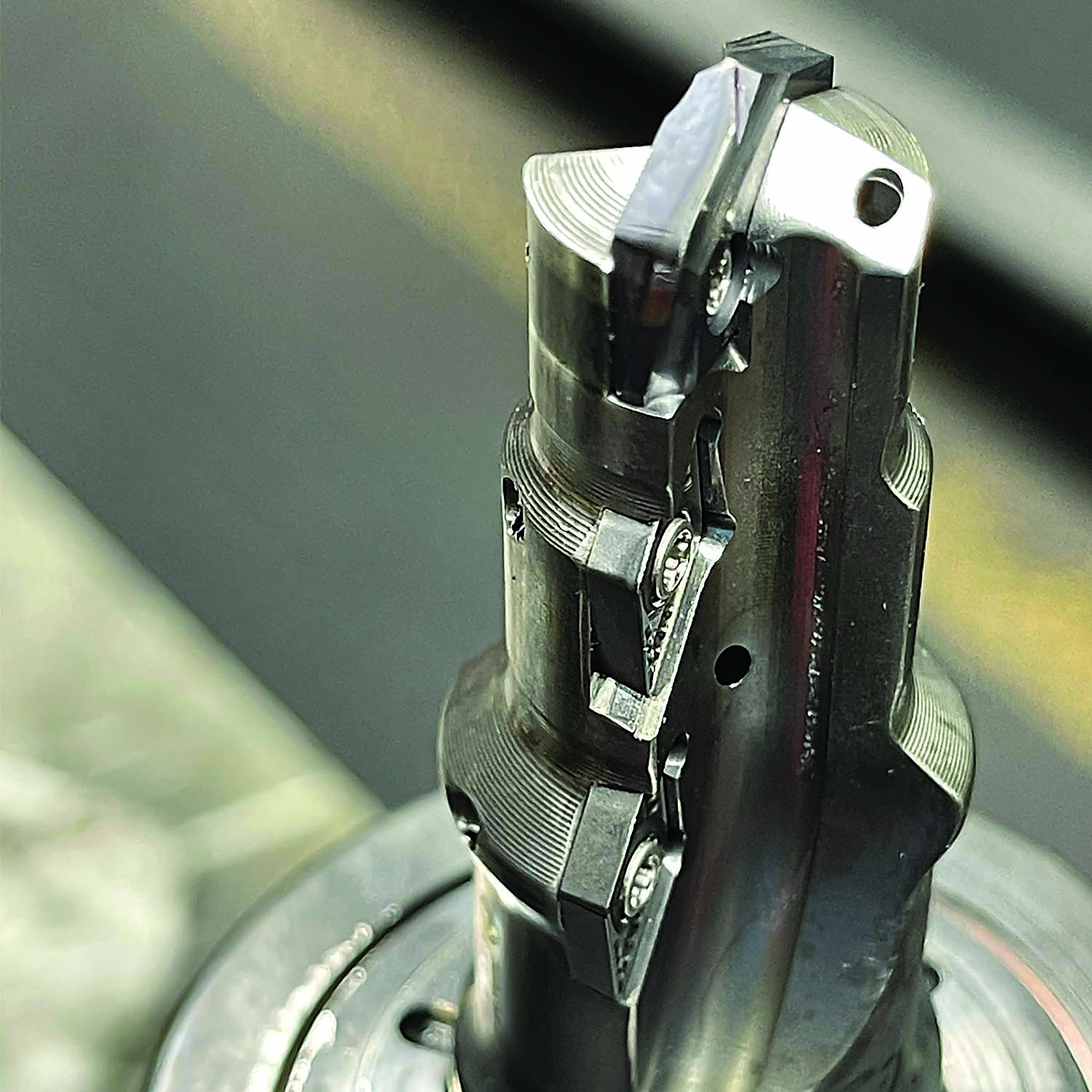
Step drills frequently are needed for ADI holemaking applications. Image courtesy of Allied Machine & Engineering
“You will see it a lot in all-terrain vehicles, boating, anything where reduced weight and structural integrity are critical,” he said. “They need the durability of a ductile iron, but they also need to be able to produce at higher quantities with less machining.”
In addition to automotive, ADI is highly suitable for producing large volumes of pump components, said Steve Pilger, product manager for holemaking at YG-1 Tool (USA) Co. in Vernon Hills, Illinois.
“It’s an improvement over the old-fashioned gray cast iron,” he said. “In the old days, we would (use) gray cast iron, and instead of chips you would get more of a powder from it. We used to call it ‘iron dust.'”
Pilger said drilling gray cast iron didn’t cause a chip evacuation problem, but ADI produces small chips when machined that must be controlled, especially when deep-hole drilling.
“If you can’t get those chips out,” he said, “they start spinning on the bottom, clog up, and you’ll snap your drill.”
Bill Ruegsegger III, product manager at Allied Machine & Engineering, said the chip is not as continuous as one that’s created when drilling steel.
“The chip is breaking off closer to the cutting edge versus steel,” he said, “where you typically have a longer deformation of material.”
Rutkowski, who also sees numerous agricultural applications for ADI, said successfully drilling the material requires controlling chip formation in addition to evacuation.
“You know you have it right when chips are just marching right out of the hole,” he said.
Best Bits
When it comes to tools for drilling high volumes of holes in cast ADI, Pilger recommends carbide ones.
“They need to process the part quickly and efficiently at the lowest cost possible, so in most modern CNC machines they are using carbide tools. You have to change a ceramic tool too often,” he said about one alternative substrate. “Ceramic tools are more suitable for high-temp alloys.”
Rutkowski said Sandvik Coromant’s “flagship” carbide substrate grade is H10F. It reportedly has an average tungsten carbide grain size of 0.8 µm (0.00003″) that’s controlled precisely by time and temperature during the sintering process and 10% cobalt to provide strength and toughness. In addition, a special additive maximizes corrosion resistance without loss of toughness.
He said the toolmaker employs a sintering process that enables the smaller, more micrograin granules to migrate to the outer cutting edges where sharp profiles are needed while the larger granules migrate to the center of the tool to enhance toughness.
“It is putting everything in the right spot,” Rutkowski said. “We use H10F in most of our drills because we want to make sure the coating adheres to it, and the H10F does a wonderful job for all types of coatings.”
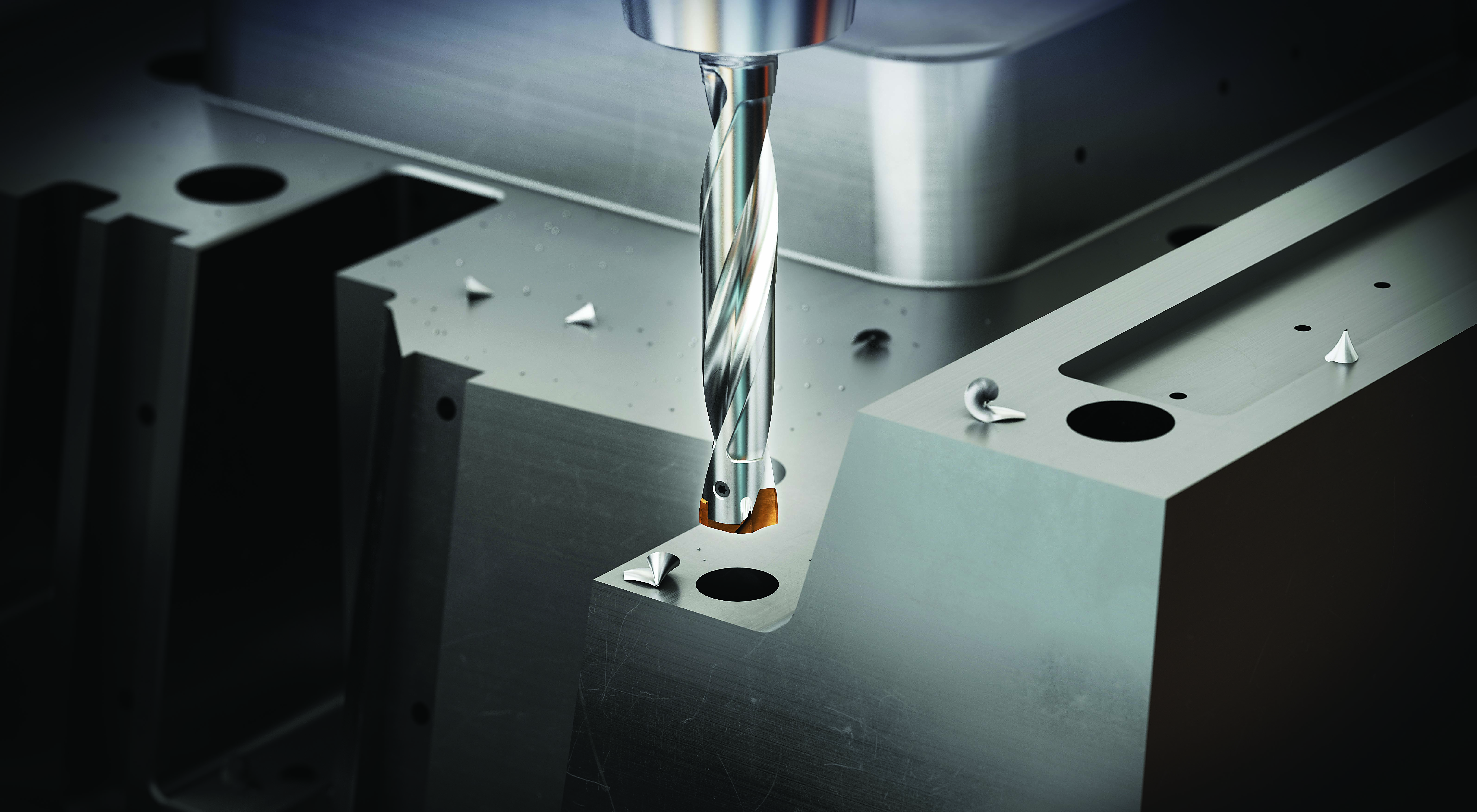
YG-1 Tool’s modular i-One drill features an exchangeable, double-effective carbide head. Image courtesy of YG-1 Tool (USA)
He said the best coating for a drill cutting ADI is a physical vapor deposition multilayer AlTiN, which Sandvik Coromant deposits on the drill tip and not after the tool’s back taper.
Ruegsegger concurred that an AlTiN coating is suitable when drilling ADI, as well as TiCN.
“Anything to make sure you are getting the balance of wear resistance and lubricity into the cut,” he said. “The coating itself is going to help with wear and take the tool life up a notch.”
Ruegsegger said polishing the coating to remove tiny peaks and valleys reduces the drill’s coefficient of friction and improves drilling efficiency.
Polishing can be done with abrasive wheels and brushes, but Rutkowski said wet blasting the coating, as well as the uncoated substrate to enhance coating adhesion, is preferred over dry blasting.
“All sorts of media are used,” he said, “but what works best is glass beads.”
The geometric features of a drill also play a critical role when machining ADI. Ruegsegger recommends Allied Machine & Engineering’s XT/T-A Pro geometries when drilling cast/ductile iron, or K ISO classification, materials. Standard iron geometries have a relatively flat cutting edge without a lot of radial rake on them.
“You have to find the happy medium,” he said. “You don’t want too much rake because you are going into a highly abrasive material where the tool is going to wear quickly if you have too much rake. You will start to see the corners of the tool break, and you might see some chipping.”
Conversely, Ruegsegger said too little rake causes problems with chip formation, in which chips will not form properly and will be unable to be evacuated while packing in the hole.
“You will struggle getting through one hole,” he said.
The correct geometry starts with the drill point, which must be conical so the drill will center itself, Rutkowski said. He said having polished flutes, double margins and an embellishment, such as a chamfer form C, on the outer face of the cutting edge is paramount for high-performance drilling.
Pilger said the flutes should have a 30-degree angle or greater.
Review the print ads from this magazine to continue
This quick advertiser review unlocks the rest of the article and keeps the full-screen reader focused on the ads instead of the page chrome.
Advertisers included in this article experience
Print placements connected to this article
mtseries.com | 800.733.3976
THE MANUFACTURING TECHNOLOGY SERIES:
FOUR REGIONS. ONE MISSION. The Manufacturing Technology Series connects decision makers from diverse industries with leading suppliers of advanced manufacturing technology, equipment and tooling. Don’t miss the most important manufacturing technology events in the U.S. Oct. 5-7, 2021 Oct. 19-21, 2021 Oct. 26-28, 2021 Nov. 16-18, 2021.
THE MANUFACTURING TECHNOLOGY SERIES: FOUR REGIONS. ONE MISSION. The Manufacturing Technology Series connects decision makers from diverse industries with leading suppliers of advanced manufacturing technology, equipment and tooling. Don’t miss the most important manufacturing technology events in the U.S. Oct. 5-7, 2021 Oct. 19-21, 2021 Oct. 26-28, 2021 Nov. 16-18, 2021 Houston, TX West Springfield, MA Greenville, SC Long Beach, CA mtseries.com | 800.733.3976 produced by
Visit mtseries.com | 800.733.3976 View this placement in the issue recordPrint ads from this magazine
FOUR REGIONS. ONE MISSION. The Manufacturing Technology Series connects decision makers from diverse industries with leading suppliers of advanced manufacturing technology, equipment and tooling. Don’t miss the most important manufacturing technology events in the U.S. Oct. 5-7, 2021 Oct. 19-21, 2021 Oct. 26-28, 2021 Nov. 16-18, 2021.
THE MANUFACTURING TECHNOLOGY SERIES: FOUR REGIONS. ONE MISSION. The Manufacturing Technology Series connects decision makers from diverse industries with leading suppliers of advanced manufacturing technology, equipment and tooling. Don’t miss the most important manufacturing technology events in the U.S. Oct. 5-7, 2021 Oct. 19-21, 2021 Oct. 26-28, 2021 Nov. 16-18, 2021 Houston, TX West Springfield, MA Greenville, SC Long Beach, CA mtseries.com | 800.733.3976 produced by
Continue reading
October 2021
“We have to make sure the spiral is at the right angle,” he said, “and more importantly has the correct spacing to remove that material at the speeds and feeds that you run at.”
Pilger said that flute configuration is found in YG-1 Tool’s Dream Drill General and MQL drills.
Another option from the toolmaker is its modular i-One drill, which has an exchangeable, double-effective carbide head, he said. The drill is suitable for producing large-diameter holes, starting at about 19 mm (0.75″).
Deep Down
The definition of a deep hole is in the eye of the beholder. DeLuca said someone at a screw machine shop might consider a hole that’s two or three times diameter to be deep while a drilled hole at a gundrill shop may need to be 100 times diameter to qualify. When drilling ADI, he said a hole that is at least seven times diameter can be considered deep.
The deeper the hole is, the more critical that effective coolant application becomes to flush chips, with high-pressure through-coolant being the method of choice.
“Something where the coolant holes are pointed toward the cutting edge and keep as much coolant at the point of cut as possible,” DeLuca said.
He said the coolant formulation when drilling ADI is slightly different from the one for traditional iron applications. For example, rather than an 8% concentration of extreme-pressure additives, it would need to be 10% to 12% because ADI cuts more like steel than traditional iron.
“It’s increasing the concentration to experience better tool life, hole quality and overall finish,” DeLuca said.
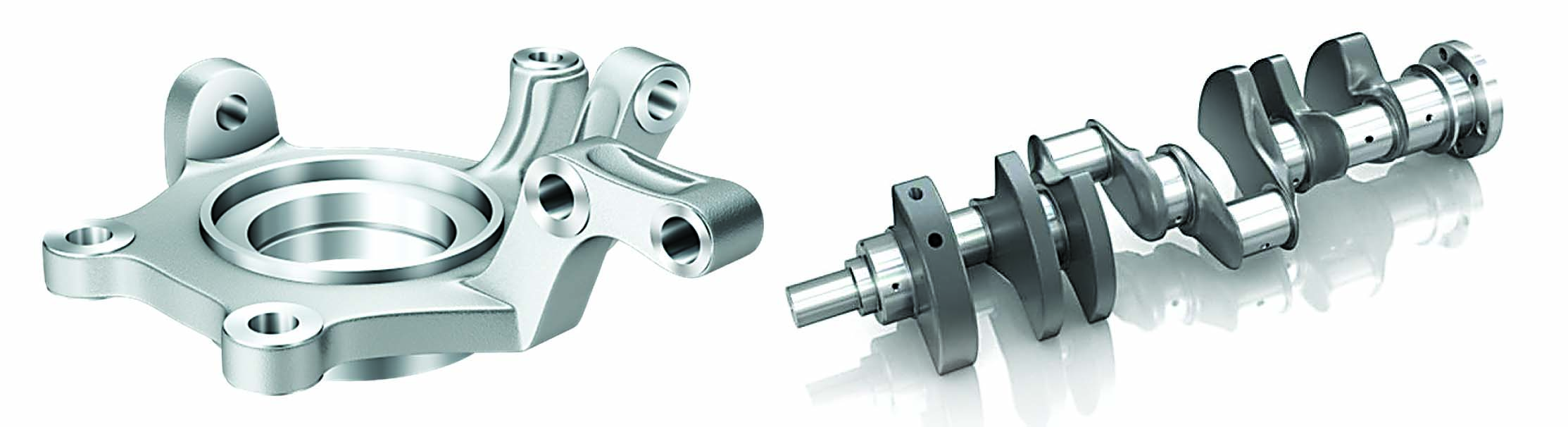
The high-strength, abrasion-resistant properties of austempered ductile iron make it suitable for a variety of automotive and agricultural applications. Image courtesy of Sandvik Coromant
Starting a deep hole frequently requires creating a pilot hole with a spot drill to guide the primary drill. He said Allied Machine & Engineering’s standard recommendation is to have the same point angle on both drills. A spot, or pilot, drill can have a flatter, or larger, point angle, but the opposite would prevent the primary drill from having any point engagement during the initial cut, he said.
“You will experience a number of issues,” DeLuca said. “Most commonly, you will blow the corners out. You will chip the corners of the cutting tool much more quickly because they are not getting any stability from the point as they enter the cut.”
Rutkowski concurred, recommending a pilot drill for holes deeper than eight times diameter with an included angle that’s 5 degrees larger than the following drill’s point.
“It guides the following drill correctly through the hole,” he said, “especially the deeper you go.”
Some people might be tempted to peck-drill deep holes in ADI, but Rutkowski said that technique isn’t needed when the drill is run at the correct speeds and feeds, which keep the material from workhardening. He said the austempering process causes fluctuation in the material’s properties from one
workpiece to another and recommends starting-point drilling parameters that are 35% less than those for conventional ductile iron.
“From there,” he said, “you fine-tune.”
In addition to the correct parameters, the drill must be held correctly. Although drills commonly are held with a collet, Pilger recommends a hydraulic chuck for deep-hole drilling ADI. He said the chuck minimizes total indicator runout and therefore the amount of whip and corresponding wear that a long drill experiences, and the oil in the toolholder dampens vibration.
“Putting it into a hydraulic chuck — just out of the box — has improved life by an average of 25%,” he said.
Rutkowski said end users would be wise to invest in the highest-quality toolholder available.
“Do not skimp,” he said. “Whether hydraulic or shrink fit, my preference is to spend the extra money for it, and it will pay off in the long run.”
On the Horizon
Rutkowski said one way to improve machinability while maintaining or even enhancing strength and structural integrity, such as with automotive drivetrain components, is by substituting ADI with solution-strengthened ferritic ductile iron. He said the improved machinability is a result of SSFDI’s higher silicon content compared with ADI. The amount of silicon ranges from 3% to 4.3%.
“That’s what we need compared with ADI is better machinability, and this SSFDI might be the cat’s meow for all those parts but not yet,” he said, referring to the automotive and agricultural components made of ADI.
While enhanced machinability reduces part cost, the cost of the raw material is a limiting factor for wider use.
For now, part manufacturers primarily will continue to drill and otherwise machine ADI when producing high volumes of relatively complex parts that must be strong, tough and abrasion-resistant.
For more information from Sandvik Coromant about deep-hole drilling, view a video presentation at cteplus.delivr.com/29nqy
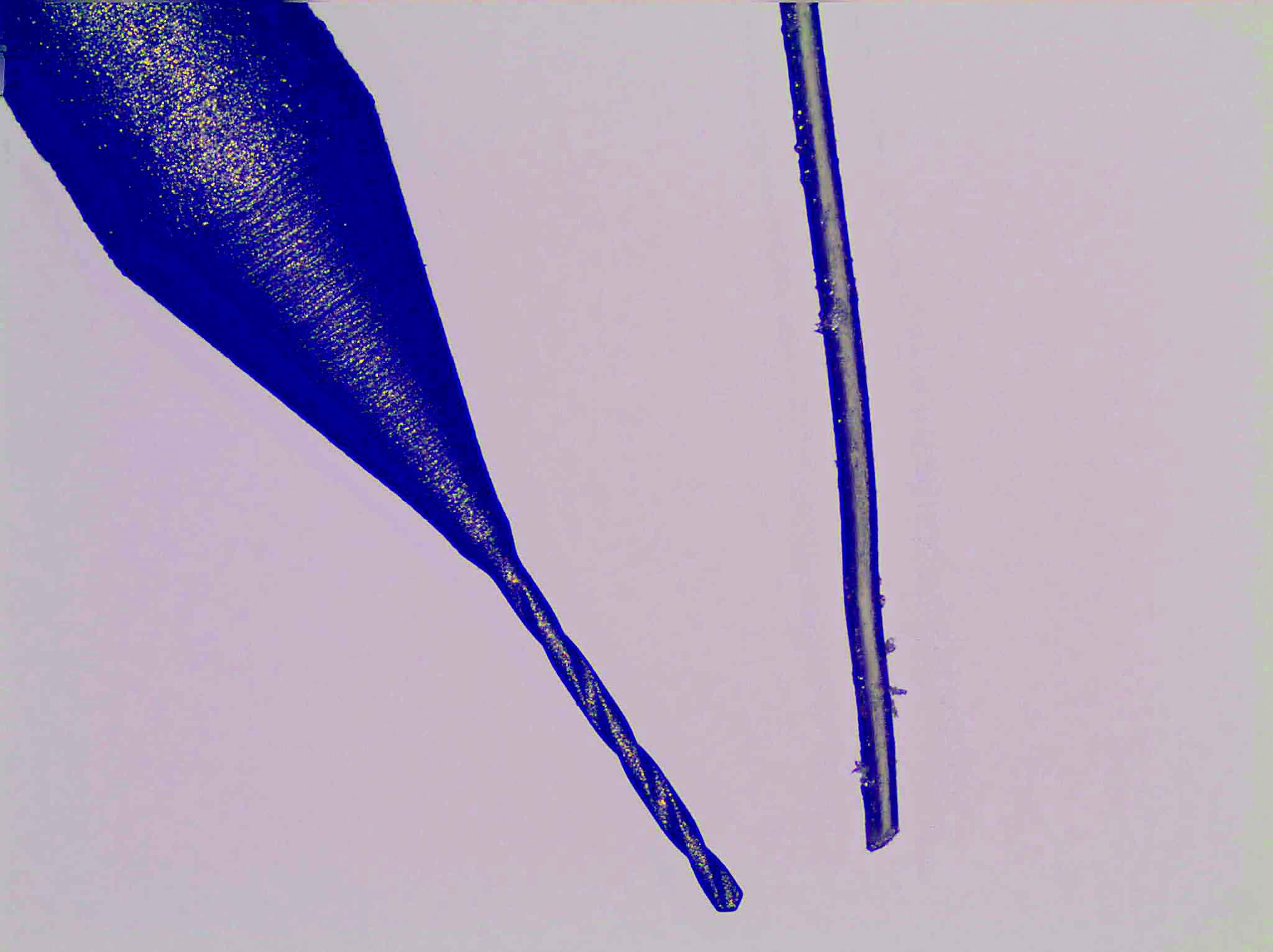
The 0.05-mm-dia. carbide drill with a 12-µm-thick multilayer diamond coating is displayed next to a human hair. Image courtesy of GCT
Shine On, You Multilayer Diamond
GCT GmbH announced that it has deposited a 12-µm-thick (0.00047″) multilayer diamond coating onto a 0.05-mm-dia. (0.002″) carbide drill. The tool is applied specifically for drilling ceramic workpieces, said Martin Vogler, managing director of the Weingarten, Germany-based company.
He said the carbide drills are from select German suppliers and produced to GCT’s specifications. The company provides coating services and typically sells diamond-coated tools for ceramic applications.
Vogler said GCT has seven chemical vapor deposition coating devices and has coated about 1.2 million cutting tools, including carbide ones for graphite, composite and ceramic applications. The industries served include dental and electronics.
For more information about the company, visit www.gctool.com.
— Alan Richter
Glossary terms in this article