



Adjustable Grind: Medical Manufacturing
More flexible grinding machines allow part manufacturers and toolmakers to fine-tune their production processes.
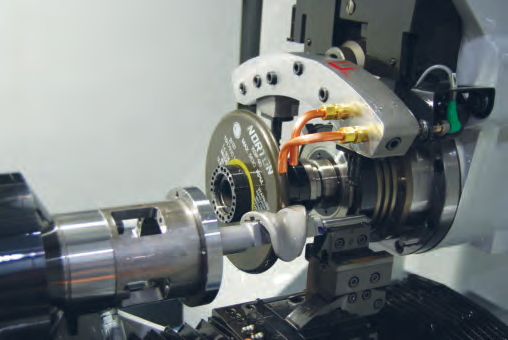
Courtesy of ANCA
Because multiaxis tool and cutter machines can grind complex contours using CAD/CAM software, many shops use the machines to produce medical parts, such as this component of an artificial knee.
More flexible grinding machines allow part manufacturers and toolmakers to fine-tune their production processes.
The days of long production runs of identical parts are essentially over in the U.S.; staying competitive today requires manufacturers to produce smaller lot sizes of different parts and part families in a just-in-time fashion. Flexibility—the ability to quickly change processes and efficiently meet changing demand—is a key manufacturing capability.
Grinding has long been considered a deliberate (slow) and dedicated process. In response to global manufacturing trends, however, grinding machine builders are focusing on flexibility as they tailor their equipment to meet the needs of widely differing end users.
Production Changes
Hans Ueltschi, vice president for the cylindrical division of United Grinding Technologies Inc., Miamisburg, Ohio, said the trend towards smaller production runs even includes automakers. “Formerly, they ran several thousand parts a day, and now they may be running lots of a few hundred,” he said.
In that scenario, the differences between lots often involve different details within a family of parts, such as altered dimensions or profiles on a family of shafts.
To quickly change from one part to another, a production grinder can be fitted with flexibility-enhancing options, such as a high-speed spindle for peel grinding. Peel grinding is, in some respects, like turning. Instead of dressing a grinding wheel with a specific profile and plunging it into the part, the peel grinding method uses a smaller, narrower, generically shaped wheel that moves in a traverse path across the part, like a lathe tool, according to programmed CNC movements.
“Peel grinding allows us to do more different shapes with the same type of wheel,” Ueltschi said. “If the shape of the part changes, it is just a matter of changing the program. We don’t have to change the wheel from part to part.”
For example, the Studer S22 production grinder produces various shafts for different transmission models without changing wheels, or it can grind a series of different carbide punches for the can die industry. With the high-speed spindle option, peripheral wheel speeds up to 140 m/sec. are possible. In high-speed operation, diamond wheels grind carbide and CBN wheels grind steel.
Another approach to flexibility addresses a job shop scenario involving small runs of different parts. In those cases, a grinder with multiple spindles enables a shop to grind a variety of part features without retooling the machine for each new part, according to Ueltschi. “It’s not just adding a wheel, but doing it in a way that minimizes interference,” he said. “Sometimes when you have multiple wheels, you reduce the work envelope of a machine.”
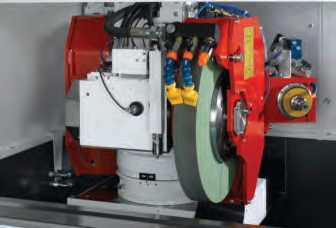
Courtesy of United Grinding
The wheelhead of the Studer S33 universal grinder has two motor spindles for external grinding as well as an internal grinding attachment. Coupled with manual or automatic swivel capabilities, the wheel arrangement allows users to grind multiple features in one clamping.
Studer designed the wheelhead of the S33 universal grinder to minimize interference. The wheelhead has two motor spindles for external grinding and an internal grinding attachment. Manual or automatic swivel capabilities permit external and internal grinding in one setup. The arrangement, Ueltschi said, “gives the most flexibility in many scenarios. This wheel arrangement allows the user to do more features in one clamping.”
The grinder also can be fitted with a smartLoad automated workhandling system from Studer. The system’s part-gripping elements can quickly be reconfigured to handle different parts. While retooling the loader on production-focused machines can take from several hours to several days, the process reportedly takes minutes on the universal machine.
Axes and Software
Grinding machines with increased flexibility are also allowing shops to enter new markets. “It comes down to having the axes and software,” said Russell Riddiford, president of ANCA Inc., Wixom, Mich. The growing market for medical tools and components is a prime example. In the past, Riddiford noted, machines that ground medical parts and surgical reamers and drills were designed specifically for those tasks.
“Years ago, you wouldn’t think of a CNC tool and cutter grinder making a hip rasp. It would be a special-purpose grinding machine,” he said. Now, because multiaxis tool and cutter grinders using CAD/CAM software can produce complex contours, many shops are acquiring tool and cutter grinders to produce medical parts (see photo on page 43).
Riddiford said a major factor influencing that trend is the move by many medical part designers to standardize on the Siemens PLM NX CAD modeling package. “The medical companies will provide a model, which has parameters of the shape they want manufactured,” he said. “Companies like ours will pass that NX model through a converting tool to create ANCA control language or other CNC language, and then that generates the software paths for what you want to grind.”
The main driver for adapting standard machines to grind special parts, Riddiford said, is shops don’t want to invest in a special-purpose machine dedicated to grinding just one part. “That part may not be around after a period of time,” he said. “Buying a multiaxis CNC tool and cutter grinder with optional software that can do these rasps and cutters is a much better investment, because if that work goes away, you have the software on the machine to do something else. Or you can just convert it back to a tool and cutter grinder to cut endmills.”
Riddiford cautioned that flexibility alone does not guarantee success. “Getting into medical can be challenging as well as financially lucrative. The demand for part quality and sophistication is extremely high, and not everyone who makes a cutting tool will be able to go through the required approval process to get certified as a supplier,” he said.
Automation is helping manufacturers further expand the flexibility of their grinding machines. Riddiford described the TXcell that ANCA presented at IMTS 2010. The system consists of an ANCA TX7+ tool grinder mated with a Fanuc robot. The robot changes grinding wheel packs and also loads/unloads parts. In a medical application, a knee prosthesis can be ground in the machine, polished with a buffing unit in the machine’s toolchanger, then moved by the robot to a laser etching machine outside the machine for addition of a part number. Such a cell, Riddiford said, allows a shop to accomplish on one machine what once took two or more machines.
High-Volume Strategies
Even the heavy-duty, traditionally high-volume side of grinding operations can benefit from flexibility. Cinetic Landis Corp., Hagerstown, Md., produces grinding machines engineered for finishing shafts 0.5m and longer. Dwight Myers, director of business development, said the company’s machines combine high volume and high precision with flexibility. He said while one machine user may run one shaft “forever,” another may grind “one or two in a row, then changeover very quickly.”
No matter the part volume, he said, “the customers we are targeting traditionally grind a shaft in more than one grinding operation and more than one fixturing. Our target is to accomplish more than one, or, in some cases, all of those grinding operations in one machine, and optimally in one fixture.”
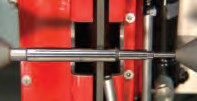
Courtesy of United Grinding
In peel grinding, shown here in a shaft-grinding application on a Studer S22 machine, a CNC-guided narrow grinding wheel moves in a traverse path across a part. Peel grinding permits grinding of different shapes with the same wheel by changing the program, not the wheel.
The company uses modules to create custom machines on basic beds and worktable support platforms. Flexibility is achieved by selecting the modular components, including different spindle types and headstock and workhead configurations. Tim Hykes, chief engineer, said the strategy enables the machines to be “custom tooled as opposed to custom built.”
Myers cited crankshaft production as an application that requires increased grinding flexibility. OEMs are outsourcing more production, with small orders for the same part given to multiple suppliers. “The tier suppliers have to be flexible; they need the capability to combine operations,” he said.
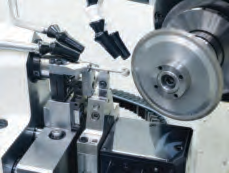
Courtesy of Rollomatic
An M2 steel bur for use in shoulder and knee surgery is ground on a Rollomatic 6-axis tool and cutter grinder.
High-volume OEM crankshaft producers traditionally performed grinding in multiple machines, such as finishing main bearings in one machine and pin bearings in another. For tier-level suppliers seeking to combine operations and effect fast changeover, Myers said the Landis LT1 swivel head grinder can combine operations into one chucking. The grinder is for single machine/single setup grinding of complete camshafts and small crankshafts, as well as general-purpose grinding of concentric diameters, eccentrics, profiles, tapers and chamfers, he added.
The machine’s wheel turret has dual-spindle pod mounting positions and offers infinitely variable positioning with a 230° working range. Its 350mm grinding wheel can grind past the workpiece centerline for orbital crankpin grinding on small crankshafts. “Using CBN grinding wheels, we can do contouring in X and Z axes, interpolate different radii and bump faces and grind micron-level accuracies on the bearing diameters, be they main or pin bearings,” Myers said.
Flexible Markets
Grinding machines that can handle round or flat parts can also help toolmakers adjust to changing conditions in global markets, according to Eric Schwarzenbach, president of Rollomatic Inc., Mundelein, Ill. For example, manufacturing volume of standard round tools in North America is decreasing due to an influx of commodity tools from overseas. A large toolmaker can adjust its output in response to such changes by employing flexible grinding machines such as Rollomatic’s 6-axis GrindSmart 628XS, which can process round tools and inserts. Schwarzenbach said switchover from round tools to inserts can be accomplished in as little as 90 minutes, enabling a tool manufacturer to match output of certain tool styles to demand.
For smaller shops that focus on producing complex, noncommodity tools, a 6-axis machine can easily generate special features, including variable helixes and special cutting geometries, edge preparations and corner radii. “The smaller shops whose niche is quick production of small lots of custom tools are candidates for flexible production methods,” Schwarzenbach said. The machines can also grind medical tools and instruments.
A key contributor to grinding flexibility has been software development. “Most grinding tool providers have made big advances in software,” Schwarzenbach said, “We realized that a machine that is only mechanically good without good software doesn’t sell.”
In addition to CAM software, Schwarzenbach emphasized the importance of simulation software such as Rollomatic’s VirtualGrind package. “It is not a flexible operation if you cannot simulate before you grind, because then you must spend time on the machine to diagnose a problem, do R&D and dial in the finished tool on the machine.”
Flexibility in grinding operations has become a competitive necessity, because the part making business is constantly changing. “No one is handing out long contracts for millions of parts that previously could justify the investment in a special-purpose machine,” said ANCA’s Riddiford. “You must have the agility within your machine to change from one part to the next.” CTE
For more information, visit “Resources,” click on “Article Archive” and select the “Grinding” category.
About the Author: Bill Kennedy, based in Latrobe, Pa., is a contributing editor for CTE. He has an extensive background as a technical writer. Contact him at (724) 537-6182 or at billk@jwr.com.
Grinding machines go green
In addition to wanting flexible grinding machines, many shops are looking for machines that can reduce energy consumption. For example, Cinetic Landis’ ECOFLEX line of machines provide process flexibility by incorporating a B-axis and a choice of straight, 30º plunge, twin-wheelhead, single-spindle or dual-spindle configurations. The base machines are targeted for parts 1.5m to 4.0m in length and up to 400mm in diameter; a 750mm-swing capacity is an option. “The machines are built from the bed up based on energy savings, savings in oil usage and coolant management—anything that costs the customer money,” said Dwight Myers of Cinetic Landis.
According to Tim Hykes, also of Cinetic Landis, automotive-focused grinders are typically built for maximum reliability and low maintenance, but not necessarily energy efficiency. Hydrostatic slides, for example, “provide submicron accuracies forever and all you have to do is maintain the oil supply,” he said. “The penalty is that they require many kilowatts of energy to run the bearings, cool the oil and so forth.”
With the ECOFLEX machines, he said Cinetic Landis takes a different approach by replacing hydrostatic way systems with linear X- and Z-axis ways, and rail-type ways for cross slides and wheelhead feed. The new way systems meet micron-level total dimensional and geometric part tolerances. Hydrostatic spindle bearings remain but consume less energy than traditional bearings and require no chiller for the hydrostatic oil. Also, frictional and fluid power system losses have been reduced, and the design isolates coolant from the machine structure, optimizing thermal stability.
The goal is reducing baseline, nonproductive power consumption, Hykes said. “Some machines have an operating power consumption of 20kW or more when not removing any chips. On the new machine platform, we are targeting 5kW.”
—B. Kennedy
Contributors
ANCA Inc.
(248) 926-4466
www.anca.com
Cinetic Landis Corp.
(301) 797-3400
www.fivesgroup.com/landis
Rollomatic Inc.
(866) 713-6398
www.rollomaticusa.com
United Grinding Technologies Inc.
(937) 859-1975
www.grinding.com
Glossary terms in this article
Related



Subscribers can use MFGAxis notes, saves and discussion tools with their innoNET account.


