Aerospace: Sky is the limit
By Eric Ostini, GF Machining Solutions
By Eric Ostini, GF Machining Solutions
The aerospace industry always has tested its parts suppliers on their ability to machine difficult materials. Critical engine components and airframe structures require components that are light yet uncompromisingly strong and durable, and the exotic alloys and composites being developed are beginning to further challenge the limits of conventional machine technology and part processing methods.
Superalloys like Kovar and Inconel provide many benefits, but the high cutting forces required to machine them generate a tremendous amount of heat and workhardening. Moreover, Inconel and other superalloy chips are gummy and stick to virtually everything in a machining center. Composites, in addition to being extremely hard, are brittle and abrasive, requiring special cutting tools to avoid delamination and achieve desired surface finishes.
If those challenges aren’t enough, lower-tier manufacturers now face the aerospace OEMs’ proprietary black art of formulating aerospace materials that are unique creations and closely guarded business secrets. Operating within this highly secretive and competitive arena has a steep, expensive learning curve that limits the advance of generalized machining parameters for efficient production. In many cases, machining methods used on one formula of these cutting-edge substances do not apply to others.
Conventional milling that uses shearing and cutting forces to machine has been pushed hardest by the continual development of new component materials. Milling remains feasible for many components, such as landing gear assemblies, seats, interior fixtures and panels. However, critical high-stress parts like engine components demand near-perfect integrity devoid of microcracking caused by the high thermal forces of machining. This is why conventional machine shops often struggle to establish throughputs that are efficient and profitable while maintaining proper thermal conditions.
To keep pace, tooling suppliers have had to advance cutting tool technology. Little more than a decade ago, polycrystalline diamond tools were among the hardest tools available that also provided a high degree of abrasion resistance and tool life. The new generation of aerospace materials, unfortunately, quickly wore down PCD tooling to the extent that a single part required multiple tool changes to complete.
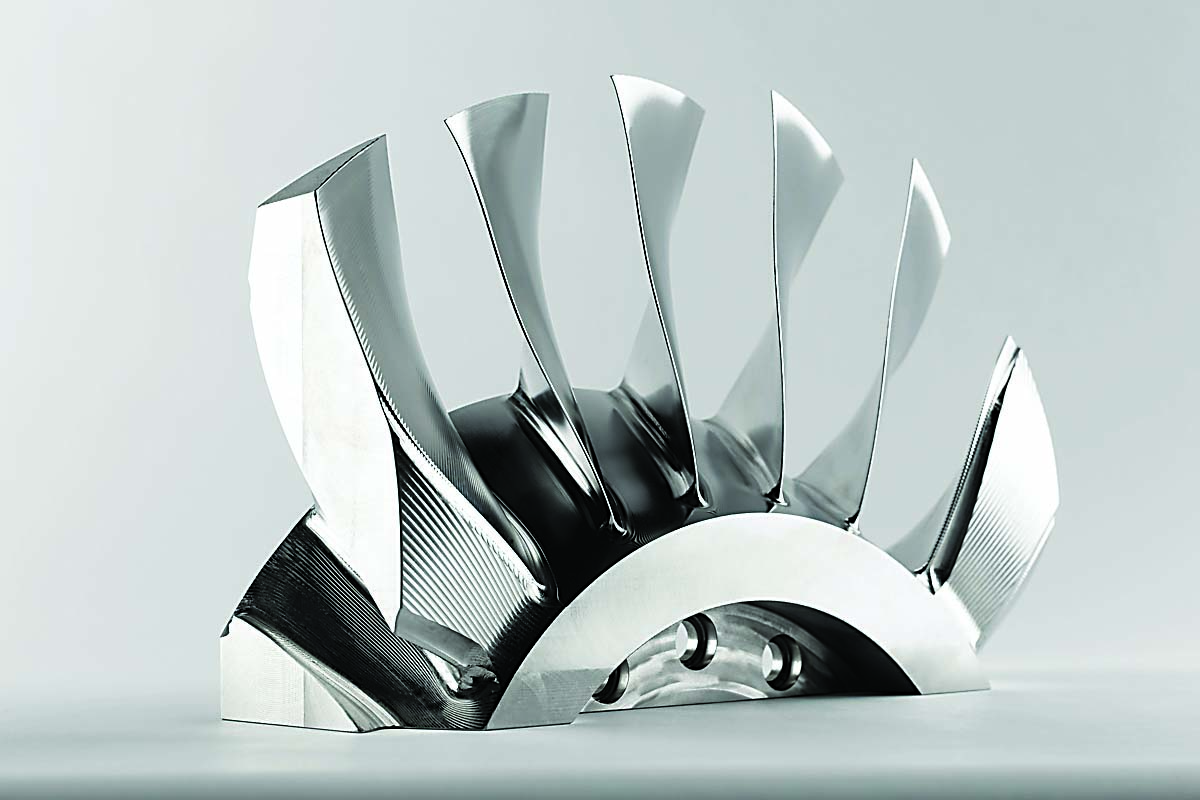
In addition to pushing machine tool cutting parameters to the limit, complex shapes, such as a blisk, present workholding challenges. Image courtesy of GF Machining Solutions
Today, conventional milling of complex aerospace parts calls for cutting tools sintered with manufactured diamonds in which the shape of the part being milled is engineered into tool geometry. While these advances solve some of the challenges of aerospace part machining, they are extremely expensive, and their cost effectiveness is not always clear. Further, the materials used in today’s aerospace sector are not only battering cutting tools but wearing out the machine tools. As a result, a growing number of aerospace part manufacturers have adopted other technologies like electrical discharge machining, laser machining and additive manufacturing.
Contactless Cutting
EDM has taken a leading role in many aspects of aerospace manufacturing. Because the EDM electrode never contacts the workpiece, precision seal slots and other high-tolerance features can be machined without imparting stress to the part. Overall, EDM’s ability to cut very hard materials and complex shapes without the thermal distortion associated with conventional machining has made it a chief technology in aerospace manufacturing. However, electrical discharge machine tool builders have had to work hard to adapt the technology to aerospace’s unique challenges.
Review the print ads from this magazine to continue
This quick advertiser review unlocks the rest of the article and keeps the full-screen reader focused on the ads instead of the page chrome.
Advertisers included in this article experience
Print placements connected to this article
Platinumtooling
THE NAME TO KNOW FOR...
LIVE TOOLS / ANGLE HEADS / SPEED MULTIPLIERS / SWISS COMPONENTS MARKING TOOLS / KNURLING TOOLS / BROACHING TOOLS / SHRINK FIT TOOLS Platinum Tooling is proud to be the importer of Heimatec Live Tools and Angle Heads, Tecnicrafts Swiss Collets and Guide Bushings, Henninger Spindle Speeders, Quick Knurling and Marking Tools, Rineck Shrink Fit Tool Holders and REV Broaching Tools
THE NAME TO KNOW FOR... LIVE TOOLS / ANGLE HEADS / SPEED MULTIPLIERS / SWISS COMPONENTS MARKING TOOLS / KNURLING TOOLS / BROACHING TOOLS / SHRINK FIT TOOLS Platinum Tooling is proud to be the importer of Heimatec Live Tools and Angle Heads, Tecnicrafts Swiss Collets and Guide Bushings, Henninger Spindle Speeders, Quick Knurling and Marking Tools, Rineck Shrink Fit Tool Holders and REV Broaching Tools. Platinum Tooling offers a wide selection of machine tool accessories for most machine brands, including standard and custom tools to help with the most challenging applications. If you need live tooling, we’re here to help. 16 E. Piper Lane, Ste.128 | Prospect Heights, IL | 847-749-0633
Visit Platinumtooling View this placement in the issue recordPrint ads from this magazine
LIVE TOOLS / ANGLE HEADS / SPEED MULTIPLIERS / SWISS COMPONENTS MARKING TOOLS / KNURLING TOOLS / BROACHING TOOLS / SHRINK FIT TOOLS Platinum Tooling is proud to be the importer of Heimatec Live Tools and Angle Heads, Tecnicrafts Swiss Collets and Guide Bushings, Henninger Spindle Speeders, Quick Knurling and Marking Tools, Rineck Shrink Fit Tool Holders and REV Broaching Tools
THE NAME TO KNOW FOR... LIVE TOOLS / ANGLE HEADS / SPEED MULTIPLIERS / SWISS COMPONENTS MARKING TOOLS / KNURLING TOOLS / BROACHING TOOLS / SHRINK FIT TOOLS Platinum Tooling is proud to be the importer of Heimatec Live Tools and Angle Heads, Tecnicrafts Swiss Collets and Guide Bushings, Henninger Spindle Speeders, Quick Knurling and Marking Tools, Rineck Shrink Fit Tool Holders and REV Broaching Tools. Platinum Tooling offers a wide selection of machine tool accessories for most machine brands, including standard and custom tools to help with the most challenging applications. If you need live tooling, we’re here to help. 16 E. Piper Lane, Ste.128 | Prospect Heights, IL | 847-749-0633
Continue reading
October 2023
Manufacturers like GF Machining Solutions LLC have worked for years to adapt machines and technology to the aerospace industry, specifically regarding machine generator settings to obtain the proper spark. Previously, spark energy ramped up slowly, plateaued and then diminished slowly. That long duration transferred too much heat into the workpiece, causing a loss of integrity and microcracking.
With EDM advancements and enhancements, the spark now is generated at its cutting temperature, which tapers off almost immediately. The spark cutting forces do not penetrate the workpiece deeply enough to affect its integrity, and the heat-affected zone is virtually eliminated. Additionally, advanced EDMs now generate 300,000 to 400,000 sparks per second directly at the cutting zone, whereas before only 80,000 to 100,000 sparks per second were achievable, increasing overall production efficiency.
Laser machining and laser micromachining are technologies finding an emerging position in aerospace manufacturing as well. Also able to machine with a minimal to no heat-affected zone,micromachining laser sources, for instance, provide repeatability, precision and accuracy for delicate parts with complex shapes, especially when micron-sized features are involved. Many aerospace components now are being coated with ceramics, and manufacturers are discovering that laser machining brings precision and efficiency to cutting hard ceramic. Compared with EDM, lasers can remove nonconductive materials, such as ceramics, and use no consumables.
Although additive manufacturing is finding its niche in the aerospace sector, the process is by no means the comprehensive solution to all of that industry’s challenges. Currently, it is used mostly for parts with ribbed or hollow pockets, such as components for seats and fuselage framing. While some aerospace OEMs are producing critical high-strength parts like jet engine components via additive manufacturing, at present the process is unable to produce such parts fast enough to make the application profitable or even cost-effective.
Pushing the Envelope
Regardless of the machining technology used, aerospace has forced manufacturers in many cases to develop machines and processes specifically dedicated to the sector. In addition to material composition requiring machine technology to adapt, component shape/design can be a significant challenge. Unique shapes, such as blisk airfoils and thin-walled parts, require special workpiece holding solutions or modifications to the machine cutting/machining envelope to accommodate complex designs.
Additionally, aero-systems design — engines, airframes, wings, etc. — continues to push the manufacturing envelope with demands for quieter, longer and more efficient performance with no single process adequately meeting the industry’s myriad of needs. Manufacturers are compelled to employ a variety of processes in production runs, but that kind of versatility requires a tremendous amount of diversified expertise that many shops simply do not have and cannot acquire at a reasonable cost.
As a result, the sector is spawning specialized enterprises that provide comprehensive solutions to shops for aerospace and other advanced manufacturing. GF Machining Solutions’ Liechti Engineering group, for example, determines an entire part production process, including the appropriate production technology, machine settings, programs and application methods. These turnkey packages also include proof of process, operator documentation and even maintenance schedules. The high cost of process development with exotic and obscure materials, paired with advanced machining and zero tolerance for error, in many cases justifies manufacturer reliance on a company that can supply the most efficient, cost-effective part production method.
Ultimately, aerospace parts manufacturers have found themselves chasing the ongoing developments in materials and technology of the industry itself. To keep from being outpaced by these advances, they are forced to employ every tool at their disposal for the part accuracy and integrity required by the sector while maintaining an acceptable throughput that makes the process efficient. Finding and keeping that balance will be critical to future success.
about the author: Eric Ostini is head of business development for North and Central America at GF Machining Solutions LLC. For more information, call 800-282-1336 or visit www.gfms.com.