AI checks spindle health
As with humans, age can take its toll on machine spindles. Over time, for example, a spindle can be damaged by a crash, drift out of balance or suffer adverse effects from lubrication starvation. Consequences eventually can include costly machine downtime and production of out-of-tolerance parts.
As with humans, age can take its toll on machine spindles. Over time, for example, a spindle can be damaged by a crash, drift out of balance or suffer adverse effects from lubrication starvation. Consequences eventually can include costly machine downtime and production of out-of-tolerance parts.
So Mazak Corp., Florence, Kentucky, is employing artificial intelligence to check the condition of spindles in some of its machines. The company’s new Spindle Health Monitoring System includes two sensors that feed data to an acquisition unit connected to an industrial computer for processing.
“The main things we’re using are vibration and current sensors to establish a baseline for the spindle,” said Joe Sanders, sales engineering assistant manager.
The system uses edge computing and data analytics based on a proprietary AI algorithm to model a spindle’s “signature.”
“Each spindle has its own signature — like a signal fingerprint — and no two are alike,” Sanders said.
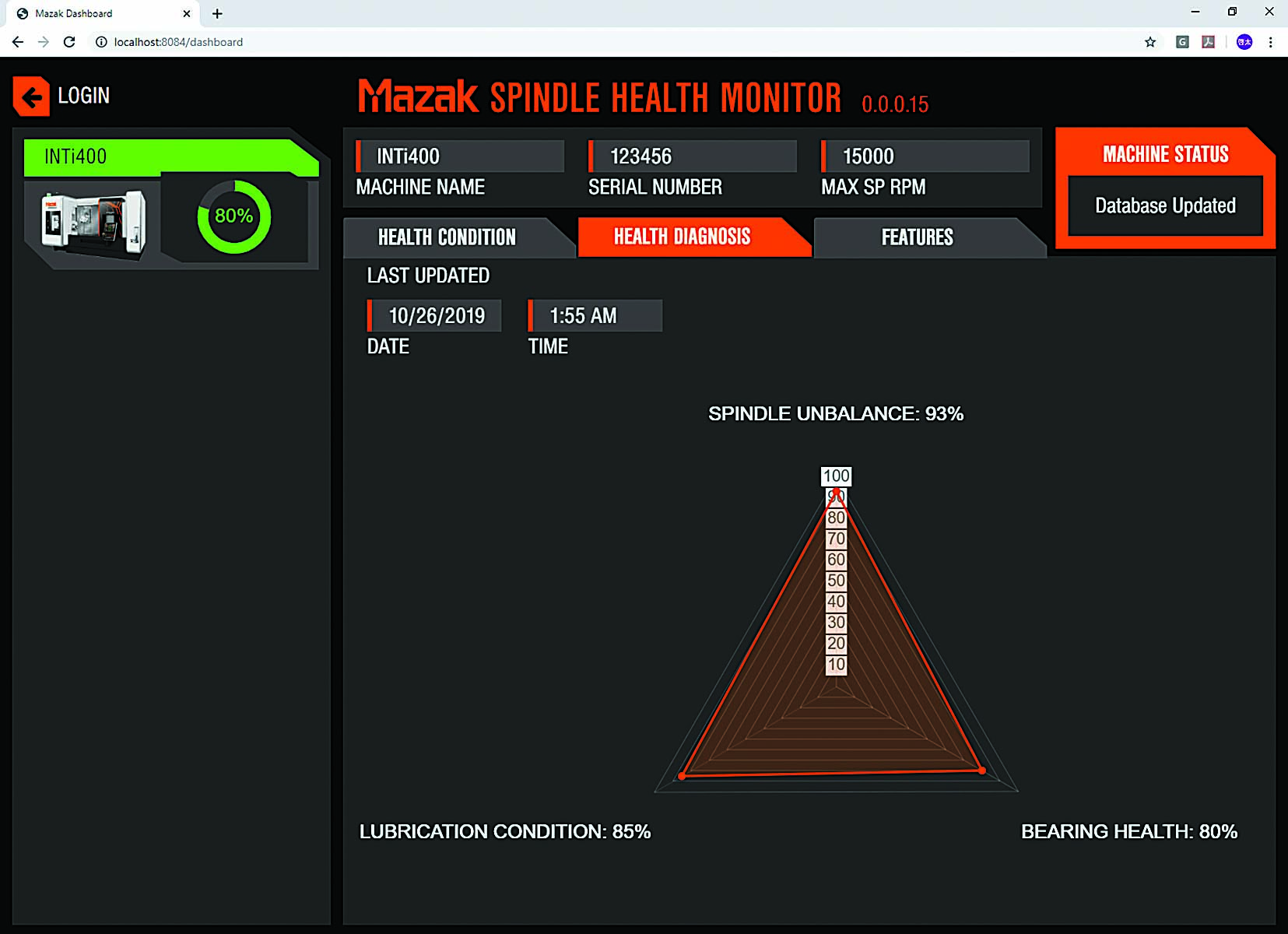
The Spindle Health Monitoring System displays the percentage of remaining spindle life related to three factors. The lowest of these values is used as the remaining spindle life estimate as shown on the upper left of the screen. Image courtesy of Mazak
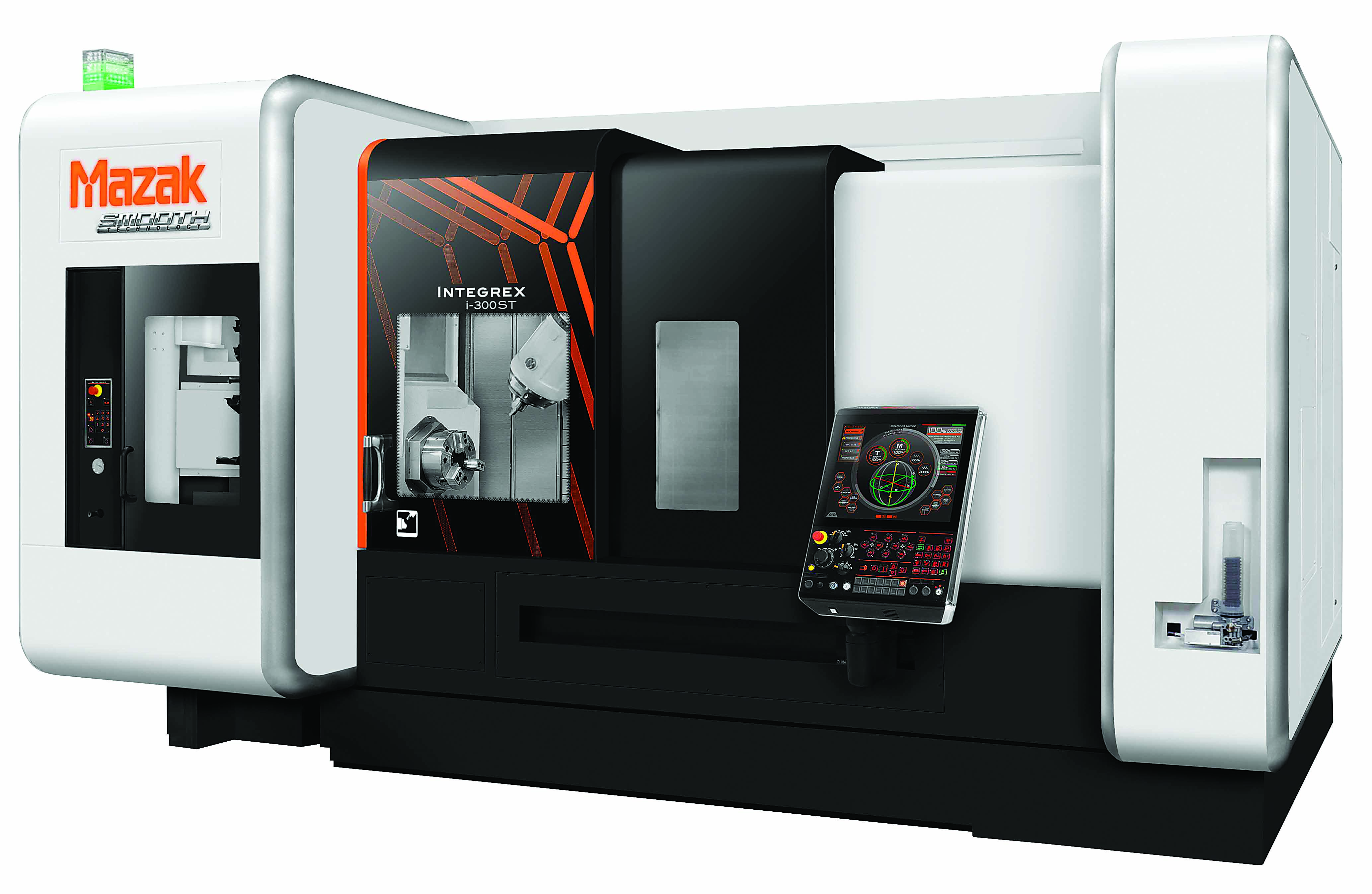
The Integrex i-300ST (below) is one of the horizontal machining centers equipped with Mazak’s Spindle Health Monitoring System. Image courtesy of Mazak
An initial 60-second, fixed-cycle test run establishes the baseline value for comparison during subsequent tests. Machine operators can run these tests anytime and view spindle health metrics on screens.
“The system tells you how the spindle compares to the ‘golden model’ that came from the data recorded,” Sanders said.
Presented metrics include spindle unbalance, lubrication condition and bearing health. Each is displayed as a percentage of remaining spindle life based on the individual metric, as shown in the image on Page 13. The lowest of these percentages is used as the overall estimate of remaining spindle life.
Over time, a neural network self-organizing map adds to the profile of each spindle, learning to better assess its health using information gleaned from an increasingly large dataset.
Review the print ads from this magazine to continue
This quick advertiser review unlocks the rest of the article and keeps the full-screen reader focused on the ads instead of the page chrome.
Advertisers included in this article experience
Print placements connected to this article
Ctemedia
Land More Leads
Enroll in a CTE Prospect Report plan and get LEADS delivered right to your INBOX! Pair it with Print: Run a half-page or larger ad in our May issue and a Box ad on our website to receive a weekly CTE Prospect Report during the month of May. Contact your CTE sales team for details! Scott Beller Marc Condon Dave Jones East Central/West Central.
Land More Leads Enroll in a CTE Prospect Report plan and get LEADS delivered right to your INBOX! Pair it with Print: Run a half-page or larger ad in our May issue and a Box ad on our website to receive a weekly CTE Prospect Report during the month of May. Contact your CTE sales team for details! Scott Beller Marc Condon Dave Jones East Central/West Central 847-714-0183 847-714-0170 708-442-5633
Visit Ctemedia View this placement in the issue recordPrint ads from this magazine
Enroll in a CTE Prospect Report plan and get LEADS delivered right to your INBOX! Pair it with Print: Run a half-page or larger ad in our May issue and a Box ad on our website to receive a weekly CTE Prospect Report during the month of May. Contact your CTE sales team for details! Scott Beller Marc Condon Dave Jones East Central/West Central.
Land More Leads Enroll in a CTE Prospect Report plan and get LEADS delivered right to your INBOX! Pair it with Print: Run a half-page or larger ad in our May issue and a Box ad on our website to receive a weekly CTE Prospect Report during the month of May. Contact your CTE sales team for details! Scott Beller Marc Condon Dave Jones East Central/West Central 847-714-0183 847-714-0170 708-442-5633
Continue reading
March 2020
“We are taking terabytes of data every time we do sampling of these spindles,” Sanders said, “and every iteration improves the model. So the more times you sample, the more accurate it is.”
Certain types of data can help spot impending failures. Vibration analysis, for example, may reveal abnormal patterns that indicate potential problems.
“When you starve a spindle of lubrication, you get a different vibration signature,” Sanders said. “Or if a bearing has been crushed, that will change the signature of that bearing.”
With this information, part manufacturers can schedule spindle maintenance or replacement to prevent unplanned failure-related downtime.
On the downside, Sanders said, the system in its current form cannot get high-quality data on high-torque spindles and those built for low-rpm operations. But Mazak is investigating to see if the system can be made suitable for these spindles as well.
While third-party sensor-based systems could be employed for spindle monitoring, he contends that their usefulness would be limited for Mazak machines because information about how the company’s spindles are built is proprietary. Without this information, he said, a third-party monitoring system could not determine exactly what is wrong with a Mazak spindle.
At present, Sanders said, Mazak is equipping only horizontal machining center spindles with the system. The plan, however, is eventually to incorporate the system into the company’s entire line.
Mazak developed the system in conjunction with the University of Cincinnati’s Center for Intelligent Maintenance Systems. The center created the AI algorithm that monitors spindle health and determined which sensor locations would yield the best readings, said Marcella Miller, a graduate researcher at the center.
Although the system has been rolled out, the center continues to collaborate with Mazak.
“While Mazak works on selling the system to their customers, we are supporting them by (dealing with) any bugs they may find as they move forward,” Miller said. “We’re also making the algorithm more robust and adaptable so it works for all their different machines.”