All about aluminum
All about aluminum
Aluminum is light, clean and easily machined, which is why machinists enjoy working with it.
Machinists and toolmakers are a hardy bunch and fear little. Many have conquered the world of manufacturing with little more than a set of micrometers and a file. Most have survived encounters with engineers, quality inspectors and dreaded safety professionals.
The only thing that scares this group of crusty manufacturing professionals is difficult-to-machine materials. Being assigned to machine tap-breaking, drill-dulling and generally aggravating metals like stainless steel, Hastelloy and Inconel is the main anxiety for these pros. They all look forward to aluminum jobs.
Aluminum is light, clean and easily machined, which is why machinists enjoy working with it. Aluminum alloys arrive without scale, dirt and oils because aluminum manufacturing processes are cleaner than those for other materials. Aluminum is also one of the least dense materials commonly used for manufacturing, making the metal easy to handle. Most importantly, it is a ductile material, which makes fabrication and machining processes uncomplicated.
People sometimes ask, "How fast can you machine aluminum?" The answer is as fast as a machine will run. Because aluminum is easy to machine, there is a broad range of effective cutting speeds. Aluminum is very forgiving and can be machined successfully using a wide extent of cutting parameters. The merciful nature of aluminum makes it an ideal material for training students, proving out new CNC programs and creating cool machine tool demonstrations at trade shows.
Challenges
Although machining aluminum can be easy, the characteristics that make it simple to machine may pose challenges, especially when presented with high production quantities, stringent cycle requirements and close tolerances.
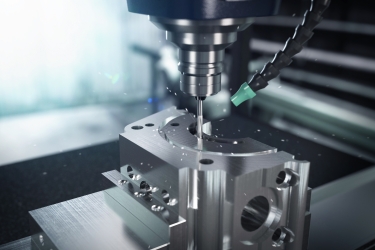
Rolled and extruded alloys are prone to deformation during the machining process because internal stresses are disrupted. It is common for a part to be in tolerance while restrained in a fixture and out of tolerance when unrestrained. Combating distortion might require heat treatment, altered machining techniques and post-machining operations. Large parts with thin sections, such as aerospace structures, are the most problematic.
In addition to being ductile, aluminum conducts heat very well, and the combination reduces brittleness in the shear zone during chip formation. This means that aluminum doesn't like traditional grinding processes — for example, surface grinding and outer diameter grinding. Creating close-tolerance parts without grinding can be challenging. When I was in the aerospace industry, we would apply hard-coat anodize to aluminum surfaces so we could use OD grinders on aluminum parts.
Chip control is another typical problem with rolled, forged and extruded alloys. In short, forming a chip is easy, but it can be difficult to break the chip, resulting in long, stringy ones that wrap around tools and parts. Cutting tool geometries have advanced significantly in recent years, but light depths of cut and high cutting speeds still can create issues with continuous chip formation. Eliminating stringy chips may require altering cutting speeds, chip loads and tool geometries. Continuous chips are a substantial hindrance to achieving optimal cycle times.
Development of machine tools, cutting tools and machining techniques specifically for aluminum has advanced quickly since the 1990s, and several machine tool builders have placed machines on the market expressly designed for machining aluminum. When paired with advanced cutting tools, the combination can create huge volumes of aluminum chips. If they are not removed from a work area, bad things might happen. Commonly known as re-cutting, chips can be drawn in by a cutting tool and become trapped between the tool and part, causing poor surface finish, tool breakage and increased tool wear. Manufacturers have employed high-pressure coolant to blast chips out of the cutting zone and applied high-volume flood systems to wash chips out of the machine. The volume of chips from these machines is so great that machine tool designs had to change so gravity could be used to help evacuate chips. Some vertical lathes have been reversed so their chucks are above the cutting tools, forcing chips to fall away from parts.
Aluminum also has a propensity for chip welding, or adhering to the edge of a cutting tool. Chip welding alters tool geometry, which exacerbates the welding problem and creates a chain reaction that typically results in tool failure. A fuzzy or melted-looking surface finish is the primary indicator of chip welding. Well-formed aluminum chips should be very shiny and smooth on one side and have a frosted appearance on the other. This indicates that chips are sliding across the face of the tool uninhibited. If a chip is fuzzy and white on both sides, chip welding likely has occurred. Correct cutting speeds, suitable coolant, properly prepared cutting tools and good process development are needed to combat chip welding.
Aluminum automotive parts often are made by die casting, and automakers use enormous quantities of die-cast aluminum. Although it is fast and accurate and creates near-net-shape parts, machining is frequently required to ensure proper mechanical fitment. The alloying chemicals used to create die-casting alloys make the materials extremely abrasive and can wreak havoc on cutting tools. The use of high-speed steel is not even a consideration when machining die-cast parts, and carbide tools usually are used only when necessary. Machining die-cast alloys requires polycrystalline diamond tools.
PCD tools are manufactured by brazing industrial-grade diamonds onto carbide or HSS bodies. These tools then are lapped to create the desired geometry. Two significant characteristics make PCD ideal for machining aluminum. PCD is the most wear-resistant substance used for cutting tool manufacturing and is highly resistant to chip welding. Machining high-volume automotive parts in autonomous cells demands the use of PCD tools.
As you may guess, PCD tools are very expensive and almost always custom-engineered for a specific application. PCD is capable of working at extremely high speeds. It is also the first choice when finishing close-tolerance parts because aluminum does not weld to the cutting edge. Chip welding is the primary cause of poor surface finish and the inability to hold tight tolerances.
Aluminum can present challenges, but machine tool and cutting tool manufacturers have made significant advances in the past two decades. Becoming efficient requires understanding available technologies and balancing costs with production quantities.
There are amazing videos of machining aluminum on the internet. Check them out, and see how fast a well-designed process can move aluminum.
For more information about machining aluminum, view a video presentation at cteplus.delivr.com/27bpa