

Arsenal Buildup: Turning Performance
The United States can design and deploy some of the most advanced weapon systems in the world. The question facing the defense industry today is far more practical: Can it produce enough of them — fast enough? Recent conflicts and sustained global commitments have exposed a growing gap between demand and production.
The United States can design and deploy some of the most advanced weapon systems in the world. The question facing the defense industry today is far more practical: Can it produce enough of them — fast enough?
Recent conflicts and sustained global commitments have exposed a growing gap between demand and production. Stockpiles have been drawn down, munitions consumption rates have exceeded expectations, and the Pentagon has signaled increasing urgency around rebuilding capacity — pushing industry toward a “wartime footing.”
For manufacturers, the issue is not theoretical — it shows up on the shop floor as longer lead times, tighter schedules and increasing pressure to scale beyond traditional capacity.
Production is rising. Contracts are being awarded. Investment is increasing. But across the manufacturing sector, a consistent message is emerging: scaling output is not simply a matter of turning up the dial.

A System Not Built for Surge
From a structural standpoint, the U.S. defense industrial base is not currently positioned for rapid expansion, according to defense industry expert William C. Greenwalt, a former deputy undersecretary of defense for industrial policy at the U.S. Department of Defense from 2006-2009. Greenwalt, currently a senior fellow at the American Enterprise Institute, a Washington, D.C.-based public policy think tank, focuses his research on the defense industrial base.
The defense industry doesn’t have enough skilled labor “or likely all of the necessary tooling to think about 5x or 10x increases in capacity in the short term,” Greenwalt said. That limitation reflects decades of operating under a fundamentally different model.
“Since the end of the Cold War,” Greenwalt explained, “we have operated a peacetime system of low-volume production to barely keep the industrial base alive. Our Arsenal of Democracy became the Artisans of Democracy.”
The distinction is critical. The U.S. manufacturing base has evolved to excel at precision, complexity and low-volume work — not sustained, high-output production. Reversing that reality, Greenwalt noted, will take several years and require significant defense demand and budgets.
U.S. munitions production, Greenwalt said, has always been cyclical and the government has always underpurchased. This history, he added, is “a major hurdle” for getting more of the industrial base to serve the defense market.
Meanwhile, the existing defense manufacturing base continues to grapple with a series of significant hurdles that impede defense production expansion.
A Supply Chain With Limited Visibility
The most immediate constraint is not necessarily at the OEM level, but deeper in the supply chain. Defense manufacturing depends on a layered network of:
- precision machine shops,
- specialty processors (heat treatment, coatings, plating), and
- raw material suppliers.
And it is often the lower layers where delays originate.
CTE readers who responded to our “Defense Manufacturing Capacity” survey last month consistently pointed to material shortages and outside processing constraints as key factors making it difficult to increase defense production. Plating services, in particular, were cited as a recurring bottleneck. Other respondents pointed to delays in receiving critical materials such as tungsten and specialty alloys.
Even when capacity exists at the machining level, a single delayed process or unavailable material can stall production. To mitigate such delays, the DoD is pursuing several visibility efforts to improve its ability to identify foreign dependency risks in the supply chain, according to a July 24, 2025, Government Accountability Office report titled Defense Industrial Base: Actions Needed to Address Risks Posed by Dependence on Foreign Suppliers.
While the report acknowledges progress gathering supplier information for major subsystems and components, “these efforts are uncoordinated and limited in scope and provide little insight into the vast majority of suppliers, including those that provide raw materials and parts.” With more than 200,000 suppliers supporting U.S. defense production, there remains limited visibility into where parts are made and whether suppliers are domestic or foreign.
Machining Workforce Shortage
Just as supply chain issues limit flow, workforce constraints limit throughput. Across the survey responses, one theme appeared repeatedly: the shortage of skilled labor.
These are not new concerns — but defense demand is amplifying them. Unlike many commercial applications, defense manufacturing often requires:
- experienced machinists,
- familiarity with documentation and compliance requirements, and
- the ability to maintain tight tolerances consistently.
Without enough skilled labor, even shops with available machines may be unable to increase output. Several respondents pointed to this uncomfortable reality: “capacity exists — but cannot be fully utilized.”
At the same time, cultural perceptions of manufacturing careers as a “dirty, unrewarding skilled trade” continue to haunt workforce development efforts. Without a pipeline of trained workers, and without a shift in how manufacturing careers are perceived, scaling production becomes significantly more difficult.
Production Model Mismatch
Perhaps the most important — and least discussed — constraint is the mismatch between U.S. manufacturing’s strengths and what the nation’s current defense demand requires. The industry is highly effective at building one complex part perfectly — but that is very different from producing thousands of identical parts on tight deadlines.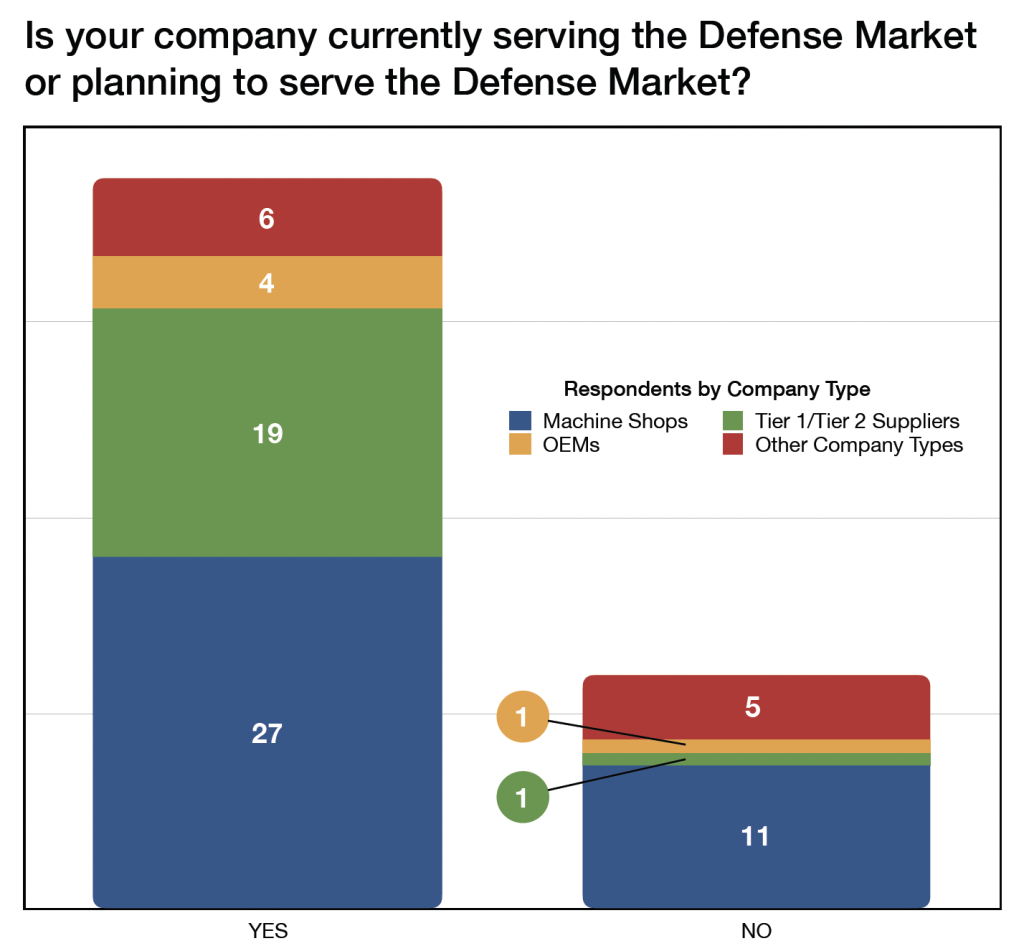
Survey respondents echoed this disconnect in different ways. Some pointed to outdated specifications and processes that slow production: “Lead times [are] extended due to specifications calling out outdated processes and materials.”
Review the print ads from this magazine to continue
This quick advertiser review unlocks the rest of the article and keeps the full-screen reader focused on the ads instead of the page chrome.
Advertisers included in this article experience
Print placements connected to this article
IMTS
Achieve the Impossible
IMTS promotes registration for the 2026 manufacturing technology show.
IMTS 2026 invites readers to register and experience manufacturing technology at the show.
Visit IMTS View this placement in the issue recordSharon-Cutwell
Advanced Aerospace Manufacturing Solutions
Sharon-Cutwell promotes Wave-Point and Wave-Router tools for complex aerospace manufacturing.
Wave-Point and Wave-Router tools are presented for complex aerospace and machining applications.
Visit Sharon-Cutwell View this placement in the issue recordPrint ads from this magazine
IMTS promotes registration for the 2026 manufacturing technology show.
IMTS 2026 invites readers to register and experience manufacturing technology at the show.
Continue reading
May 2026
Others highlighted procurement inefficiencies: “The lengthy time to get the authorization to complete projects for defense.”
Greenwalt views this issue as deeply rooted in how defense contracting works. “The cost-based system of traditional contracting where the government approves every dime of investment is completely misaligned with incentivizing companies to make the right investments to achieve rapid, scalable manufacturing.”
In contrast, he noted, newer contracting models — those that enabled companies like SpaceX — are designed to reward speed, efficiency and innovation. These models, however, still represent less than 1% of defense contracts, according to Greenwalt.
Barriers to Entry and Missed Capacity
One of the more striking insights from some CTE survey respondents and Greenwalt is that U.S. defense production capacity may exist, but remains untapped.
Some survey respondents expressed confidence in the industry’s ability to respond to increased defense production demand: “We are capable of handling an increased workload.” Another respondent described the U.S. manufacturing base as a “sleeping giant,” capable of scaling with the right investment and coordination. Greenwalt shares a similar view.
“U.S. manufacturing is stronger than we sometimes believe,” he said. “The number of contract manufacturers who currently do not do business with the federal government is an important data point.”
 However, the scale of that untapped capacity is not well defined. According to the U.S. Department of Homeland Security, through its Cybersecurity & Infrastructure Security Agency, more than 100,000 companies are included in the DoD’s Defense Industrial Base (DIB). Just how many of those companies are machine shops is open for discussion.According to the U.S. Bureau of Labor Statistics’ latest estimates from the third quarter of 2025, there are a total of 18,515 machine shops (NAICS 332710) throughout the country. Some informal estimates suggest that a significant portion of U.S. shops — possibly 80% or more —may be included in the DIB.
While those percentages seem unrealistically high, CTE’s defense market survey showed that about 71% of machine shop respondents currently serve the defense market. The CTE survey, however, purposely targeted subscribers at companies most likely serving the defense industry, and received only 74 total responses.
Whatever the actual number of machine shops included in DIB may be, Greenwalt suggested that prospects for U.S. defense production expansion would improve if more shops served the defense market. But he cites a number of significant barriers that may be preventing more machine shops from considering the defense market.
The overall problem, as he sees it, is access.
Entering the defense market requires navigating a complex web of requirements, including:
- International Traffic in Arms Regulations (ITAR),
- Cybersecurity Maturity Model Certification (CMMC),
- supply chain risk compliance, and
- cost accounting standards.
Collectively, Greenwalt acknowledged that complying with these requirements can take a year or more of effort, along with significant legal and administrative costs. “These are not weeks-long efforts,” he added. “It is a wonder that anyone wants to join the defense supply chain at all.”
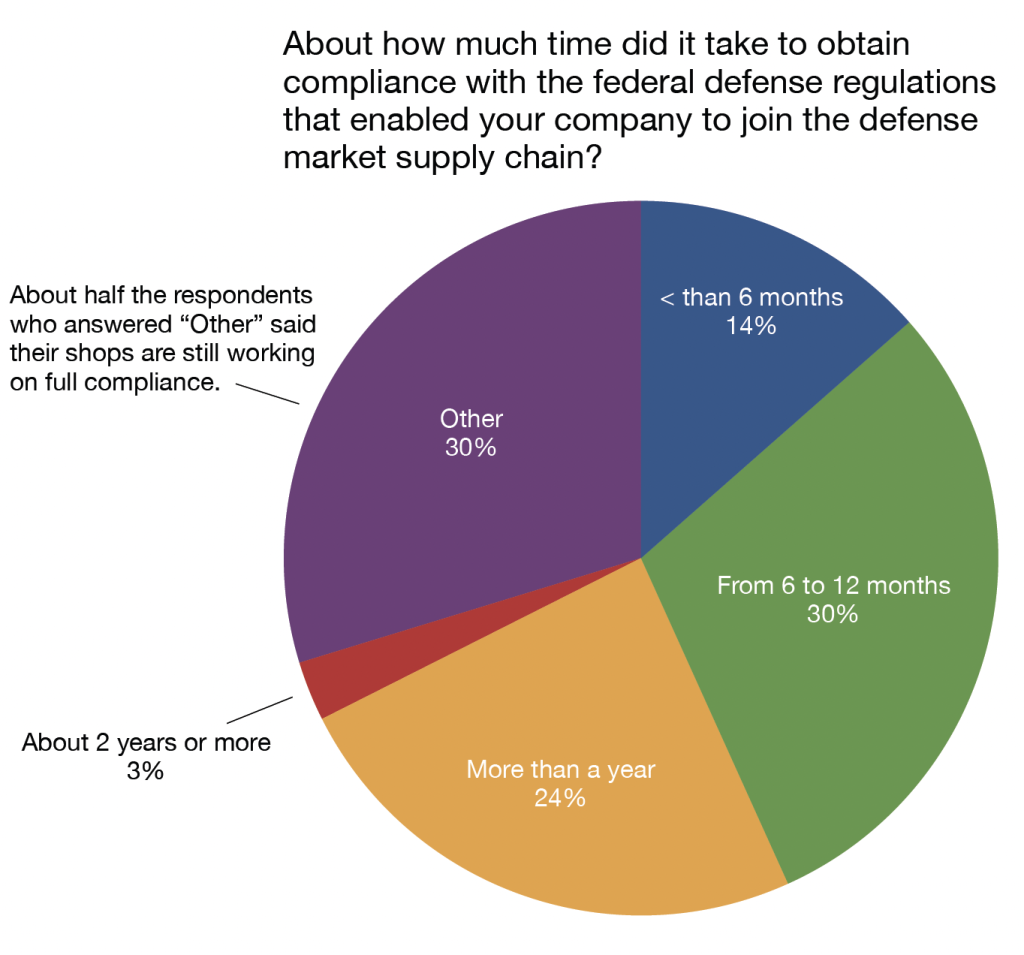
About 24% of our CTE survey respondents said it took more than a year for their companies to obtain compliance with defense market regulations, while another 3% said the process took about two years. Nearly 30% of respondents said compliance took from six months to a year. About 14% obtained compliance in less than six months.
“Those barriers need to come down and be addressed as the country will need to take advantage of all of its capabilities if we are to compete with China and others in the future,” Greenwalt suggested.
Bottom Line for Machine Shops
For machine shops, the current defense market presents both opportunity and risk.
Among the opportunities:
- increased RFQs tied to defense programs,
- greater visibility into long-term demand, and
- potential access to higher-value work.
Among the risks:
- regulatory burden and compliance costs,
- workforce limitations, and
- uncertain long-term demand cycles.
The path forward will depend on more than just increased spending.
Greenwalt suggested companies look beyond traditional defense channels and pay close attention to commercial innovation.
“The commercial market will continue to be years ahead of defense in many areas,” he said. “Those companies that can rapidly take advantage of what is proven in the commercial market will maintain their competitiveness.”
The challenge is not simply building advanced systems — it is building them at scale, at speed and with a workforce and supply chain capable of sustaining that output. As one survey respondent put it: “The biggest misconception is that we can’t get it done.”
Whether that proves true will depend on how quickly the system — and the industry — can adapt.
Related




 MFGAxis Discussion
Be part of the shop-floor conversation
Like, save, or comment on this CTE story.
MFGAxis Discussion
Be part of the shop-floor conversation
Like, save, or comment on this CTE story.


MFGAxis Discussion