


Avoiding Workholding Woes: Design & Engineering
Whether a fixture is hydraulic, pneumatic or mechanical, or whether it's built internally or subcontracted to others, it's important to understand your true costs and to consider workholding early in the part-design process.
I once did applications engineering for a Minneapolis machine tool distributor. When the owner presented me with the opportunity to design and build a hydraulic workholding fixture for a customer, I said, “Sure, why not?” I’d made plenty of fixtures in the past, albeit none as complex as the one I now faced. The distributor’s showroom had all manner of wire EDMs, grinders and machining centers on its floor. Because we represented several lines of modular tooling and hydraulic clamping components, there was nothing stopping me from my mission.
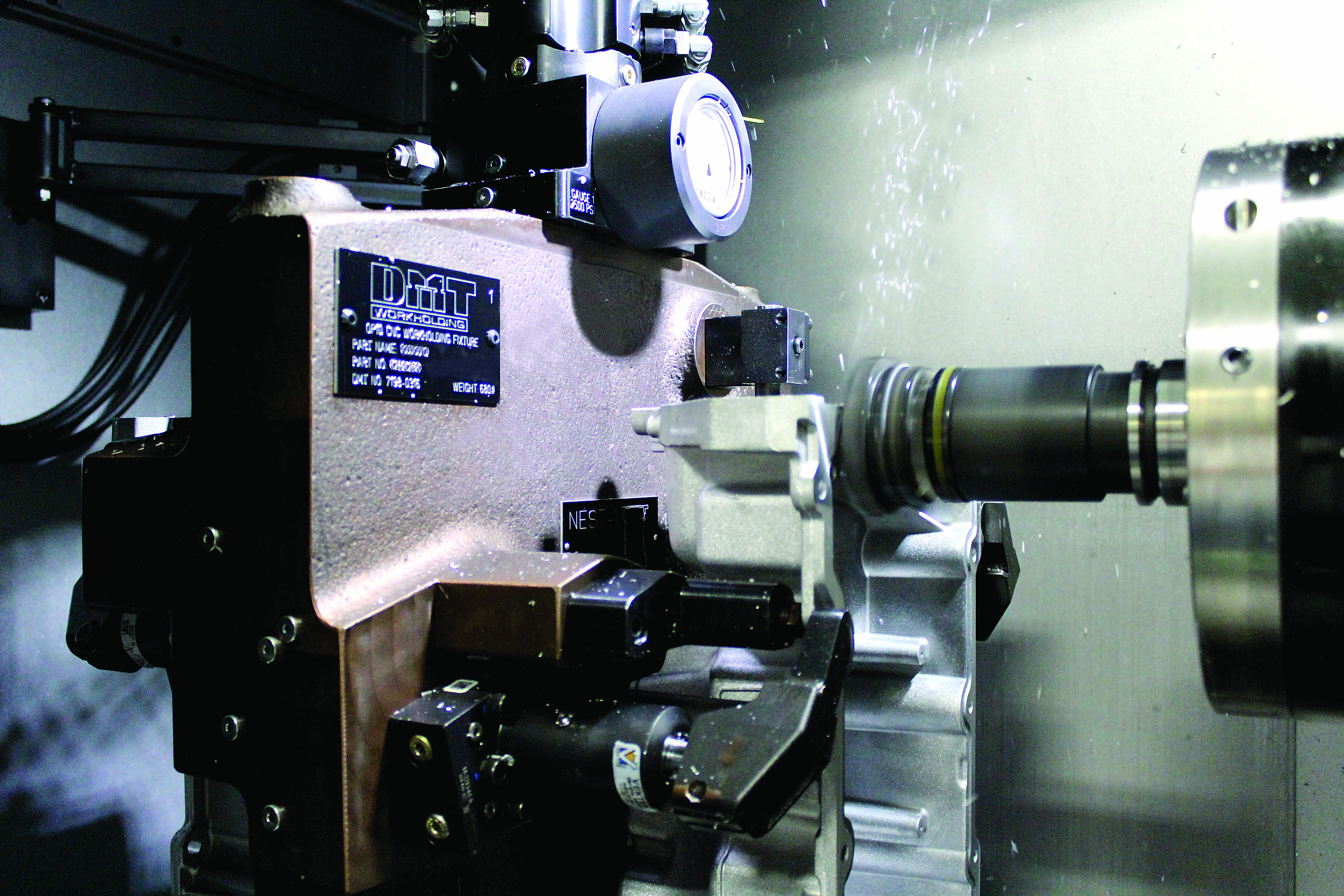
Properly designed hydraulic workholding is often a game changer in terms
of productivity and part quality. Image courtesy of DMT Workholding
Except myself, that is. Several months of late nights and long weekends later, with the customer growing increasingly impatient, the boss finally pulled the plug and sent my partially machined fixture to a local tool and die shop for completion. It was an epic fail, certainly, yet I learned an important lesson: Stick with what you’re good at. For me, that was programming CNCs and making parts. Fixtures? Not so much.
Greg Hoerter, vice president of sales for DMT Workholding Inc., Slinger, Wis., said this situation isn’t unusual, especially as shops transition to hydraulic workholding. “For those who’ve been using homemade, manual fixtures, the move to hydraulics can be a little daunting,” he said.
Hoerter added that the in-house design team may not be challenged to keep up with the latest techniques and technologies in the way that a dedicated workholding manufacturer must be.
“Without these best-practice experiences to ensure it works well out of the gate, the fixture will most likely have to be sent back to the toolroom for rework and redesign multiple times,” he said. “Or worse yet, it just gets ‘fixed’ on the production floor, since ‘we are all on the same team’ anyway, right? Where, then, does the accountability lie?”
Maybe your shop has no use for hydraulic clamping and an experienced tooling department with no apparent need for outside support. Hoerter emphasized that partnering with a company such as DMT is a smart move regardless.
He has found that a shop’s limited exposure to advanced fixture-building techniques can restrict its ability to try something new. “They get used to building fixtures a certain way, using the same components and time-tested methodologies with no exposure to what others in the industry are doing,” Hoerter said. “They become very stymied in their way of thinking. We’ve transformed dozens of companies that thought they were on the cutting edge.”
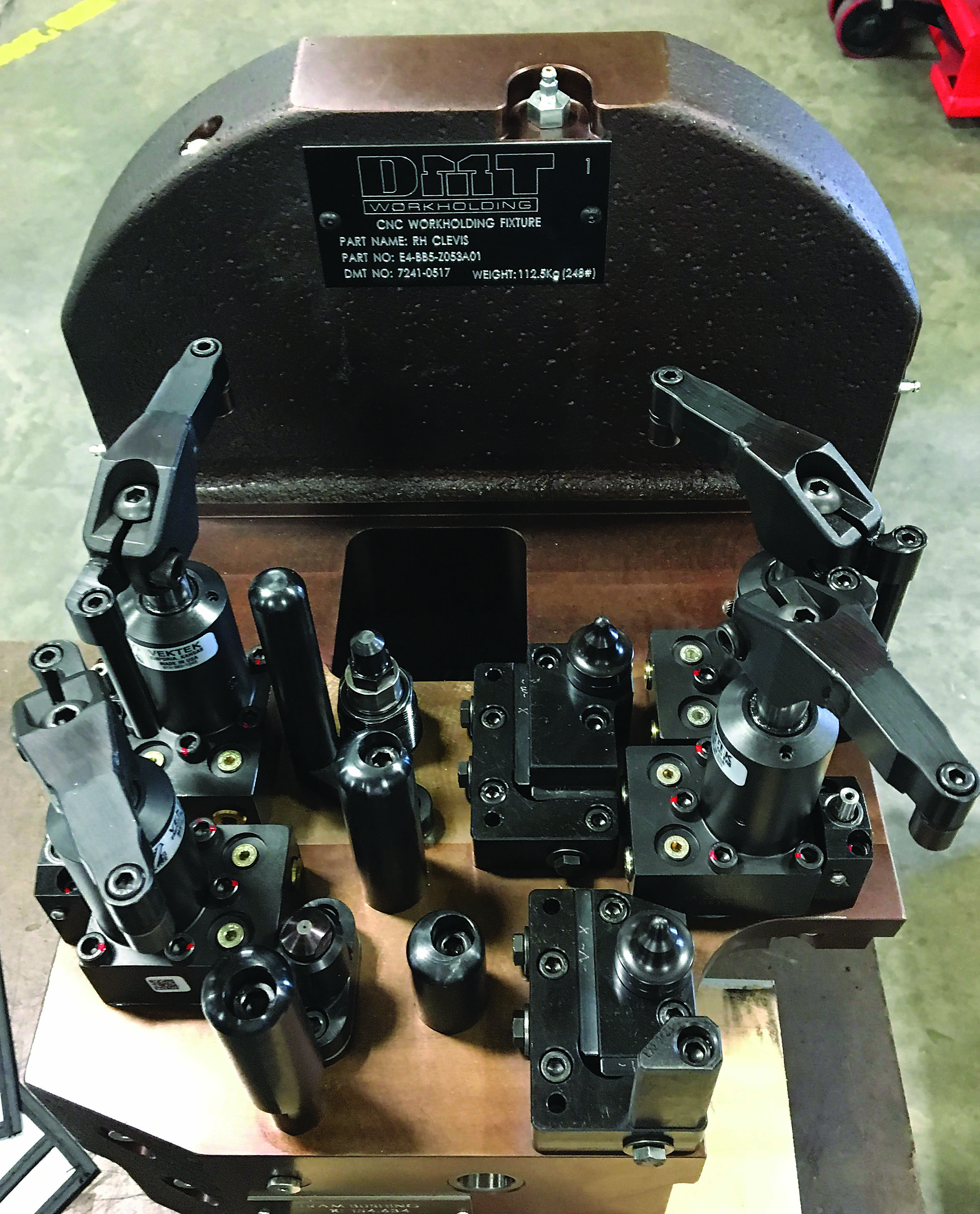
It’s important to consider the design of the workholder
as early as possible in the part-design process.
Internal costs and accountability must also be considered. According to Scott Bower, DMT’s executive vice president of sales and engineering, a toolroom might send fixtures to the production floor that aren’t quite ready for prime time. Rework and downtime will result.
Even when an in-house fixture does not work adequately on its first iteration, lost production and rework costs in the toolroom are rarely accounted for accurately. Other costs that are not accounted for come from inaccuracy and the inability to push feeds and speeds as hard as would otherwise be possible due to insufficient clamping pressures or poor datum structures.
“Using the correct workpiece datums is key to effective workholding,” Bower said, adding that DMT is working on a job in which the company that designed and built the original fixture made design choices that led to the use of undersized componentry, either from a cost-saving perspective or from inexperience. “They ended up in a situation where it was impossible to achieve the forces needed to truly hold the part in place.”
There isn’t the same level of accountability as when you work with an external workholding supplier, Bower explained. If it’s not done correctly the first time, it’s no big deal to send it back to the toolroom for adjustments. The actual tooling costs are also frequently skewed in the toolroom’s favor. Maybe the burden rates aren’t applied properly, or the rework and reduced productivity aren’t taken into consideration during the costing process. “You don’t have any of that when you work with a qualified supplier,” he said.
Hoerter agreed, noting that whether a fixture is hydraulic, pneumatic or mechanical, or whether it’s built internally or subcontracted to others, it’s important to understand your true costs and to consider workholding early in the part-design process.
“A handful of the customers we work with are more partner than customer,” Hoerter said. He explained that these customers involve DMT very early on, when the products are still napkin sketches. They collaborate to determine the best datum structure, how the part will be processed and which machine tool(s) will be used, almost as an extension of the customer’s engineering department.
“Even if they take it from there and end up building the tooling in-house,” he said, “this allows us to provide them with the most robust fixturing solution possible and minimize their overall manufacturing costs.”
Glossary terms in this article
Related


Subscribers can use MFGAxis notes, saves and discussion tools with their innoNET account.