

Better-balanced robots
Researchers at Carnegie Mellon University's Robotics Institute have designed a system that makes an off-the-shelf quadruped robot nimble enough to walk a narrow balance beam — a feat that is likely the first of its kind.
Researchers at Carnegie Mellon University’s Robotics Institute have designed a system that makes an off-the-shelf quadruped robot nimble enough to walk a narrow balance beam — a feat that is likely the first of its kind.
“This experiment was huge,” said Zachary Manchester, assistant professor at the institute and head of the Robotic Exploration Lab. “I don’t think anyone has ever successfully done balance beam walking with a robot before.”
By leveraging hardware often used to control satellites in space, he and his team offset existing constraints in the design of the quadruped to improve its balancing capabilities.
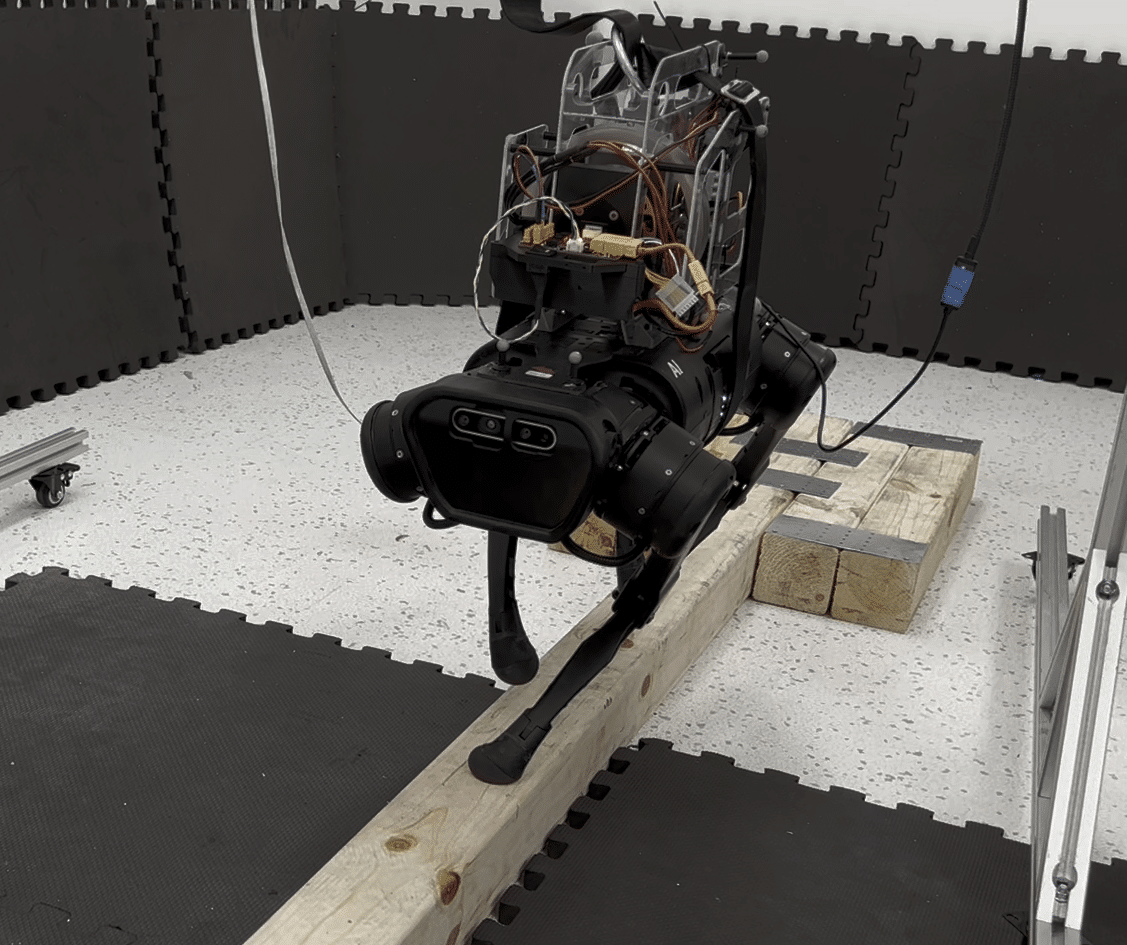
Researchers have designed a system that makes an off-the-shelf quadruped robot nimble enough to walk a narrow balance beam — a feat that is likely the first of its kind. Image courtesy of Carnegie Mellon University
The standard elements of most modern quadruped robots include a torso and four legs that each end in a rounded foot, allowing the robot to traverse basic, flat surfaces and even climb stairs. The design resembles a four-legged animal. But unlike cheetahs, which use their tails to control sharp turns, or falling cats, which adjust their orientations in midair with the help of their flexible spines, quadruped robots do not have such instinctive agility. As long as three feet of the robot remain in contact with the ground, the robot can avoid tipping over. But if only one or two feet are on the ground, the robot can’t correct easily for disturbances and has a much higher risk of falling. This lack of balance makes walking over rough terrain particularly difficult.
“With current control methods, a quadruped robot’s body and legs are decoupled and don’t speak to one another to coordinate their movements,” Manchester said. “So how can we improve their balance?”
Review the print ads from this magazine to continue
This quick advertiser review unlocks the rest of the article and keeps the full-screen reader focused on the ads instead of the page chrome.
Advertisers included in this article experience
Print placements connected to this article
mtseries.com | 800.733.3976
FOUR REGIONS,
ONE MISSION. A powerful face-to-face event series, where people and advanced manufacturing technology unite. REGISTER TODAY. Feb. 21-23, 2023 May 16-18, 2023 Oct. 24-26, 2023 Nov. 7-9, 2023 Houston, TX West Springfield, MA Long Beach, CA Greenville, SC produced by.
FOUR REGIONS, ONE MISSION. A powerful face-to-face event series, where people and advanced manufacturing technology unite. REGISTER TODAY. Feb. 21-23, 2023 May 16-18, 2023 Oct. 24-26, 2023 Nov. 7-9, 2023 Houston, TX West Springfield, MA Long Beach, CA Greenville, SC mtseries.com | 800.733.3976 produced by
Visit mtseries.com | 800.733.3976 View this placement in the issue recordPrint ads from this magazine
ONE MISSION. A powerful face-to-face event series, where people and advanced manufacturing technology unite. REGISTER TODAY. Feb. 21-23, 2023 May 16-18, 2023 Oct. 24-26, 2023 Nov. 7-9, 2023 Houston, TX West Springfield, MA Long Beach, CA Greenville, SC produced by.
FOUR REGIONS, ONE MISSION. A powerful face-to-face event series, where people and advanced manufacturing technology unite. REGISTER TODAY. Feb. 21-23, 2023 May 16-18, 2023 Oct. 24-26, 2023 Nov. 7-9, 2023 Houston, TX West Springfield, MA Long Beach, CA Greenville, SC mtseries.com | 800.733.3976 produced by
Continue reading
September 2023
The solution by the team employs a reaction wheel actuator, or RWA, system that mounts to the back of a quadruped robot. With the aid of a novel control technique, the RWA permits the robot to balance independently of the positions of its feet.
RWAs are used commonly in the aerospace industry to perform altitude control on satellites by manipulating the angular momentum of spacecraft.
“You basically have a big flywheel with a motor attached,” said Manchester, who worked on the project with Robotics Institute graduate student Chi-Yen Lee and mechanical engineering graduate students Shuo Yang and Benjamin Boksor. “If you spin the heavy flywheel one way, it makes the satellite spin the other way. Now take that and put it on the body of a quadruped robot.”
Manchester predicts that quadruped robots soon will transition from being primarily research platforms in labs to becoming widely available products for commercial use, similar to where drones were about 10 years ago.
“Quadrupeds are the next big thing in robots,” he said. “I think you’re going to see a lot more of them in the wild in the next few years.”
— Kayla Papakie
Related


Subscribers can use MFGAxis notes, saves and discussion tools with their innoNET account.


