


Better workholding improves machining
Ever since CNC machining became the dominant method to cut and grind metal, a perception has existed that machining can be manipulated and easily simplified. With computers crunching the numbers, how hard can machining be?
Ever since CNC machining became the dominant method to cut and grind metal, a perception has existed that machining can be manipulated and easily simplified. With computers crunching the numbers, how hard can machining be?
That perception couldn’t be further from the truth. Whether you are looking at 4 weeks or 4 days of lead time, cutting metal still takes time and a lot of preparation.
But while the basics of cutting and grinding remain the same, part manufacturers have an opportunity to improve processes to better match the requirements of the information age we live in.
In this column, which focuses on workholding, or fixturing, I hope to bring an awareness of this potential “added value.” I’ll start with the basics, or “Fixturing 101,” and work my way up in future columns.
Every part is made of geometrical elements designed to work in concert with other parts. For example, a rack-and-pinion steering system, or any gearing really, contains housings to hold the gearing, shafts driven from the gearing, support structures to hold the shafts, braking systems to control the speed, wheels bolted to the shafts, bearings to keep the shafts rotating … you get the idea.
But all those parts fit in two categories: round and non-round.
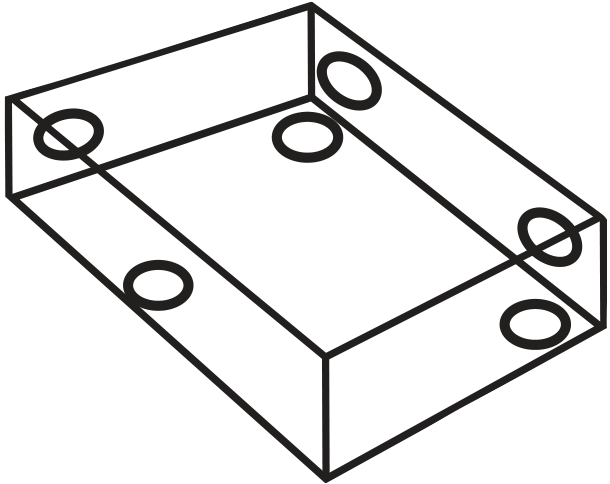
A nonround part usually has six datum points.
Round parts can be turned and cut with stationary tools. Nonround parts must be held stationary and cut with rotating tools. Effective workholding allows shops to machine both types of parts fast and accurately.
Workholding requires datums, or dimensional origins, for each part. Datum targets vary with each part, but a minimum of six points are required to define an adequate workholding system for any part. There are typically three points on the OD of a round part, and three points on the face of the part. Round parts may also require an orientation about the centerline of the axis.
There are typically six datum points on a nonround part: three on the bottom face, two on the top edge and one on the side locator (see figure above). Traditionally, it has been the responsibility of the customer, or end user, to define the required work material and type of manufacturing process and provide the datum points on the part prints. Today, it is becoming more common for the end user to pass these responsibilities to the value-added supplier, the shop making the part. As a result, the shop must fully understand these requirements and how they affect workholding.
Finally, accurate machining depends on the information in the part print. The most important features of a part are often designated as special, or key characteristics—print dimensions considered critical to the part’s function as well as the relationship of features to each other as designated by geometrical positioning and tolerancing. These features can significantly influence workholder design, which must ensure the print requirements are maintained so the part manufacturing process works as intended. While these features vary from part to part, workholding for round parts typically requires concentricity, and workholding for nonround parts requires accurate positioning.
When defining workholding requirements for any part, you must mentally suspend the part in space on the datum points, look at it from a 360º view, determine if the part can be roughed and finished in one setup while allowing the cutting tool to reach all the required points, determine how many operations are required and then sketch the workholding design for engineering and build.
Sometimes this can be a simple process, but most times it is not—especially if outsourced processes and finishing operations are required. As a result, determining all of the part-processing variables is crucial when designing workholding.
Most simple parts are no longer manufactured in the U.S. What’s left are the complex, tough jobs that require careful planning. With the right approach, shops can solve their challenges—including workholding. CTE
About the Author: Joe Mason is cost estimator and process engineer for United Machining Inc., Sterling Heights, Mich., a supplier of high-heat manifold, turbine and exhaust components, and a division of Wescast Industries. He has worked in the metalworking industry since 1978, starting as a machinist. Contact him at cncgcode@earthlink.net.
Related


Subscribers can use MFGAxis notes, saves and discussion tools with their innoNET account.