



Buying time: Turning Performance
Using standard tooling on a CNC lathe means leaving money on the table, according to the cover story in the April 2013 issue of Cutting Tool Engineering magazine.
Using standard tooling on a CNC lathe means leaving money on the table.
It’s the 47th lap of the Indianapolis 500. You’ve been leading the pack all morning but the left rear tire is getting a bit squishy. After signaling the crew to get ready, you barrel down pit lane and slide to a stop before the garage, just as the tire changers come running out equipped with … monkey wrenches?
To a racecar driver, quick changeover means the difference between victory and defeat. But it seems machine shop owners and manufacturing engineers aren’t getting the message. Talk to most any machine tool expert and you’ll hear the same thing: fewer than 10 percent of all 2-axis lathes are equipped with quick-change tooling.
That Stuff Ain’t Cheap!
“A lot of people don’t see the benefit of quick-change,” said Michael Minton, national application engineering manager for Methods Machine Tools Inc., Sudbury, Mass. “People are looking for ways to reduce setup time, but the perception of high cost gets in the way of the benefit of quick-change. Machine and tooling suppliers need to do a better job of explaining the technology to end users. Given the proper application, the benefits clearly outweigh the cost.”
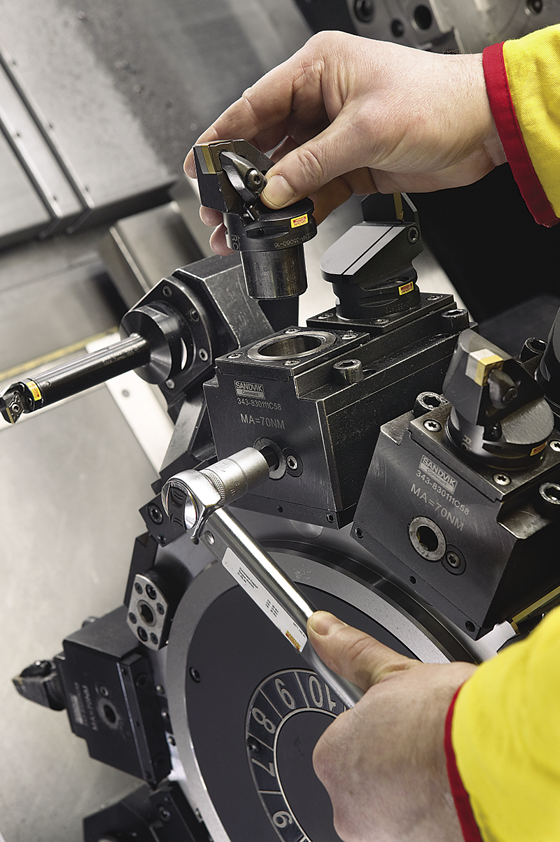
Courtesy of Sandvik Coromant
Quick-change tooling on a twin-spindle machine.
Quick-change toolholders cost several hundred dollars each. The blocks to mount them to the turret could be more expensive than a Caribbean cruise. Adding insult to injury, lead times can be long. Once you’ve purchased a new CNC machine, you might wait 8 to 10 weeks for delivery of a quick-change tooling package and spend another 20 percent over the machine’s $150,000 price tag. “It is very hard to convince a guy who just bought a 2-axis lathe that it’s a viable solution,” Minton said.
It sounds like a lot of money. But do the math: Assuming quick-change tooling reduces downtime by 1 hour per day, a shop charging $80 per hour could save more than $20,000 annually per machine. A tool change with a conventional holder might take 10 to 15 minutes, according to Minton, but takes 1 minute or less with a quick-change holder.
“For a job shop doing two to three setups a day, it could be very advantageous,” Minton said. “Some manufacturing companies are looking at single-piece part flow or deal with just-in-time manufacturing, where small lot sizes are the norm. Here, you don’t have a whole lot of choice—go quick-change or spend a lot of time setting up.”
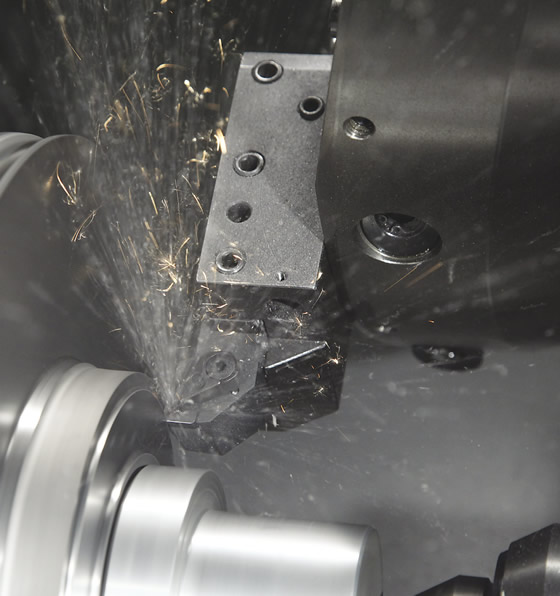
Courtesy of Kennametal
A square-shank Kennametal quick-change toolholder and insert face cast iron without coolant.
Despite this, Minton said the biggest opportunity for quick-change holders is on multitask machines. “On a regular 2-axis lathe, most of the tools reside on the machine anyway. Certainly, the OD tools—roughing, finishing, cutoff, grooving and threading—are there all the time. It’s the ID tools that change between setups: the drills, boring bars and grooving tools.”
So unless there is a high-tool-wear situation that requires changing inserts several times an hour or the low-volume scenario previously described, it might be difficult to sell the advantage of quick-change on a 2-axis lathe, according to Minton. “But on a multitasking machine, it’s far more advantageous,” he said.
On a mill/turn center with two or three turrets, setup can get quite involved. “You might be looking at several dozen tools, and quite a few of those could be live,” Minton said. “Unlike a machining center, where you can load tools in the magazine while the machine is running, the only way to load new tools on a mill/turn machine [without quick-change] is to take the machine out of service. In this situation, you should certainly evaluate quick-change.”
What’s the Holdup?
So, if quick-change tooling is such as good idea, why don’t more shops use it? “It’s a mindset,” said David Fischer, lathe product specialist at Okuma America Corp., Charlotte, N.C. “In the majority of shops, particularly those with repetitive or low-volume work, quick-change would be a tremendous advantage. I really don’t get why they haven’t embraced this more. It would make them more competitive than they can possibly realize.”
Fischer agreed that it frequently comes down to cost. “Most of them look at it and say, ‘Wow, those are expensive toolholders.’ But you have to look at this long term. What is your payback over a year’s time? How many times do you change tools and how many setups do you do? With a fully implemented quick-change system, you can go from hours of setup time to just a few minutes.
“There’s a lot more to it than changeover,” Fischer added. “You get to the point where you don’t care about the interruptions. For example, a customer calls and wants to drop an order in. If your setup only takes 15 minutes, who cares? So aside from saving money, now you can provide better customer service and win more business as a result.”
Still, setup time reduction isn’t as simple as running out and buying a bunch of quick-change holders. Staff and equipment are needed to support it, including a setup man, a programmer and a toolcrib to set the tools. “Everyone on the team has to embrace the concept and be confident the guy next to them isn’t dropping the ball,” Fischer said.
To this point, one big piece of the quick-change puzzle is offline presetting. Most shops still use touch setters on a machine, but that doesn’t make sense for a piece of CNC equipment. A better approach is presetting tools in the crib. When the operator takes a replacement tool, the presetter sends the offset to the machine and machining can begin.
“Very few people do it that way, and that means poor use of machine time,” Fischer said. “It’s interesting how the issue of cost—say, the cost of a presetter for the toolcrib—can very quickly trip people up from doing something that would otherwise save them a ton of money. Long term, a company can jeopardize its ability to compete. Most shops guess their uptime to be way higher than it is, but they’re just kidding themselves.”
One Size Doesn’t Fit All
If this is the best thing since sliced bread, why aren’t machine tool builders equipping their CNC lathes with quick-change-capable turrets? That would certainly go a long way toward reducing the high investment cost. Fischer explained that some builders have tried this, but met with poor results.
“If you buy a machine with a turret dedicated to one brand of quick-change tooling, you’re really locked in,” he said. “And there are very few situations where every tool you’re going to use has a quick-change adapter. So if my turret is dedicated to KM or Capto [quick-change tooling], that’s great, so long as every tool I’m going to use—ever—is available in that platform.
“Most shops are not going to be all Kennametal [KM] or all Sandvik [Capto],” he continued. “And it’s very unlikely you’re going to find one system that meets every need. Boring bars, especially, are a problem, because you’re locked into whatever length is available for the toolholder. There are times when you might have chatter issues and you’ll need to adjust bar length to maximize your reach and minimize your chatter. If you’re tied into one system, maybe you can’t do that.”
Fischer pointed out another flaw of dedicated quick-change turrets: stuff happens. “With our turrets, you have to mount a quick-change tool block of some sort. This makes it easy to mix and match different tooling systems. But the nice thing is, if you have a crash, you can replace the block and you’re back in business. It’s not like you have to rebuild the turret. This not only gives you a lot more flexibility, but less risk of extended downtime for machine repair.”
Jim Grimes, senior product specialist for machine tool integration at Sandvik Coromant Co., Fair Lawn, N.J., agreed: “Machine builders are not integrating quick-change out of the factory. It’s usually our responsibility as cutting tool manufacturers to bring it to market. Most customers want to buy a standard machine, so we’ve developed a program of machine-adapted clamping units for specific machine tool models.”
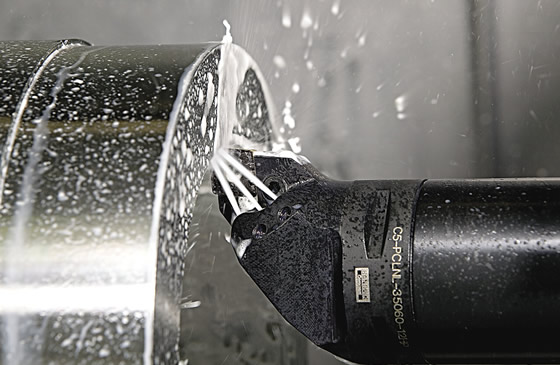
Courtesy of Sandvik Coromant
Integrated cooling allows for efficient chip evacuation during a boring operation using a quick-change head.
From a quick-change perspective, this means whatever the machine tool brand, chances are good that a quick-change tool block exists that bolts directly to the machine’s turret. These blocks have the proper bolt pattern, clearance and coolant inlets.
When making the leap to quick-change tooling, consult with the supplier to avoid unnecessary purchases. “When shops go to purchase a new turning center, I would suggest getting us involved from the beginning,” Grimes said. “Back in the day, machines would come standard with an assortment of tool blocks. But today, nobody’s giving that stuff away. So, if we get involved early enough in the process, you can avoid buying a bunch of blocks you don’t need and go right to a machine-adapted clamping unit.”
What if the machine’s on your loading dock? No worries, Grimes said. Sandvik Coromant offers different levels of adapting to a turret, including a clamping unit that replaces a stick tool. Otherwise, a shop can remove the standard wedge lock-style clamp and replace it with a quick-change unit that fits into the turret. For ID holders, the company offers cylindrical units that fit into the bore of a standard holder.
Smarter and Faster
Despite the apparent reluctance of most shops, Grimes said interest in quick-change tooling is on the rise. “Only a small minority of shops are using quick-change, but we’re getting double the inquiries today that what we were getting a few years ago. Manufacturers are getting smarter and more competitive. Anyone who survived the last couple of years is looking for ways to increase profit.”
He pointed to one shop that switched entirely to quick-change. “They hired a consultant to advise them on how to reduce setup time,” Grimes said. “They called us in and we retrofitted everything with Capto. Some of their equipment was 15 years old, but they figured if they could get another 2 good years out of the machine, it would be worth it. As it turned out, the clamping units paid for themselves within 9 months.”
For the repeat jobs, Sandvik Coromant kitted the required tools. The tools are preset and labeled according to the station they go into, so an operator can switch an entire turret in a few minutes. The shop reduced setup times by 3 hours (15 minutes per tool times 12 tools). Setup now takes just 45 minutes.

Courtesy of Kennametal
A KM quick-change tool turns a steel part with coolant. View a video comparing the KM quick-change tool to a standard tool by clicking this link.
Sandvik Coromant also licenses other manufacturers to make Capto tooling. Brendt Holden, president of Haimer USA LLC, Villa Park, Ill., said his company has been making Capto tools since 2010. “Demand is definitely up. We offer one more solution to customers looking to purchase Capto. We do a lot with shrink-fit and special-length rotary holders, extended-reach options that aren’t in the Sandvik catalog. Of our Capto sales, almost 100 percent goes on mill/turn centers, the majority of which are in job shops. Almost every industry is dipping into mill/turn today, which is one area where quick-change tooling is critical to success.”
Doug Ewald, director of global product management for Kennametal Inc., Latrobe, Pa., said it’s important to get the quick-change message out so shops can reap the benefits. He said: “I’m often surprised as I go out to different customers at the number of shops still using square-shank tooling. There’s a variety of quick-change systems available, but whichever one you consider, it’s important to look at the cost savings potential from both uptime and setup reduction. It all comes down to doing things more efficiently. By investing in quick-change, you’re buying time.”
It should be a no-brainer, yet the U.S. market has yet to catch on, unlike Europe, where acceptance is widespread, according to Ewald. Part of that situation is a broader acceptance of new manufacturing strategies in Europe, as well as a higher technology focus.
Ewald said: “Companies in Europe tend to turn their machines around more quickly. They put more pressure on ROI, so they really want to adopt the latest technology. When someone does invest in a new machine tool, they want to squeeze every penny out as quickly as possible. Quick-change does that for you.”
So here’s the message: Quick-change technology has been around for more than 30 years and is reliable and accurate. It’s not cheap but payback is quick. However, most of your competitors aren’t using it, at least not yet. What are you waiting for? Get changing quick! CTE
About the Author: Kip Hanson is a contributing editor for CTE. Contact him at (520) 548-7328 or khanson@jwr.com.
Contributors
American QC Systems Inc.
(941) 782-1180
www.americanqc.com
Haimer USA LLC
(866) 837-3265
www.haimer-usa.com
Kennametal Inc.
(800) 446-7738
www.kennametal.com
Methods Machine Tools Inc.
(877) 668-4262
www.methodsmachine.com
Okuma America Corp.
(704) 588-7000
www.okuma.com
Sandvik Coromant Co.
(800) 726-3845
www.coromant.sandvik.com/us
Quick-change tooling on a budget
It’s a common assumption that quick-change tooling is expensive, but it doesn’t have to be. A low-cost quick-change alternative comes from American QC Systems Inc., an offshoot of a Bradenton, Fla., machine shop. Owner Dan Walters said, “We have a design that fits into any ER-style holder and is used for quick-change of round-shank tools. It’s a fraction of the cost of competing systems.”
Walters sees quick-change a little differently. “To me, it’s all about a shortage of machinists,” he said. “We’ve used these holders in our sister shop, American Torch Tip Co., for more than 5 years. As a result, we’ve eliminated the need for skilled machinists to change tools. It’s a big cost savings for us. We can hire people with no machining skills, bring them in and have them be effective immediately. All they have to do is be able to unscrew the nut and pop in a new tool.”
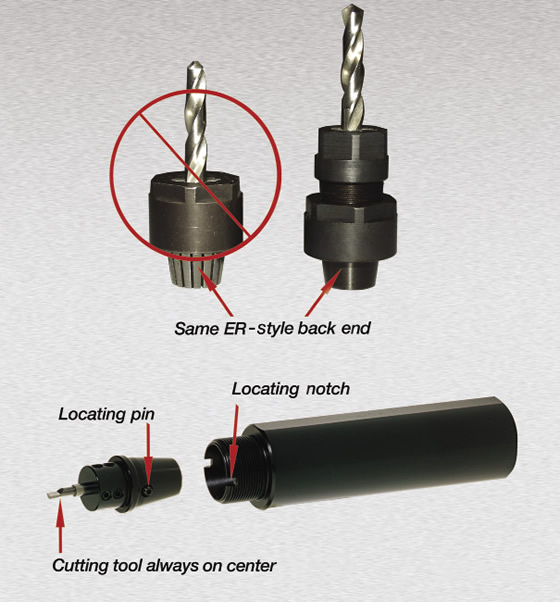
Courtesy of American QC Systems
American QC Systems makes quick-change toolholders for ID tools.
With 5,000 part numbers in its catalog, American Torch Tip performs more than 20 setups a day across 40 machines. “We keep maybe 100 tools set up all the time,” Walters said. “These are the standard tools we use most frequently, and they’re preset the same no matter which machine you put them on. For everything else, we have the tools kitted in bins. All the operator has to do is read the setup sheet, load the tools, enter the offsets and hit go.”
Because of this, American Torch Tip enjoys setups that take minutes, using operators whose only previous skills might have been flipping burgers. “Buy a new machine and you’ve just created a problem for yourself,” Walters said, “because you’ll be unable to find a machinist to run it.” Walters has solved this with quick-change tooling. “We invested big into it to start, but over the years, the cost per year has dropped to nothing, and I can hire anyone.”
—K. Hanson
Glossary terms in this article
Related




Subscribers can use MFGAxis notes, saves and discussion tools with their innoNET account.


