

Charge ahead: Industry Trends & Analysis
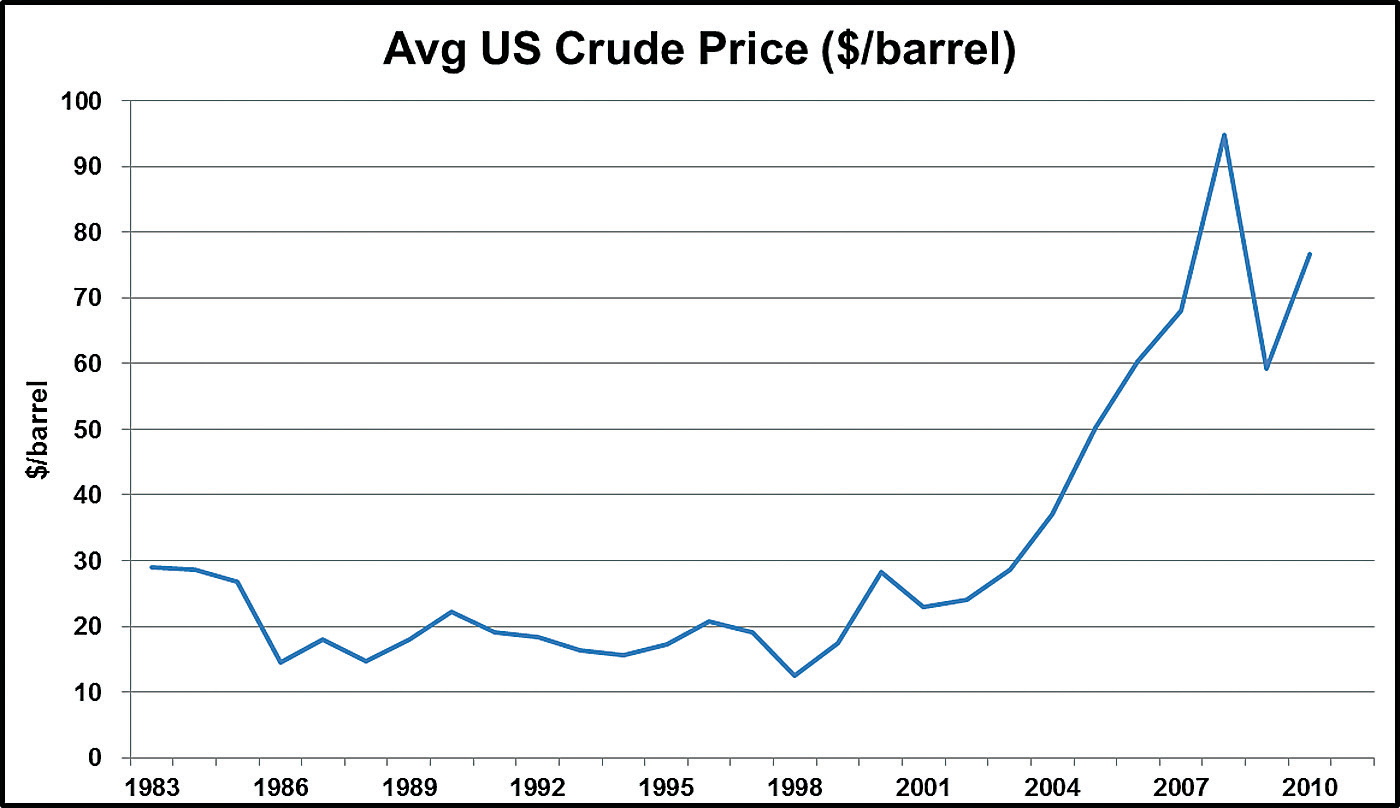
Over the last 30 years, energy prices have risen significantly. Crude oil prices have risen 300 percent since 1983, according to the U.S. Energy Information Administration (see graph on page 65). The sharpest increase has been over the past 10 years.
Managing energy costs and improving energy performance requires an ongoing commitment.
Over the last 30 years, energy prices have risen significantly. Crude oil prices have risen 300 percent since 1983, according to the U.S. Energy Information Administration (see graph on page 65). The sharpest increase has been over the past 10 years. Experts project global energy consumption will continue to increase by as much as 49 percent from 2007 to 2035. With this in mind, there is no better time to examine your operations and commit to better management of energy consumption and costs.
The Correct Approach
Two approaches to managing energy and improving energy performance are typically employed. With the traditional approach, someone within an organization becomes aware of high energy costs and implements one or two simple, cost-effective energy saving activities.
Unfortunately, soon after that everyone resumes business as usual, costs creep up and the cycle continues. With this approach, there is little to no awareness of the value energy management provides. The result is generally about a 5 percent reduction in overall energy costs.
The second approach is more structured and applies “best practices” in energy management. It typically involves support from top management, commitment to resources and a budget, naming of an active energy manager who heads a team that is accountable for success, a detailed energy efficiency audit, and set policies, objectives, targets and actions.
Even though more effort and investment is required with this approach, it has several benefits. Arguably, the most important are financial. A best practices energy management organization will typically see initial energy cost reductions of 10 to 20 percent by identifying the most lucrative energy saving measures, followed by a commitment to invest resources for successful implementation of these improvements. Operational improvements will typically require an investment in time and personnel resources, while equipment improvements will require an additional capital investment.
Furthermore, with a structure in place that fosters continuous improvement, the organization will continue to drive down energy costs, leading to additional cost reductions of 3 to 5 percent annually for many years.
Another benefit of structured energy management is it creates enthusiasm and awareness for energy conservation and corporate responsibility, which improves employee morale, reduces the organization’s carbon footprint and improves the corporate image.
Suggested First Steps
The initial steps in a best-practices energy initiative are to establish an energy baseline, conduct an energy management review and perform an energy efficiency assessment.
To establish an energy baseline, the organization must compile monthly energy and production data going back at least 2 years, preferably 3, for each of the facilities under management. The data includes consumption, cost and demand for major sources of energy, such as electricity, natural gas, steam, coal and chilled water.
Also, monthly production data should be collected for the same time period. A baseline year is chosen and the energy consumption for that baseline year typically becomes the reference for measuring energy performance improvement.
Because production is usually proportional to energy consumption, it helps to develop a metric, such as Btu per pound of production output, as a way to normalize the measurement for production. Then, this metric is used to develop specific targets for energy performance.
The second step is to conduct an energy management review. This is a gap assessment that evaluates where the organization is today in its energy management practices compared to a best-practices approach. Here, management practices such as procurement, level of executive support, policymaking, organizational structure and awareness activities are examined. By way of this review, the organization can determine its current energy status, the financial value of moving forward with a structured energy management program and its energy management goals.
The third step is to perform an energy efficiency assessment. Different from the energy management review, this is a
detailed, on-site audit of the facility’s energy systems. The audit examines and models the major energy systems, such as compressed air, steam/boiler, process heating and HVAC, to determine their contribution to plant energy consumption.
The main goal of the audit is to describe and quantify the most economically beneficial energy saving measures within the plant. This provides the organization with 10 to 20 activities, or projects, that can yield lucrative energy savings, ranging from an immediate to a 4- or 5-year payback.
Review the print ads from this magazine to continue
This quick advertiser review unlocks the rest of the article and keeps the full-screen reader focused on the ads instead of the page chrome.
Advertisers included in this article experience
Print placements connected to this article
info.star-su.com/solid-carbide-gundrills
Solid Carbide Gundrills
System technology from one source • Ideally suited for drilling small diameter holes, including stainless steel or titanium • Hold very tight TIR tolerances from start to finish • Engineering solutions for Design and Build • Technical services available • Competitive lead-times.
Solid Carbide Gundrills System technology from one source • Ideally suited for drilling small diameter holes, including stainless steel or titanium • Hold very tight TIR tolerances from start to finish • Engineering solutions for Design and Build • Technical services available • Competitive lead-times 248-474-8200 info.star-su.com/solid-carbide-gundrills
Visit info.star-su.com/solid-carbide-gundrills View this placement in the issue recordPrint ads from this magazine
System technology from one source • Ideally suited for drilling small diameter holes, including stainless steel or titanium • Hold very tight TIR tolerances from start to finish • Engineering solutions for Design and Build • Technical services available • Competitive lead-times.
Solid Carbide Gundrills System technology from one source • Ideally suited for drilling small diameter holes, including stainless steel or titanium • Hold very tight TIR tolerances from start to finish • Engineering solutions for Design and Build • Technical services available • Competitive lead-times 248-474-8200 info.star-su.com/solid-carbide-gundrills
Continue reading
June 2012
A comprehensive audit includes the installation of data loggers on significant-use equipment with data recorded over several days or weeks. Solid estimates for costs, savings and return on investment/simple payback should be provided, along with descriptive pictures, tables and graphs.
Energy Saving Tips
Unique and significant opportunities for energy savings are available in plants where machine tools are used. According to studies conducted by TechSolve Inc., Cincinnati, many plants keep machine tools energized while in idle mode. This can result in energy consumption many times greater than the energy consumption while the machine is “in cycle” or “under cutting load.” An idle machine may still draw a large percentage of the energy consumed if it were in cycle. If the machine is not effectively utilized and in cycle for significant periods of time, then there is an opportunity to greatly reduce costs by shutting down the machine while not in operation.
Also, with modern controls and advanced machine technology, long warm-up times and startup failures are less of an issue than in the past. This allows the machines to be completely shut down when not in operation with minimal effect on production schedules.
Another opportunity focuses on compressed air systems. One study by TechSolve found the energy consumed by a scroll compressor serving one machine in idle mode to be about 50,000 kWh annually. At 9 cents per kWh, this equates to nearly $5,000 annually in electricity costs. Had the air supply to the machine been disconnected while the machine was not running, the energy consumption and cost of the machine tool compressor would be reduced by 50 percent.
Other activities for improving compressor energy efficiency include repairing piping air leaks, increasing the size of the air storage reservoir, lowering the system’s air pressure and using a different style of compressor that is more efficient under partial load, such as a piston or reciprocating type.
Sustaining Improvement
One of the benefits (and characteristics) of a best-practices energy management approach is that it provides the framework for continuous improvement. This framework effectively forces the organization to be responsible, to implement the stated plans and to meet its targets. Often, it is a good idea to first implement confidence-building low- or no-cost projects that confirm to management their support and investment are worthwhile. This should be followed up quickly with projects requiring capital investment that have rapid paybacks.
Sometimes, energy efficiency projects have a relatively long payback but are sorely needed for production or operational purposes. Obviously, these projects will be given a high priority. Once a project is implemented, it is important to measure and monitor its performance. Additional room in the budget should be incorporated for instrumentation, such as submeters. For instance, submeters can be installed to directly monitor energy usage and provide real-time data on specific processes or systems. This will allow organizations to accurately measure and verify the pre- and post-implementation energy performance of individual systems. Finally, it is essential that the progress, results and accomplishments be thoroughly documented and communicated, and to reward those involved with the initiative.
Becoming World Class
During the last 4 years, energy management practitioners from around the world have collaborated and written a new global standard for energy management that aligns all of the best practices in energy initiatives to date. ISO 50001, administered by the International Organization for Standardization, provides organizations with the instrumental guidelines to develop a comprehensive energy management system.
The standard incorporates the recognized and industry-proven PDCA (Plan, Do, Check, Act) continual-improvement approach synonymous with other familiar standards, such as ISO 9001 and ISO 14001. Thus, ISO 50001 can be launched as a self-standing program or seamlessly integrated with other management systems.
ISO 50001 provides the framework to manage and improve energy performance. Since its June 15, 2011, release, ISO 50001 has been adopted internationally by numerous organizations, including ones in China, France, South Korea and Germany. It is expected to be very popular in the U.S. as the first energy management standard of its kind.
It is widely recognized that energy is a significant fraction of the total cost required to manufacture goods. Manufacturers also have an opportunity to reduce emissions of carbon dioxide and other greenhouse gases and establish their organizations as energy conservation leaders.
 Although the unit costs of energy cannot be controlled by individual companies, total energy spending is manageable through adoption of an energy management initiative that offers real solutions and continuous improvement. CTE
About the Author: Young Paik is a project manager for the Energy and Environmental Services team at TechSolve Inc., Cincinnati. Contact him at paik@techsolve.org. Web: www.techsolve.org.
Related




Subscribers can use MFGAxis notes, saves and discussion tools with their innoNET account.


