

Chip off the Hard Block
A new laser machining center laser ablates 3-D profiles in superhard cutting tools.
A new laser machining center laser ablates 3-D profiles in superhard cutting tools.
Courtesy of All images: Wendt
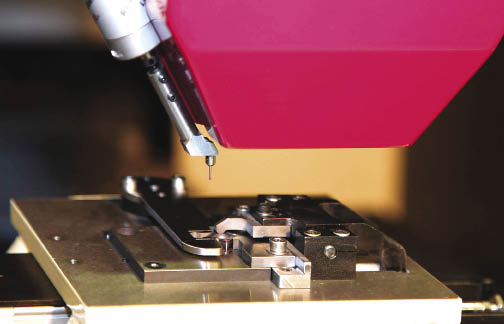
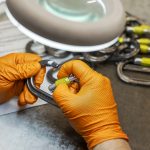
The working environment of the Spectra laser machining center features modular clamping and a 3-D measuring probe for positioning the workpiece.
The machining of 3-D profiles, such as chipbreaker geometries, into PCD, PCBN, carbide and ceramic cutting tools presents unique processing challenges. These challenges have created limitations to the profitability of the process and to the profile’s dimensional accuracy.
Electrical discharge machining is probably the most common machining process for generating 3-D profiles in superhard cutting tools, but it also has tool wear limitations, long cycle times and is suitable only for conductive materials.
Laser ablation offers an attractive alternative to EDMing. Eliminating the need to compensate for tool wear while increasing material-removal rates make laser ablation appropriate for creating 3-D profiles. Additionally, the workpiece does not need to be conductive and therefore laser ablation offers the potential for machining ceramics and other nonconductive materials. It creates chipbreakers in superhard cutting tools, profiles in punch dies and toolholder locating and locking geometries in inserts.
Removing Material
A laser removes material either by burning or vaporizing it from the surface. A laser beam burns a continuous path on a workpiece surface, a typical technique for engraving or cutting. However, a pulsing laser will vaporize material at a specific point, thereby leaving a small cavity. It does this with each pulse of light.
The cavity size is a function of the size of the laser and the light’s focus diameter. A higher wattage laser creates a larger cavity than one with less wattage, and a larger cavity means a higher mrr.
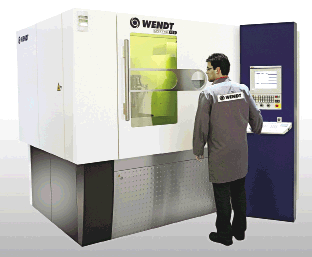
The Spectra 820 laser machining center from Wendt uses a stationary diode-pumped, solid-state laser and oscillates the workpiece to the light source to achieve material-removal rates and impart surface finishes similar to finish grinding. Unlike grinding, where parameters such as wheel diameter or wheel speed are continually changing and interacting with each other, Wendt says the laser machine’s parameters are predictable and do not interact with each other.
Review the print ads from this magazine to continue
This quick advertiser review unlocks the rest of the article and keeps the full-screen reader focused on the ads instead of the page chrome.
Advertisers included in this article experience
Print placements connected to this article
Mastercam
training program reports Advertorial
To receive additional information about the products and services described here, refer to the Product Information form on page 3. training program reports. cnc software inc. offers training kennametal inc.’s Knowledge Center Keeping workers abreast of the for its Mastercam CAM software through in Latrobe, Pa., provides expert instruction.
training program reports Advertorial To receive additional information about the products and services described here, refer to the Product Information form on page 3. training program reports. cnc software inc. offers training kennametal inc.’s Knowledge Center Keeping workers abreast of the for its Mastercam CAM software through in Latrobe, Pa., provides expert instruction latest technological developments its reseller channel and also offers in metalcutting application engineering. through training can help increase a online training at MastercamU.com. Courses are offered at the basic and manufacturer’s competitiveness. To All training classes include a certificate advanced levels, and include classroom, assist in locating metalworking training, of completion. Also, the Mastercam lab and machine demonstrations. presented in this special training section Certification program, a set of
Visit Mastercam View this placement in the issue recordPrint ads from this magazine
To receive additional information about the products and services described here, refer to the Product Information form on page 3. training program reports. cnc software inc. offers training kennametal inc.’s Knowledge Center Keeping workers abreast of the for its Mastercam CAM software through in Latrobe, Pa., provides expert instruction.
training program reports Advertorial To receive additional information about the products and services described here, refer to the Product Information form on page 3. training program reports. cnc software inc. offers training kennametal inc.’s Knowledge Center Keeping workers abreast of the for its Mastercam CAM software through in Latrobe, Pa., provides expert instruction latest technological developments its reseller channel and also offers in metalcutting application engineering. through training can help increase a online training at MastercamU.com. Courses are offered at the basic and manufacturer’s competitiveness. To All training classes include a certificate advanced levels, and include classroom, assist in locating metalworking training, of completion. Also, the Mastercam lab and machine demonstrations. presented in this special training section Certification program, a set of
Continue reading
June 2009
However, bigger is not always better. The size of the laser must also complement other attributes of the machine platform and the profile’s tolerance and finish requirements. The Spectra 820 laser machining center from Wendt GmbH, Meerbusch, Germany, utilizes a high-focal precision laser to achieve a focus diameter of 20μm. This means it creates a cavity about 20μm in diameter and 10μm deep. The cavity depth, which can influence surface finish, can also be controlled by manipulating the laser’s pulse pattern. The pulse pattern is manipulated by Wendt’s “Nano-Spot-Technology” algorithm that varies the X-, Y- and Z-axis movement, depending on the characteristics of the form profile.
Pulse frequency and pattern control the mrr. Because each light pulse vaporizes a small piece of material, a high pulse frequency results in a high mrr. The Spectra has a program-controlled pulse frequency between 0 and 100 kHz and typically uses the full frequency range to impart a fine surface finish. The surface finish is a function of the frequency and the axis movement, with both being adjusted depending on a tool’s geometric requirements.
The profile or chipbreaker geometry has a significant influence on mrr. The Spectra is programmed to use a “meandering” technique to remove material. With this technique, the workpiece moves under the laser beam in a linear path along the Y-axis (front to back). When the end point on the profile is met by the laser beam, the workpiece will index across the X-axis to the next row and begin a path along the Y-axis (back to front). The workpiece continues moving row by row until the entire surface has been machined. The laser will then index down the Z-axis to the next level for machining.
In simplified terms, the workpiece begins meandering row by row as the laser moves step by step deeper into the profile until the form is fully created. If the profile has an island, typical of many chipbreaker designs, optimized material-removal strategies are applied to reduce cycle time. Typical strategies include “jump function,” which jumps over island webs when this path is shorter than machining around an island web, and “short way,” where the software plots the shortest path through geometric elements even though the operator’s program path may be different. These functions are automatic when enabled.
Hardness Matters
Workpiece material hardness also influences mrr. However, the mrr for carbide, ceramic, PCD and PCBN are close to each other even though each has a different hardness. That’s because the hardness must be significantly different—on the order of carbide to mild steel—before it has a profound impact on mrr.
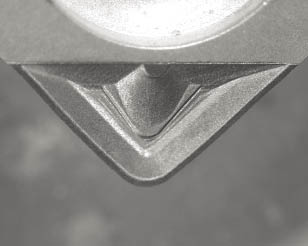
A chipbreaker generated in a PCD insert via laser ablation.
The Spectra’s laser beam remains fixed and the workpiece moves under the light source to achieve tolerances as tight as ±0.010μm. In a typical laser machining operation, the meandering workpiece accelerates at rates exceeding 3 Gs.
Surface finish, or integrity, is also controllable when laser ablating. As previously mentioned, the focus quality and laser power can control the surface finish. However, selecting machining parameters using the Spectra’s software also influences the surface finish. By manipulating the laser power, pulse frequency, pattern and software attributes, a surface finish as fine as 0.2μm Ra can be imparted in PCD and PCBN and as fine as 0.45μm Ra in carbide.
Laser ablation is a relatively new machining process that has the potential to accurately produce 3-D profiles in extremely hard materials, including diamond—the hardest known material. CTE
About the Authors: Richard P. Thalmann is general manager, machines, for Wendt USA Diacraft, Wixom, Mich., and Richard Marshall previously served as general manager, grinding wheels, for Wendt USA. For more information, visit www.wendtgroup.com, call (248) 926-2500 or enter #310 on the IS Form.
Glossary terms in this article
Related

Subscribers can use MFGAxis notes, saves and discussion tools with their innoNET account.


