Choose the proper grinding wheel
Choose the proper grinding wheel
The selection process is often one of trial and error working to optimize the combination of machine, cutting fluid, cutting parameters and grinding wheel.
Grinding is a machining process found at almost all shops. Some grinding operations, such as snagging castings, grinding welds or bench grinding, are relatively simple. Other grinding activities can be complex like those used to hold very close tolerances or machine difficult materials. Grinding has a broad range of applications in manufacturing. As with many procedures, selecting the best tool is critical.
Although the cutting edges are much smaller and arranged in a random order, grinding wheels are cutting tools and perform the same job as endmills, drills and turning tools. Whether snagging castings or grinding gears, wheels are similar.
Abrasives
Grinding wheels are made from several types of abrasive materials, from aluminum oxide — the softest and most common — to diamond, which is the hardest and most expensive. Most wheels are manufactured by mixing the abrasive material with a bonding agent and then placing the mix in a mold to achieve the desired shape.
A vitrified wheel is formed under pressure and then baked at a very high temperature, which turns the bonding materials — for example, clay — to glass, giving strength and rigidity to the wheel. Resinoid-bonded wheels use the same sort of abrasives with a softer resin bond that often is reinforced with other materials like fiberglass to add strength. Resinoid wheels can operate at higher cutting speeds than vitrified wheels and are less likely to fail, with uneven loading making resinoid wheels ideal for use on hand tools or machines, such as chop saws. Vitrified wheels hold their shape better and are stiffer than resin-bonded wheels, making them best suited for close-tolerance work performed on rigid machine tools. Both kinds of wheels can break and fragment during use, but vitrified wheels are more susceptible to catastrophic failure, which is another reason they typically are not used for hand work.
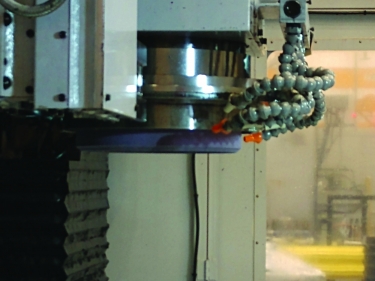
Curvic grinding is performed with a vitrified wheel not much different from the wheel found on a bench grinder. Imagge courtesy of C. Tate
Super-abrasives like diamond and cubic boron nitride are expensive. To reduce the amount of abrasive needed to make a usable wheel, an abrasive is bonded to the periphery of a metallic disc. Diamond and CBN bonds can be vitrified, resinoid or metallic. Metallic-bonded wheels use metal powder, such as cobalt and copper, mixed with an abrasive. Using a process known as sintering, the mixture is formed around the periphery of a wheel. The abrasive and metal powder are baked at a high temperature, causing them to bind together.
Super-abrasive wheels have better performance characteristics but a narrower range of applications as the wheels do not perform well on softer materials. CBN wheels are used most often on hardened ferrous materials and can be found in machines like tool and cutter grinders, camshaft grinders and gear grinders. Compared with Al2O3 wheels, CBN wheels run cooler, last longer and can function at higher speeds. Diamond is used to grind carbides, glass and other extremely hard nonferrous materials. Super-abrasives are more productive but expensive. They frequently cost 10 times more than other types of wheels, and their applications are typically very specific.
Other Factors
Picking the proper wheel is obviously important for grinding operations and can be challenging for even an experienced machinist or engineer. The selection process is often one of trial and error working to optimize the combination of machine, cutting fluid, cutting parameters and grinding wheel.
After the abrasive material and wheel shape, main factors for wheel selection are grit size, bond type and bond hardness. Workpiece material dictates the abrasive, wheel shape and type of bond. Grit size and bond hardness usually are chosen based on surface finish requirements and the hardness of material. Low-volume environments generally use one type of wheel and adjust grinding parameters to succeed as the variation in cycle times and wheel wear is not an issue. High-volume production work like that found in automotive manufacturing requires repeatable performance that can be achieved only with significant development time.
At a previous employer, we had seven centerless grinders, which produced about 2 million parts a year. Grinding wheels were 610 mm (24") in diameter and 508 mm (20") long. It took a full shift to remove an old wheel and mount a new one. This majorly disrupted production, so precisely controlling wheel wear was critical to manage costs and meet production requirements. It was a big blow to us when our wheel manufacturer discontinued the particular wheel we had used for years — we were the sole company using it — and the lone replacement had a harder bond. This seemingly minor change resulted in unpredictable wheel wear and unplanned wheel changes.
Because the new bond was harder, the wheel dulled faster and would cause part geometry to deviate from specifications. The only way to recover was to redevelop the grinding process. Although we had many years of experience and several experts on centerless grinding, it required a few weeks to arrive at the ideal set of grinding parameters.
Choosing a grinding wheel can seem mysterious, and developing grinding parameters is iterative. As with all machining operations, however, experience, knowledge and skilled craftspeople are the key to selecting and using the right grinding wheel.
Grinding Wheel Safety
Grinding wheels can be dangerous. I have worked at two companies where people died as a result of catastrophic wheel failures. Eye and hand injuries are common with abrasive hand tools and bench grinders. It is imperative for everyone using grinding wheels or equipment to be thoroughly trained. Simple tasks like ringing wheels, using blotters, properly torquing wheel flanges, standing and working in safe zones and incorporating appropriate personal protective equipment are critical to maintain a safe environment. The Occupational Safety and Health Administration, the American National Standards Institute, wheel manufacturers and machine builders all have detailed publications that outline safety requirements for grinding wheels and machines.