Choosing wire EDM workholders
Choosing wire EDM workholders
There comes a time when some chipmaking shops add wire EDMing to their repertoire. This is often done to reduce costs, because bringing what were once subcontracted, secondary EDMing operations in-house often makes good financial and logistical sense.
There comes a time when some chipmaking shops add wire EDMing to their repertoire. This is often done to reduce costs, because bringing what were once subcontracted, secondary EDMing operations in-house often makes good financial and logistical sense. It can also be due to demands from medical and aerospace customers, who ask their suppliers to control the entire manufacturing process under one roof. In either case, merging these disparate machining operations can be a workholding challenge.
Substantial differences exist between workholders for conventional CNC machines and those for wire EDMs, starting with the material. Pull a cast iron vise off a machining center and submerge it in a tank of deionized water dielectric and you'll soon have a rusty mess. For this reason, virtually all EDM workholders are made from hardened 400 series stainless steel.

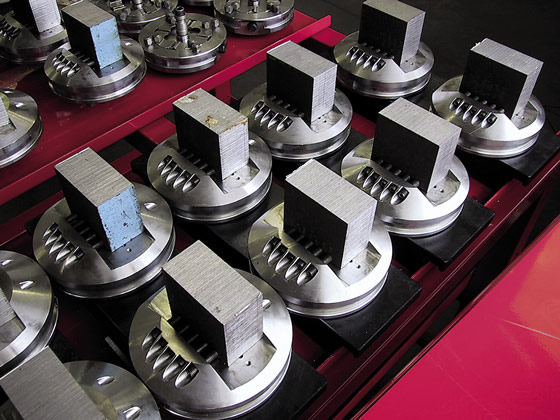
Premachining fixture locations on workpiece blanks can be eliminated with the right EDM workholder. In the example shown, saw-cut blanks are clamped once and gripped until machining is complete. This setup provides a common interface for automated handling while reducing prep time. Image courtesy Erowa.
There are exceptions. For example, some high-end wire machines use oil dielectric, so it might be possible to use a conventional vise in these instances. However, dedicated EDM workholding is often a necessity due to machine considerations.
EDM tooling can seem like alien Tinker Toys to those familiar only with conventional machine tools. Much of the confusion about what to order can be avoided by understanding the terminology.
For example, reference elements are rails that mount on pedestals inside the EDM work area. Together with reference stops, they provide a zero point to locate fixtures and other workholding components. Chucks are available in pneumatic and manually actuated versions and accept pallets that in turn accept workpieces and fixtures. Mounting heads are used as the "middleman " between the chuck and a vise or universal holder. Add to that a plethora of adapters, f rames, blocks and clamping heads, and a phone call to an EDM workholding expert might be in order.
Some of these experts work at System 3R USA LLC, Elk Grove Village, Ill. John Roskos, vice president of sales, said many shops ease into EDM workholding with a starter kit. For example, a basic system containing a vise, mounting head and adapter might cost $2,000, whereas a full-blown package with reference rails and pneumatic clamps could easily cost 10 times that amount.
This might seem expensive to shops that 've used only homegrown fixtures and commodity vises. Before yelling at the salesman, however, consider the accuracy of these systems, which often provide repeatability and positional accuracy to within a few microns.
As Roskos explained, this accuracy greatly exceeds that of traditional zero-point clamping systems (ZPS), which are often used when milling and turning. For shops that clamp workpieces once for multiple machining operations that now include wire EDMing, ZPS are available to survive EDM's watery rigors, while still providing the high clamping forces needed for conventional machining, he said.
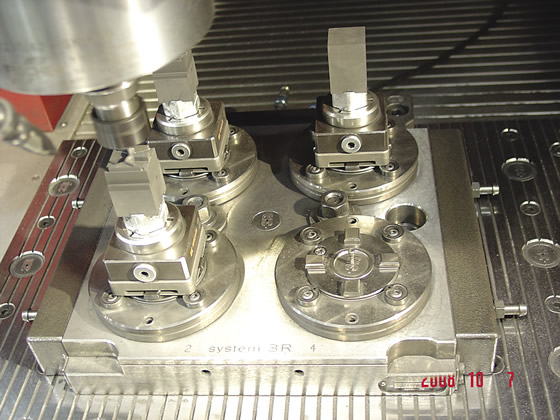
Graphite electrodes are machined while held with quick-change chucks from System 3R. Image courtesy System 3R.
Just because the option exists to palletize workpieces in this manner doesn't mean shops are using it. Mike Stevens, applications and technical support manager for tooling manufacturer Erowa Technology Inc., Arlington Heights, Ill., said palletizing EDM electrodes—which reduces handling and increases locating accuracy—is widely accepted in mold and die shops, but that few companies use the same technology with their workpieces.
"For most shops, picking the right tooling system is a basic concept, but how you attach the workpiece to the pallet or carrier can take some thought," he said. Methods include using bolts, magnets, vises and custom fixtures.
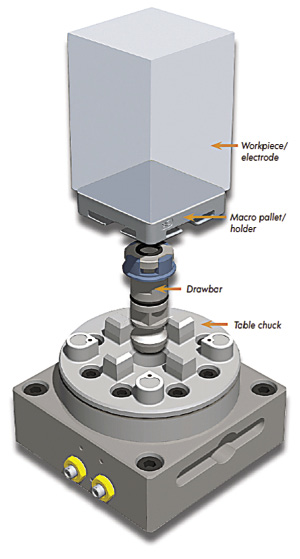
The Nano Precision clamping system from System3R
offers pneumatic clamping, accuracy within 0.001mm
and workpiece weight capacity of up to 50kg.
Image courtesy System 3R.
Stevens pointed out another benefit to workholding standardization and palletization: a common interface to automated part handling systems. When shops get overloaded, he explained, the knee-jerk reaction is to buy and staff another machine. Implementing a workholding system like Erowa 's in combination with a robot allows shops to maximize the productivity of the machines they already own, for a fraction of the cost, Stevens said.
Automation, however, takes a shopwide workholding strategy and substantial tooling investment. Shops willing to embrace such a strategy can realize productivity gains of 80 percent or more, Stevens noted.
Before reaching that level, shops new to wire EDMing must adopt unfamiliar workholding methods. Existing fixtures must be adapted for EDM-style clamping or replaced entirely. Before buying an EDM, budget accordingly. Because of their accuracy and technical sophistication, EDM workholders might cost 10 to 20 percent of the machine purchase price. Despite the costs, wire EDMing can help an old chipmaking dog learn new tricks.