

Consider live tooling when purchasing a machine
When shops purchase new machinery, a common error some make is accepting the standard live tooling package from the builder without considering other options. This is not a criticism of those packages, but end users should do as much evaluation of their processes when determining the proper tooling package as they do when evaluating machine tools.
When shops purchase new machinery, a common error some make is accepting the standard live tooling package from the builder without considering other options. This is not a criticism of those packages, but end users should do as much evaluation of their processes when determining the proper tooling package as they do when evaluating machine tools. This examination can range from the simple, such as external vs. internal coolant, to the sublime, such as adjustable vs. extended tooling configurations, to the truly exotic.
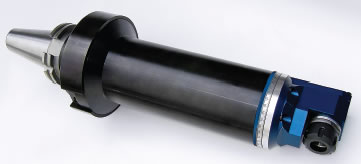
A large, deep-pocket tool, such as this one from Heimatec, might initially seem too expensive, but a machining test can prove otherwise. Image courtesy Heimatec.
Live tooling is driven by the CNC, the spindle turret and powered subspindle config-urations on CNC lathes to perform various operations while the workpiece remains oriented to the main spindle. As opposed to static tools applied when turning, these devices, whether with BMT (base mount tooling) or VDI (German acronym for the Association of German Engineers) connections, are also called driven tools and are usually customized for a particular machine tool builder’s turret assembly.
Live tooling is generally offered in standard straight and 90º con-figurations with various tool output clamping systems, including col-let chuck, arbor, Weldon, Capto, whistle notch, hydraulic, HSK, CAT and ABS.
The types of live tooling appro-priate for shops depend on the jobs they machine. Two seemingly iden-tical job shops can have vastly differ-ent tooling needs because, for ex-ample, one serves the automotive industry and the other serves medical, or one specializes in low-volume work while the other predominantly sees long part runs.
Bearing construction and the re-sulting spindle concentricity drive the life of any live tool. Even in-vesting just 10 to 15 percent more to obtain a better design can sig-nificantly extend cutter life and im-part consistently finer surface fin-ishes. For example, roller bearings are consistently superior to spindle bearings in live tooling applications.
Review the print ads from this magazine to continue
This quick advertiser review unlocks the rest of the article and keeps the full-screen reader focused on the ads instead of the page chrome.
Advertisers included in this article experience
Print placements connected to this article
Kyoceraprecisiontools
NEW INNOVATIONS
in Steel Turning CA5 -Series Grades P -Series Chipbreakers In comparison tests, Kyocera’s new CA5-Series steel turning inserts combined with the PP, PQ, and PG smart chipbreaker lineup have consistently outperformed the competition. Don’t take our word for it…try it for yourself! Contact your local KYOCERA Sales Engineer or.
NEW INNOVATIONS in Steel Turning CA5 -Series Grades P -Series Chipbreakers In comparison tests, Kyocera’s new CA5-Series steel turning inserts combined with the PP, PQ, and PG smart chipbreaker lineup have consistently outperformed the competition. Don’t take our word for it…try it for yourself! Contact your local KYOCERA Sales Engineer or
Visit Kyoceraprecisiontools View this placement in the issue recordPrint ads from this magazine
in Steel Turning CA5 -Series Grades P -Series Chipbreakers In comparison tests, Kyocera’s new CA5-Series steel turning inserts combined with the PP, PQ, and PG smart chipbreaker lineup have consistently outperformed the competition. Don’t take our word for it…try it for yourself! Contact your local KYOCERA Sales Engineer or.
NEW INNOVATIONS in Steel Turning CA5 -Series Grades P -Series Chipbreakers In comparison tests, Kyocera’s new CA5-Series steel turning inserts combined with the PP, PQ, and PG smart chipbreaker lineup have consistently outperformed the competition. Don’t take our word for it…try it for yourself! Contact your local KYOCERA Sales Engineer or
Continue reading
April 2015
Another consideration is whether the turret rpm is sufficient for the work at hand. If not, a speed in-creaser can be used on the tool.
The most often overlooked con-sideration when buying live tooling, however, is the long-term flexibility it provides. The work a shop has currently, the work it is likely to see and the overall costs and benefits of using a changeable adapter system on live tooling are frequently not adequately considered when pur-chasing a machine. Dedicated live tools for large part families may be desirable, but consider a change-able adapter system for low-volume runs that require frequent change-overs and talk to the supplier before making that determination. Like-wise, if the work being bid on in-volves additional product families, think ahead when buying the initial tooling package.
Also, adjustable angle head sys-tems can be costly, but their stabil-ity and rigidity make them worth the price. This is particularly true when producing part families with only slight differences in dimensions.
The following example shows the value of conducting test runs with alternative live tool styles. One com-pany was cross-milling a 6063 alumi-num sheave, using an ER40 output tool on a Eurotech lathe and running at 10 ipm and 4,000 rpm. It was mak-ing three passes and getting a sub-standard, chatter finish on 20,000 pieces per year. Cycle time was 262 seconds. Annual machining cost was more than $130,000. By using an im-proved adapter tool with an ER32AX output and the same parameters, the shop was able to make the part in a single pass, impart a smooth finish and reduce cycle time to 172 seconds. This produced annual sav-ings of $45,000, about 20 times what the tool costs.
In the end, you may not need a +135º/-30 universal adjustable tool, a multispindle live holder or even a quick-change adapter system, but consider the options. Talk to the machine builder, several tool suppli-ers, and especially the most important people in this equation—your shop personnel.
Related


Subscribers can use MFGAxis notes, saves and discussion tools with their innoNET account.


