

Considerations when selecting a drill
I consider several factors when purchasing a drill and try to find the balance between price and performance that gives the best cost advantage while maintaining part quality and productivity, reports the Shop Technology columnist in the October 2013 issue of Cutting Tool Engineering.
The variety of drills on the market seems limitless, and each salesman says he has an offering that is better than the rest. The substrates, point geometries and coatings vary greatly—along with the price. I consider several factors when purchasing a drill and try to find the balance between price and performance that gives the best cost advantage while maintaining part quality and productivity.
The first consideration is the number of holes to be produced. A common misconception is that carbide is always the best substrate choice. An expensive, high-performance carbide drill may provide the highest penetration rate and shortest cycle time. However, if the number of holes being drilled is low, there may be a cost advantage to applying a less-expensive alternative, such as a HSS drill, because the tool cost savings can trump the increased cycle time.
Courtesy of All images courtesy C. Tate
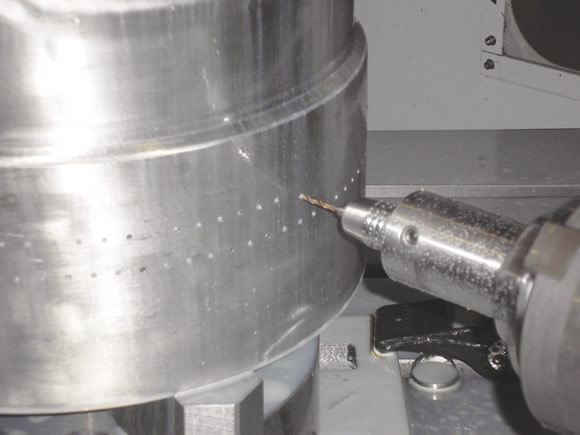
Savannah Machinery Works found that a Walter Titex 3mm (0.12 “) drill provides superior performance and long tool life when cutting Hastelloy X. The point geometry allows drilling on the part radius without using a spot drill.
Also consider hole size. Carbide drills above ½ ” (12mm) in diameter are expensive, and indexable-insert drills have limited selection in sizes below 5/8 ” (16mm). Therefore, a HSS drill might be better for making holes from ½ ” to 1 “. On the other hand, an indexable drill may be more practical than a HSS or carbide drill for producing holes larger than 1 “.
Because high-performance carbide drills can hold tight size and geometric tolerances, I have opted for them when they eliminate a secondary operation, such as reaming. In addition, an indexable drill can be applied like a boring bar on a lathe. After drilling the hole, the indexable drill is stepped off center so the periphery insert enlarges the hole to the desired diameter, possibly eliminating the need for a boring tool.
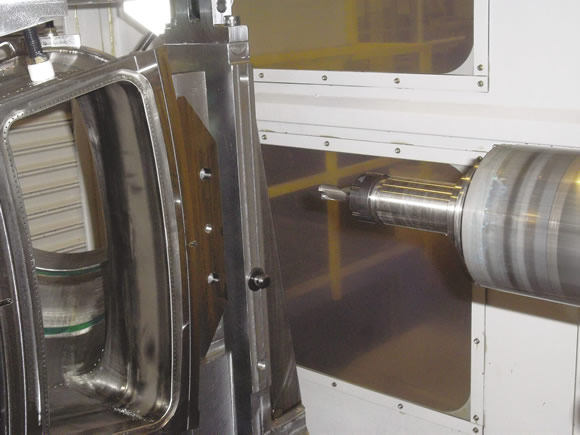
This Sandvik Coromant 17mm (0.67 “) indexable-insert drill is more cost-effective than a solid-carbide drill for producing a low number of holes in a Hastelloy X bracket, according to Savannah Machinery Works. HSS is not capable of drilling the material without risking catastrophic failure.
Besides reducing the number of tools by combining operations, reducing setup is a common goal when machining. If a drill can be used on a variety of parts, selecting an expensive, high-performance drill to extend tool life and minimize tool changes generally cuts costs. It may be possible to produce various hole sizes by drilling one size and circular interpolating with an endmill to enlarge holes that are larger than the drill diameter all in one setup.
Review the print ads from this magazine to continue
This quick advertiser review unlocks the rest of the article and keeps the full-screen reader focused on the ads instead of the page chrome.
Advertisers included in this article experience
Print placements connected to this article
PI411 please contact us directly at [email protected]
a New Generation
of PVD Coatings QUADCoatings4® The PI411 is the largest member of our "11" machine series and is designed for companies that wish to produce high-performance coatings with high productivity and round-the-clock production. Important features include Easy Tool Loading, the ability to coat 504 cutters with 10mm diameter in 3.5 hours.
a New Generation of PVD Coatings QUADCoatings4® The PI411 is the largest member of our "11" machine series and is designed for companies that wish to produce high-performance coatings with high productivity and round-the-clock production. Important features include Easy Tool Loading, the ability to coat 504 cutters with 10mm diameter in 3.5 hours and the especially ingenious, strong adhesion procedure, the so-called LGD Visit us at etching, while even tolerant of cleaning errors. For more information on the PI411 please contact us directly at [email protected]
Visit PI411 please contact us directly at [email protected] View this placement in the issue recordPrint ads from this magazine
of PVD Coatings QUADCoatings4® The PI411 is the largest member of our "11" machine series and is designed for companies that wish to produce high-performance coatings with high productivity and round-the-clock production. Important features include Easy Tool Loading, the ability to coat 504 cutters with 10mm diameter in 3.5 hours.
a New Generation of PVD Coatings QUADCoatings4® The PI411 is the largest member of our "11" machine series and is designed for companies that wish to produce high-performance coatings with high productivity and round-the-clock production. Important features include Easy Tool Loading, the ability to coat 504 cutters with 10mm diameter in 3.5 hours and the especially ingenious, strong adhesion procedure, the so-called LGD Visit us at etching, while even tolerant of cleaning errors. For more information on the PI411 please contact us directly at [email protected]
Continue reading
October 2013
Workpiece material is another consideration. A basic HSS drill performs well in carbon steel but tool life is poor when drilling abrasive materials like cast iron or die cast aluminum, justifying a costlier alternative like carbide. And P/M HSS drills effectively cut austenitic (300 series) stainless steels and similar materials. In these materials, P/M drills often have penetration rates similar to carbide and cost significantly less.
Matching the drill to the machine tool is yet another consideration. High-performance drills require rigid machine tools that have spindles with minimal runout. Vibration from loose ways and excessive spindle runout can damage the fragile edges of carbide drills, causing premature failure. Large-diameter drills, especially large indexable drills, may require more torque than the spindles of some light-duty machines can supply. This scenario may require drilling smaller-than-specified holes and enlarging them via circular interpolation or boring.
Toolholders play a critical role in drill performance. The toolholder is the interface between the drill and the spindle, so it is important to balance this relationship. Low-quality toolholders can allow drills to run out, which reduces geometric accuracy and tool life. If the holder’s grip is insufficient, the drill can slip. This causes incorrect hole depth, putting other tools at risk of failure when they enter holes that are too shallow. Insufficient grip can also allow chatter, damaging the cutting edges on carbide drills and ultimately causing catastrophic failure. The best machine tool is only as good as the toolholder in its spindle.
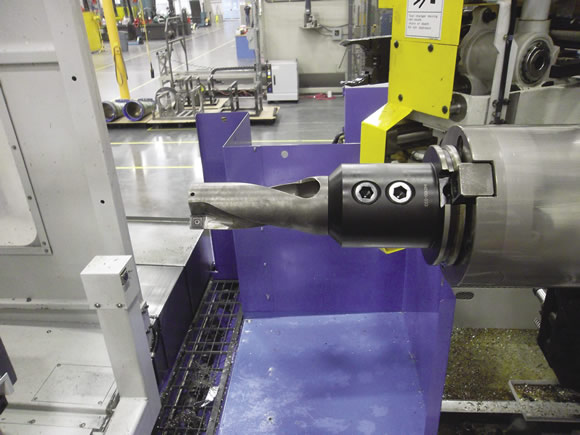
A Sandvik Coromant 38mm (1.50 “) indexable-insert drill is a good choice for producing holes in Hastelloy X, according to Savannah Machinery Works. The holes could have been drilled with a smaller drill, such as the 17mm one, and enlarged via circular interpolation or boring, but the shorter cycle time for drilling with the larger indexable tool justifies the expense of these drills. Also, the machines that use the larger drills are dedicated to one part family at SMW, so increasing flexibility is not necessary.
Finally, consider the machining environment and a shop’s practices. If the machinists, toolmakers and programmers are accustomed to using a particular type of drill, it may not be practical to introduce alternatives. For example, I tried to introduce high-performance carbide drills at a machine shop where I used to work. HSS jobber drills had been the standard. The operators applying the HSS tools were accustomed to running them at speeds many times slower than the speeds at which carbide drills can run. I was unable to change the culture, so there was no benefit to using costlier, high-performance carbide drills.
Jobs, work materials and production requirements vary greatly and there is no one definitive method for selecting the proper drill. The correct drill is the one that enables a high-quality part to be profitably shipped on time. CTE
About the Author: Christopher Tate is manufacturing engineering lead for machining at Mitsubishi Power Systems, Savannah (Ga.) Machinery Works, a global builder of gas and steam turbines. He has 19 years of experience in the metalworking industry and holds a Master of Science and Bachelor of Science from Mississippi State University. E-mail: chris23state@gmail.com.
Glossary terms in this article
Related



 MFGAxis Discussion
Be part of the shop-floor conversation
Like, save, or comment on this CTE story.
MFGAxis Discussion
Be part of the shop-floor conversation
Like, save, or comment on this CTE story.


MFGAxis Discussion