


Cranking up feed rates: General Industry Coverage
I use resin- and metal-bond diamond wheels and used to manually stick them. Now our machine does it automatically and I don't have the "feel" to determine if the wheel is being stuck hard enough. Is there a way to know how fast I should stick?
Dear Doc: I use resin- and metal-bond diamond wheels and used to manually stick them. Now our machine does it automatically and I don’t have the “feel” to determine if the wheel is being stuck hard enough. Is there a way to know how fast I should stick?
The Doc Replies: For some reason, companies that were sticking aggressively suddenly stick timidly when they switch to auto-sticking. Here’s a ballpark equation to calculate how fast to stick:
Sticking aggressiveness = 76,000 × sticking velocity (ipm) ÷ wheel speed (sfm)
Aim for a sticking-aggressiveness value around 250.
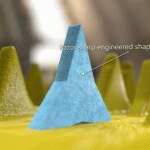
Finding an effective grit-penetration depth is critical to successful plunge grinding. If it’s too large, you’ll rip the wheel apart; if it’s too small, you’ll burn the workpiece. Illustration courtesy J. Badger.
Let’s say you’re sticking at 1.0 ipm on a wheel running at 3,000 sfm. That gives a sticking aggressiveness of 25.3 (76,000 × 1.0 ÷ 3,000). That’s a timid stick. To get in the ballpark of 250, increase sticking velocity to 9.0 ipm. This gives a sticking aggressiveness of 228—an aggressive stick.
Finally, an effective way to see if you’re sticking correctly is to monitor grinding power. If the power doubles because of wheel loading, a good stick should drop the power close to its original value. On the other hand, a timid stick will only drop it 10 percent.
Dear Doc: I cylindrical plunge grind ODs in tungsten carbide, but every time I increase the feed rate, something bad happens. What can I do?
View print ads from this spread
Review the ads on this magazine spread to continue reading. Each ad takes two seconds; a two-page ad counts once.
Advertisers on this magazine spread
Print placements on this magazine spread
United Grinding
The new benchmark
S41 for Swiss precision. 510 Earl Blvd. Miamisburg, OH 45342.
S41 The new benchmark for Swiss precision. United Grinding 510 Earl Blvd. Miamisburg, OH 45342 937.859.1975 Booth #N-6800 www.grinding.com
Visit United Grinding View this placement in the issue recordPrint ads from this magazine
S41 for Swiss precision. 510 Earl Blvd. Miamisburg, OH 45342.
S41 The new benchmark for Swiss precision. United Grinding 510 Earl Blvd. Miamisburg, OH 45342 937.859.1975 Booth #N-6800 www.grinding.com
Continue reading
June 2012
The Doc Replies: You want to focus on the grit-penetration depth. The equation for grit-penetration depth is complicated, but for a given wheel diameter and workpiece diameter, keep the grit-penetration-depth parameter (GPDP) constant.
GPDP = √plunge feed velocity × √workpiece rpm ÷ wheel speed
Use whatever units you want, as long as you’re consistent, and pay close attention to the two—not three—square-root signs.
Let’s say you’re plunging into a workpiece at 0.040 ipm, with a workpiece speed of 200 rpm and a wheel speed of 5,000 sfm. That gives a GPDP of 0.000566 (√0.040 × √200 ÷ 5,000). If you double the feed rate, to 0.080 ipm, then decrease the workpiece rpm to 145 and increase wheel speed to 6,000 sfm. That will give you a GPDP of 0.000568. That’s close enough, and the wheel will behave more or less the same.
Try it. You’ll be amazed at how high you can crank things up. Just remember, though, there are limitations to how high you can go. I’ve pushed my luck a few times and blown up wheels. But then I back off a little and successfully plunge grind at a much higher feed rate. CTE
About the Author: Dr. Jeffrey Badger is an independent grinding consultant. His Web site is www.TheGrindingDoc.com. He’ll be giving a course focused on effectively grinding tungsten carbide Nov. 6-8 at Rollomatic’s facility in Mundelein, Ill.
Related

Subscribers can use MFGAxis notes, saves and discussion tools with their innoNET account.