


Cranking out savings: General Industry Coverage
Productive Times on Tulsa Machine Works Inc., 918-834-0911. Challenge: Reduce tooling costs when milling crankshafts. Solution: Tool repair and modification services. Solution Provider: Carbide Tool Services Inc., 800-243-9577, www.carbidetool.com.
—————
on Tulsa Machine Works Inc., 918-834-0911. Challenge: Reduce tooling costs when milling crankshafts. Solution: Tool repair and modification services. Solution Provider: Carbide Tool Services Inc., 800-243-9577, www.carbidetool.com.
—————-
Machining a crankshaft’s complex features and obtuse angles from solid bar stock is a metalworking challenge. Tulsa (Okla.) Machine Works routinely handles that challenge, producing a variety of crankshafts for pumps used in the petroleum industry. The tempered 4340 steel crankshafts are as large as 74 ” long and 19 ” in diameter and have as many as five throws.
Courtesy of Carbide Tool Services
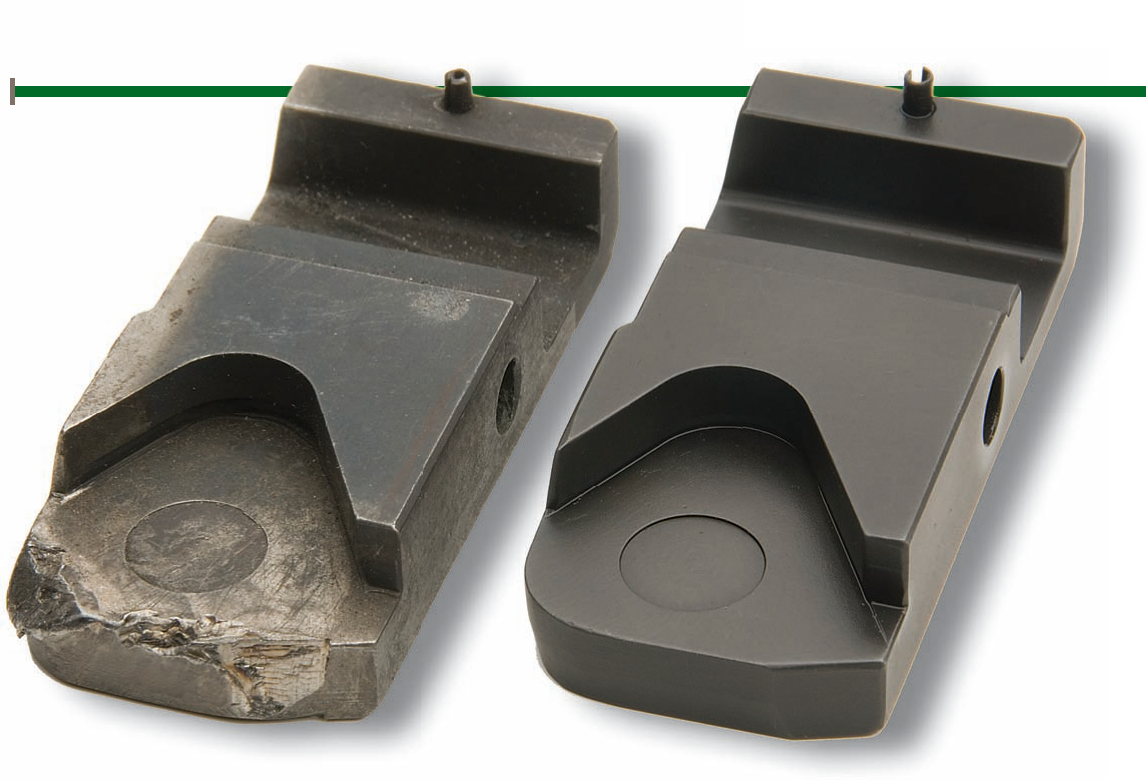
Carbide Tool Services re-engineered and repaired damaged toolholding cartridges for Tulsa Machine Works at a fraction of the replacement cost. In addition, the cartridges’ top clamps received a chromium-nitride coating to minimize wear caused by chip flow.
Tulsa Machine performs the milling on a specialized CNC milling machine from American GFM. In the crankshaft milling process, the workpiece is stationary and a milling cutter with teeth on its ID orbits around the part to cut the features. In Tulsa Machine’s mill, the cutter is assembled from 56 segments, each of which supports a cartridge that holds a custom-geometry, coated carbide insert. New cartridges cost about $300 each, so replacing them when they wear represents a significant expense.
Seeking to control tooling costs, Tulsa Machine contacted Carbide Tool Services Inc., Anoka, Minn., which specializes in the repair of damaged indexable tooling, to determine if repairing the cartridges was a cost-effective alternative to replacement. According to Pat Hjelm, Carbide Tool Services’ cutting tool specialist, about 75 percent of the company’s business consists of repairing complex pocketed tools with tight tolerances. The company also provides engineering services for the design of new tools and for tool modifications.
To rebuild a worn or damaged tool, Carbide Tool Services uses a new insert as a gage and builds the tool pocket with proprietary weld materials. The pockets are then remachined, recalibrated and inspected.
During the repair process for Tulsa Machine’s tooling, Carbide Tool Services analyzed the causes of cartridge wear and made recommendations regarding ways to modify the cartridges to improve wear performance. “There was some interference with the cartridge on the workpiece,” Hjelm said. “That’s when we decided to take a look at altering the cartridges themselves. We came up with the idea to add an extra 10° of side and end clearance to the cartridges. That would allow the tools to cut with no possibility of rubbing on the workpiece.”
Further modifications involved the cartridge’s top clamps. “The chips that were coming off the workpiece were hard and abrasive and were starting to chew right through the steel clamp,” Hjelm said.
To reduce the wear caused by chip wash, Carbide Tool Services recommended that a chromium-nitride coating be applied to the clamp. Preparation of the clamp was critical for the coating to be successful. “We polished and blasted the clamp before we did the coating,” Hjelm said. “The smoother we can get that surface, the more evenly the coating will go on.” In addition to providing a higher degree of wear resistance, the coating served to smooth chip flow and lessen the tendency of chips to stick to the clamp and holder.
The per-cartridge repair cost of $95 represented a substantial savings. “We’ve run the repaired cartridges for about 6 months now, and they are holding up real well,” said Forrest Rogers, president of Tulsa Machine.
In addition to saving tooling replacement costs, tool repair can also save time. For complex custom tools, “We can turn a repair around in a day, while it might take 10 to 12 weeks to get a new tool built,” Hjelm said. He noted that in hard economic times, Carbide Tool Services’ business actually grows, “because everyone is looking for cost savings.”
Glossary terms in this article
Related



Subscribers can use MFGAxis notes, saves and discussion tools with their innoNET account.