

Crib Sheet: General Industry Coverage
Managing tools should be no big deal. Each machinist simply calls his favorite sales rep, orders a pack of whatever insert or endmill sounds right for the job and stashes it in the bottom of his toolbox until needed. That's how it was done when I stood in front of a machine.
Managing tools should be no big deal. Each machinist simply calls his favorite sales rep, orders a pack of whatever insert or endmill sounds right for the job and stashes it in the bottom of his toolbox until needed. That’s how it was done when I stood in front of a machine.
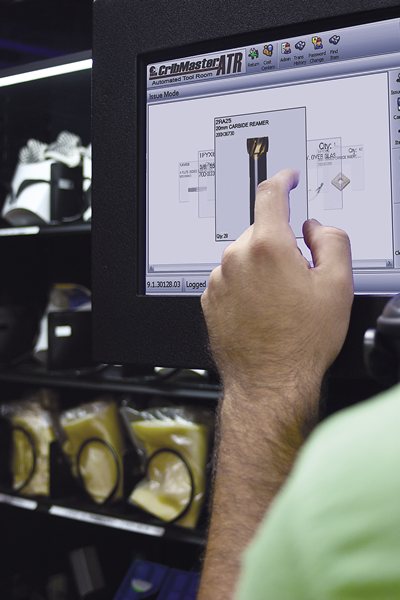
Image courtesy CribMaster.
The problem was, we eventually had hundreds of tooling brands, grades and geometries floating around the shop. When a job repeated, delivery was often dependent on how well the machinist managed his mini-inventory, whether the tool was still available and whether the job had to be reprogrammed because tools were replaced.
It was a tool-hoarding free-for-all—error-prone and costly.
Cribs Aren’t for Babies
Tooling is a sizable investment for any shop and should be treated as such. Without a secure and predictable toolcrib, one stocked with known quantities of cutters, inserts, holders, collets and hardware, machining processes will not run smoothly.
To do it right, each item number in the toolcrib should be accompanied by documented feeds and speeds, tool and assembly dimensions, supplier data, inventory levels and tool life management data. That’s a lot of stuff to keep track of. Fortunately, tool management systems (TMS) are available to organize the massive amounts of information needed for efficient tool usage.
While a good-sized shop could easily buy a new lathe or machining center for the cost of a high-end TMS package, management would do well to look beyond price and consider what TMS brings to the table.
Dan Speidel, sales director for tool data management software developer TDM Systems Inc., Schaumburg, Ill., said the inefficiencies and duplication of data without TMS may easily cost more than the software itself, but added that such systems are often a tough sell. “TMS isn’t like a machine that actually produces something,” he said. “But without it, companies are left with silos of information and tribal knowledge to run the shop floor.”
Speidel offered the example of a shop that managed its tool data in a homegrown, Excel-based system. Because such systems are typically poor at data validation, accuracy is often suspect, making the search for tooling part numbers difficult. Shop employees often found it easier to simply enter a new number when looking for a tool. After moving to a centralized TMS database, the company soon discovered some tooling part numbers had been entered 200 times. Tools that were in stock under one number were being reordered under another, often with expedited shipping costs. In some cases, there was sufficient inventory to last several years.
TMS can eliminate this problem, Speidel explained, often reducing tooling costs by 30 percent or more. It brings all relevant tool data to a single location—the TMS database—that everyone in the company can access.
Opening Doors
TMS does more than lower inventory costs. The transparency of information gained minimizes the time lost searching for tools and keying in data, in turn increasing the amount of time people can spend doing value-added work.
Kevin Duncalf, product manager of Tool Management vending systems for cutting tool manufacturer Guhring Inc., Brookfield, Wis., said TMS provides far greater control than manual tool management, eliminating errors and reducing tool consumption. One example of this is a Guhring customer with more than 3,000 tools in its database. After implementing Guhring’s software for managing tools, operators are able to login and tell the system what tool number or job they are working on and let the software do the rest.
“Instead of having to sort through thousands of items to find what they need, only the ones assigned to that particular job appear,” Duncalf said. “There’s no more head scratching, trying to figure out what they need. It’s a fast, user-friendly transaction that removes the chance of somebody taking the wrong insert or cutting tool. Everything they need is right there.”
Review the print ads from this magazine to continue
This quick advertiser review unlocks the rest of the article and keeps the full-screen reader focused on the ads instead of the page chrome.
Advertisers included in this article experience
Print placements connected to this article
Rollomaticusa
challenge
Your Our solution Technological advance through innovations Rollomatic will exhibit 6 models for the efficient and reliable production of high-end cutting tools, including a laser machine for economical manufacturing of PCD/CVD-D cutting tools with highest quality demands for the IT, aerospace, automotive and medical industries. In addition, the latest development of the Kawada.
Your challenge Our solution Technological advance through innovations Rollomatic will exhibit 6 models for the efficient and reliable production of high-end cutting tools, including a laser machine for economical manufacturing of PCD/CVD-D cutting tools with highest quality demands for the IT, aerospace, automotive and medical industries. In addition, the latest development of the Kawada Nextage Humanoid Robot to economize your tool production will be on display during the EMO 2015. Please visit our booth at Hall 14, Booth M16
Visit Rollomaticusa View this placement in the issue recordPrint ads from this magazine
Your Our solution Technological advance through innovations Rollomatic will exhibit 6 models for the efficient and reliable production of high-end cutting tools, including a laser machine for economical manufacturing of PCD/CVD-D cutting tools with highest quality demands for the IT, aerospace, automotive and medical industries. In addition, the latest development of the Kawada.
Your challenge Our solution Technological advance through innovations Rollomatic will exhibit 6 models for the efficient and reliable production of high-end cutting tools, including a laser machine for economical manufacturing of PCD/CVD-D cutting tools with highest quality demands for the IT, aerospace, automotive and medical industries. In addition, the latest development of the Kawada Nextage Humanoid Robot to economize your tool production will be on display during the EMO 2015. Please visit our booth at Hall 14, Booth M16
Continue reading
August 2015
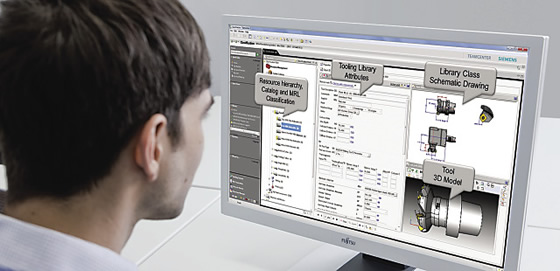
The single Teamcenter manufacturing data structure can manage tool definition, inventory and usage across the entire manufacturing process, from selection in the engineering office through deployment and use in the shop. Image courtesy Siemens.
Most of Guhring’s TMS installations are bundled with an automated dispensing system, such as a vending machine or electronically controlled tool cabinet, which opens the correct drawers or deposits the necessary tools based on operator input. This allows for cost allocations against specific jobs, people or departments, and simplifies expense tracking. “It gives customers the ability to know over the last 12 months, for example, consumption reports for a particular part or how many tools were used for a given job,” Duncalf pointed out. “The software offers complete transparency of every tool movement.”
Tracking tool usage in this manner also opens the door to other improvements. When tooling costs are a known factor, fine-tuning becomes a matter of targeting tools that cost the most per part and working with suppliers to deliver more efficient or cost-effective alternatives for that particular application. Duncalf said many customers begin with cutting tools, but soon configure their TMS to include every item in the shop, down to shop rags, gloves and the exit sign that hangs next to the loading door.
TMS also benefits the management of used cutting tools. “Everybody knows the age-old saying that machinists don’t like regrinds,” Duncalf said. “We avoid the situation where new cutting tools are used in favor of regrinds by telling the software to always dispense a reconditioned tool first, assuming one is available.”
TMS can also be configured to ask for the return of a used cutter before a new one is dispensed and prompt operators to enter the number of pieces produced by that tool, thus providing important usage and efficiency information. Of course, each shop can determine its own rules, Duncalf added, and security settings based on a user’s authority level. Also, email or text message alerts can be configured to indicate if tool usage expectations are exceeded or stocking levels fall below a certain threshold.
Mastering the Crib
Properly implemented, TMS not only improves cost control but also promotes standardization and accountability. John Johnson, strategic accounts manager for CribMaster, Marietta, Ga., a Stanley brand and provider of inventory management systems, said TMS forces shops to think about what they’re buying. “The fact that people now have to consider what goes into the system, whether it will fit in a vending machine, where it will be used, leads to significant inventory reduction right off the bat, typically 25 to 35 percent.”
Another benefit of TMS is the elimination of hoarding. “In shops without TMS, machinists go to the crib or cabinet to discover that the tools they need are missing,” Johnson said. “You can be sure the next time those tools come in, they’ll grab a handful and stick them in their toolbox. Because of this, many shops don’t order cutting tools and other supplies for months after installing TMS. It takes that long for everyone to burn through what they had stashed in their toolboxes.”
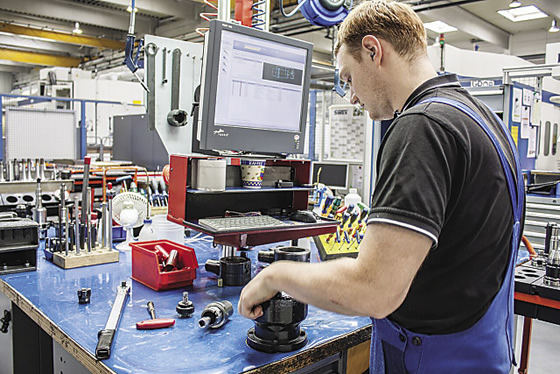
A machine operator assembles tooling based on instructions from a TMS terminal. Image courtesy TDM Systems.
TMS can also be linked to ERP (enterprise resource planning) or PLM (product lifecycle management) software systems, Johnson explained. This provides an important link between the shop floor and the front office, and brings visibility to calibration schedules, dimensional data and other details often overlooked by non-TMS software.
Siemens PLM Software Inc., Plano, Texas, makes one such linkage, connecting its NX CAD software directly to the company’s Teamcenter data and process management software. Aaron Frankel, senior director of product marketing, said a good TMS should provide a central location for every piece of information the shop floor needs to produce parts. “It’s important in today’s manufacturing environment to digitize the entire process, from product design all the way to production, connecting all of the different steps, people, applications and departments, and enabling them to be more efficient while making fewer errors.”
According to Frankel, failing to implement such systems leaves money on the table. “One of our customers is a large tool manufacturer,” he said. “They wanted to understand how to manage their tools more effectively, by analyzing the cutting tools on every machine on the shop floor. They were wasting around $25,000 annually per machine due to inefficient tool use.”
Frankel hints at a world far bigger than tracking a few wandering inserts. Tomorrow’s shop floor will be fully integrated, with centralized systems that talk to the toolcrib, the machine tools and the CAD/CAM and ERP systems. It will automatically present the operator with digital work instructions and collect production and quality information. Tool dimensions and machining parameters will be pulled from the cloud, giving the CAM system information about how to best program the part and the presetter data about which tools need setting and the size to expect. When a tool is in the cut, this super-TMS will query the machine tool’s servo and spindle motors, adjusting feed rates and replacing tools based on feedback from those systems.
As it turns out, much of that world is available today. Manufacturing operations management (MOM) is the big sister to TMS, and Siemens actively promotes its development. Granted, MOM might be overkill for many manufacturers, but Frankel said even the smallest of shops can ease into TMS, beginning with basic organization of tool data and expanding from there. CTE
About the Author: Kip Hanson is contributing editor for CTE. Contact him at (520) 548-7328 or khanson@jwr.com.
Glossary terms in this article
Related




Subscribers can use MFGAxis notes, saves and discussion tools with their innoNET account.


