A custom grind: Drilling Performance
Sam Yu, president and owner of Corona, Calif.-based Machine Control Technologies Inc., said he builds specialty tool and cutter grinders in months—and at a fraction the price of competitors' custom grinders.
Machine Control Technologies’ Sam Yu on making custom tool and cutter grinders.
Custom machine tools can cost millions of dollars and have long development times. Sam Yu, president and owner of Corona, Calif.-based Machine Control Technologies Inc., said he builds specialty tool and cutter grinders in months—and at a fraction the price of competitors’ custom grinders. And, he’ll even come out and train customers on how to operate their new machines.
In an interview conducted by CTE Contributing Editor Kip Hanson, Yu talked about his career before and after he began building grinding machines.
Cutting Tool Engineering: You didn’t start out to be a machine builder. What is your background?
Sam Yu: I studied electronics and computer engineering at the California State Polytechnic University, Pomona, during the early 1980s. After graduating, I was hired by a company in Irvine, Calif.—HiLevel Technology—and helped develop bit-slice processor development systems, which were used to build large parallel-processing CPUs from off-the-shelf components. They were considered to be the most-advanced systems of their kind at that time. While there, I also invented an access time tester for checking to see how fast memory and logic chips can process information.
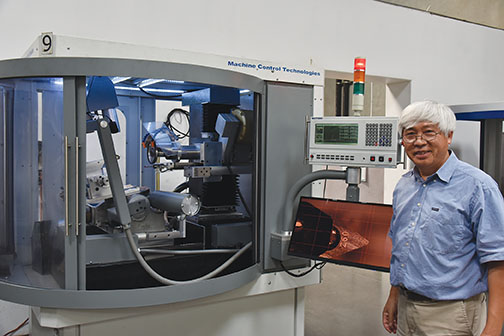
Sam Yu stands in front of one of the 200-plus custom tool and cutter grinders his company has built.
Image courtesy of K. Hanson
CTE: When did you go into business for yourself?
Yu: I always found bit-slice processors inconvenient to use. They are hardware-intensive and generate a type of cascading signal that most software applications don’t need. I created my own microprocessor development system—an alternative to bit-slicing technology—and in 1985 I started my own company, Yu Instruments, to manufacture microprocessor development systems for R&D companies. The problem was there were not many R&D companies and most didn’t need more than a single system, so there wasn’t much demand. I took a job with Hughes Aircraft to make ends meet. I would write test software for the F-16 and different missile systems during the day and continue my microprocessor equipment work in my garage at night.
Review the print ads from this magazine to continue
This quick advertiser review unlocks the rest of the article and keeps the full-screen reader focused on the ads instead of the page chrome.
Advertisers included in this article experience
Print placements connected to this article
Ntkcuttingtools
Patented
Are you machining Inconel at 1600 SFM? JX1 Grade JP2 Grade •Rough (no scale) & semi-finish •High speed finishing •Cut HRSA @ 1600 SFM •Cut HRSA @ 1700 SFM •Longer tool life vs. whisker •10 – 15 x speed vs. carbides •Produces mirror surface finish •Multi-tipped brazed inserts •Produces mirror surface finish.
Patented Are you machining Inconel at 1600 SFM? JX1 Grade JP2 Grade •Rough (no scale) & semi-finish •High speed finishing •Cut HRSA @ 1600 SFM •Cut HRSA @ 1700 SFM •Longer tool life vs. whisker •10 – 15 x speed vs. carbides •Produces mirror surface finish •Multi-tipped brazed inserts •Produces mirror surface finish Wixom, MI | Toll free: 866-900-9800 | [email protected] | WWW.ntkcuttingtools.com
Visit Ntkcuttingtools View this placement in the issue recordPrint ads from this magazine
Are you machining Inconel at 1600 SFM? JX1 Grade JP2 Grade •Rough (no scale) & semi-finish •High speed finishing •Cut HRSA @ 1600 SFM •Cut HRSA @ 1700 SFM •Longer tool life vs. whisker •10 – 15 x speed vs. carbides •Produces mirror surface finish •Multi-tipped brazed inserts •Produces mirror surface finish.
Patented Are you machining Inconel at 1600 SFM? JX1 Grade JP2 Grade •Rough (no scale) & semi-finish •High speed finishing •Cut HRSA @ 1600 SFM •Cut HRSA @ 1700 SFM •Longer tool life vs. whisker •10 – 15 x speed vs. carbides •Produces mirror surface finish •Multi-tipped brazed inserts •Produces mirror surface finish Wixom, MI | Toll free: 866-900-9800 | [email protected] | WWW.ntkcuttingtools.com
Continue reading
January 2017
CTE: Rumor has it you once fixed a glitch on a rocket-guidance system for Hughes Aircraft.
Yu: During my work with Hughes Aircraft, besides writing software for testing the F-16 control board, I was solving problems for the TOW missile simulator that they couldn’t correct. The rocket-guidance system had an errant signal in one of the cable bundles, which was created by cross talk. I cut a wire and it disappeared. After 2 years, at the end of the project, there was nothing else challenging me, so I decided to tell my boss that I was going to move forward with my own company, but my boss enticed me to stay by challenging me with the next project. At the time, Raytheon and Hughes were working on a laser-guided bomb, but they couldn’t get it to work. They even brought in some engineers from Israel to help. The project was around 2 years overdue by the time my boss suggested I take a look, even though I was scheduled to go on vacation the following week. I found the problem a few days later. It was a processor setup condition error. Sometime after that project, I decided it was time to work on my own company. I left Hughes not long after that.
CTE: How did you get involved in machine building?
Yu: Yu Instruments, by then, was selling more microprocessor development systems out of my garage. One time, a salesman recommended me for a job assisting Rockwell International in Fullerton, Calif. They were having problems with their 68000 microprocessor-based system used in a warship. I used my 68000 microprocessor to plug into their system and found their system was trapped in a dead loop, which they had no way of finding. The next day, they bought three systems from Yu Instruments. In addition, the Department of Defense heard about my projects and purchased [some of my] equipment. But besides the defense projects, there just weren’t enough people who understood what the systems could do for them. So I decided to build a target system to demonstrate its capabilities, a simple CNC that I mounted on a drilling machine. It turned out that people were more interested in the CNC than they were in my microprocessor equipment. Eventually, I said, “OK, I’m going to make CNCs.” I placed an ad in a local magazine, took a few orders, but people started asking me to make machines for them as well. I built a CNC lathe and a mill, then someone asked if I could make a tool and cutter grinder, one where an operator without any knowledge of complex tool geometry could answer a few questions about tool length and diameter, flute depth, helix angle and so on. So I wrote a conversational software program that could automatically generate CNC code for tool grinding and put it into my control. That’s when I finally said, “OK, I’ll just make tool and cutter grinders.”
CTE: What’s the advantage of a custom grinder?
Yu: We do make standard models, but most everything we sell has been modified in some way for a specific application—grinding a certain insert shape or resharpening cutters for high-production shops. Cost, however, is a big factor. Our machines are far less expensive than other commercial machines and come equipped with in-process gaging, automated part handling—whatever you need to get the job done. Second, everything is made here in the United States. I’m pretty sure we’re the only domestic manufacturer of multiple models of 5- to 8-axis CNC tool and cutter grinders. If you have a question or a problem, you know exactly who to call.
CTE: What does the future hold for Machine Control Technologies?
Yu: I enjoy solving customer problems. Since it’s my CNC, I can design anything I want. It’s a single system. I control the whole machine—all of the automation, software and gaging. This gives me a lot of flexibility. Also, I continue to improve the products and find new ways to accomplish tasks. I’ve been in business 32 years now, and I’ve always found that when people can’t do it or they don’t want to do it, then they come to me. That’s what’s made the company successful.