CVD Diamond for Everyone
CVD Diamond for Everyone
It took years to perfect, but manufacturers finally found a way to economically coat carbide inserts with a diamond film. This article describes the coating process and looks at that companies that are offering diamond-coated tools, the companies that are coating tools for other manufacturers and the companies that are supplying coating equipment. Thick-film diamond is also discussed.
It was a long time coming, but all those promises about CVD diamond-coated carbide tools are finally being fulfilled. And just about every carbide toolmaker in the United States is after a piece of the action.
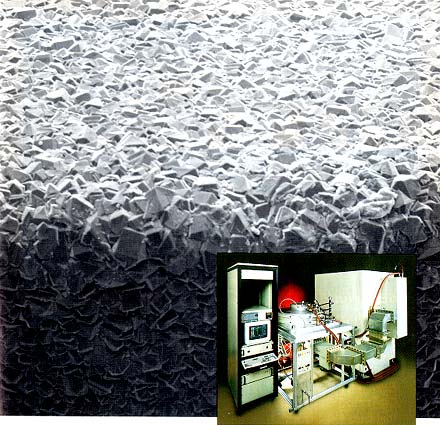 | |
| Figure 1: The surface of a CVD diamond-coated carbide insert, magnified 219 times. | Figure 2: This commercially available turnkey microwave reactor from ASTeX is designed to deposit diamond film on cutting tool inserts. |
At the 1994 International Manufacturing Technology Show in Chicago last September, four tool companies—Crystallume, Menlo Park, CA; Sandvik Coromant Co., Fair Lawn, NJ; Kennametal Inc., Latrobe, PA; and Teledyne Advanced Materials-Cutting Tools, La Vergne, TN—displayed CVD diamond-coated carbide inserts. Statements from other big firms such as Valenite Inc., Madison Heights, MI; Mitsubishi Materials Corp., Garden Grove, CA; and Carboloy Inc., Detroit indicated that they too would soon be offering CVD diamond carbide tools.
The good news for end users is that they now have the happy problem of deciding when to use PCD tools and when to use CVD diamond-coated carbide tools. Let's examine how CVD diamond coating works and why it is such an important advancement in coating technology.
How It's Done
Making diamond films at low pressures is a remarkably simple process. CVD diamond is made when a mixture of between 1 and 5 atomic percent methane in hydrogen is chemically excited to produce hydrogen and hydrocarbon radicals. In most commercial systems, excitation is performed using microwave radiation. A diamond film is formed on a surface held to about 900°C in proximity to the excited gas. Typical pressures are subatmospheric (20 to 100 Torr) and deposition rates for tool applications range between 0.1µm/hr. and 10.0µm/hr., depending on the design and power of the reactor.
This synthetic diamond for cutting tool applications is an agglomeration of small (typically 1µm- to 10µm-dia.) crystals (Figure 1). Each crystal is virtually identical to natural diamond and high-pressure synthetic diamond, only purer in most cases. Each crystal is bound strongly to its neighbors as evidenced by transgranular fracture surfaces.
Applied Science and Technology Inc. (ASTeX), Woburn, MA, has developed several commercially available turnkey microwave reactors capable of fully automated diamond deposition over areas up to 12" in diameter (Figure 2). The throughput of the largest ASTeX reactor is 300 SPG-422-style tools coated with 20µm-thick CVD diamond per day. A smaller version capable of coating 50 tools per day also is available.
Because of recent technological advancements such as the ASTeX reactor, smaller toolmakers can now participate in the CVD diamond market. One form of participation is known as toll coating. Here, a company offers to diamond-coat another manufacturer's tool. For example, Teledyne's CVD diamond products are actually coated by a small firm named sp3, Mountain View, CA. Other forms of participation for smaller tool houses include coating custom tools and manufacturing thick-film CVD diamond for PCD replacement. As a result of smaller companies getting involved, users will get to choose their CVD diamond tools from a greater number of tool manufacturers than they might have expected.
CVD Diamond Benefits
Diamond tools have long filled an industry need for machining nonferrous abrasive materials such as high-silicon aluminum. Such materials cannot be machined economically using carbide tools. For many years, tool manufacturers have produced diamond tools consisting of artificial diamond grit manufactured at high pressure and temperature and then compacted, with cobalt as a binder, to produce a solid known as PCD. The PCD is then cut and brazed onto a corner of a cutting tool.
CVD diamond-coated carbide tools offer several advantages over uncoated carbide and PCD tools. A diamond-coated carbide tool can typically manufacture more than 10 times as many parts as an uncoated carbide tool can. CVD technology also makes it possible to coat complex tool shapes, such as inserts with chipgroove geometries. Such shapes are not readily available through PCD technology. Also, CVD diamond in its thick-film form is a cheaper, more effective replacement for PCD composite in brazed tools.
|
| |||||||||||||||||||||||||
| Table 1: Hardness of typical tool materials, tool-coating materials, diamond coating, and metal-matrix composites (SiC, Al2O3). | |||||||||||||||||||||||||
CVD diamond tools have been found to excel in the cutting of green ceramics, graphite- or fiberglass-reinforced composites, brass, bronze, metal-matrix composites (such as A-359 aluminum/SiC and 6061 aluminum/Al2O3), magnesium alloys, plastics, and laminates. Table 1 shows that the hardness of the particulates present in some aluminum alloys is greater than that of tungsten carbide. This leads to rapid tool failure when an uncoated carbide tool is used on these alloys. Diamond, however, because of its extreme hardness, does an excellent job of machining these materials without sacrificing tool life.
Thin-film diamond coatings for cutting tools are typically 0.001" (25µm) thick. The coatings are kept thin to maintain the cutting-edge sharpness. The rake and flank of the tool are both coated. The diamond coating conforms to all geometries, including chipbreaker designs and custom-tool geometries. While a PCD blank can be brazed onto only one corner of an insert, CVD diamond can coat all corners. This allows diamond-coated tools to outperform PCD tools in some tool-life tests. The promise of CVD coating is a cheap, throwaway tool that provides the performance of PCD, while requiring no resharpening of the diamond and the attendant costs of inventory and tracking.
The Adhesion Problem
The quality of a CVD diamond coating's adhesion to the underlying tool surface depends on the tool material. The adhesion of a diamond coating to Si3N4 is good. CVD diamond-coated Si3N4 tools outperform PCD tools in many cutting applications, such as the machining of graphites and polymer composites. While diamond coatings improve the performance of a Si3N4 tool, they cannot overcome some of the inherent shortcomings of Si3N4 itself, such as poor fracture strength. That's why so much effort in recent years has gone into CVD diamond-coating carbide tools.
Under CVD diamond growth conditions, the cobalt in tungsten carbide tools acts as a catalyst for the formation of weakly bonded carbon. This graphitic layer essentially prevents the adhesion of the diamond to the substrate. One solution to this problem is to diamond coat binderless tungsten-carbide tools. Diamond adhesion to cobalt-free carbide is reliable, leading to excellent cutting performance by the tool. However, the cobalt binder used in a tungsten- carbide tool gives the tool its high fracture strength. Without the cobalt binder, diamond-coated carbide tools aren't as useful.
When cobalt-enriched carbide tools are coated with CVD diamond, the life of these tools is severely limited by delamination and spalling of the coating. In recent years, however, several companies and research institutions attempted to solve the problem of diamond adhesion to standard carbide grades. Several successful adhesion-promoting treatments have been reported. So far, success has been limited to carbides with a maximum of 6% cobalt, which is C-2 carbide, the most widely used carbide grade. The most successful approach has been to etch the cobalt from the surface layer using wet, electrochemical, or plasma etching techniques. It was found that removing the cobalt from the surface region to a depth of 5µm to 10µm does not significantly weaken the substrate but does dramatically increase adhesion of diamond to the surface.
Currently, most of the major carbide-tool manufacturers possess access to good adhesion technology for CVD diamond on tungsten carbide with cobalt. Tool life in turning applications is now limited by diamond wear—not by brittle substrates, delamination, or spalling. Note, however, that interrupted cutting is still a challenge and work is still being done to improve coating performance in interrupted applications.
Thick-Film Vs. PCD
Thick-film CVD diamond can be grown to a thickness equal to that of PCD, up to 1mm. PCD is often bought by the tool manufacturer as a blank with a tungsten-carbide backing. It is then cut by EDM into triangular tips (2mm to 5mm thick). Each tip is open-air brazed onto a tool corner. CVD thick-film diamond is also bought as a blank and is laser cut. (Without the cobalt backing or filler, the diamond is strictly an electric insulator, and hence it cannot be EDMed.) CVD diamond can be brazed readily in large quantities using a vacuum furnace.
One advantage CVD thick-film diamond has over PCD is the fact that thick-film is pure, compared to PCD's diamond/cobalt composition. The resulting performance improvements are listed in Table 2. Over the past two years, researchers have conducted extensive testing of CVD diamond thick-film vs. PCD. Both products have specific advantages, but thick-film is more abrasion-resistant, and more thermally conductive. Also, thick-film has a lower coefficient of friction and better chemical and thermal stability than PCD. PCD is superior in terms of fracture strength.
| ||||||||||||||||||||||||||||||||
| Table 2: A list of properties of CVD-diamond coated tools, as compared to PCD tools, and their relationship to machining. |
CVD thick-film diamond also has some distinct manufacturing advantages over PCD. The CVD diamond can be grown on a mirror-smooth surface, typically a silicon wafer or a molybdenum puck. After deposition the diamond can be released from the substrate to yield a mirror-finish top surface for the tool tip. This obviates the top polishing required by PCD. CVD thick-film can be deposited over areas up to 12" in diameter. The versatility and affordability of laser cutting enables custom manufacturing of diamond cutting edges of practically any shape.
Who's Buying?
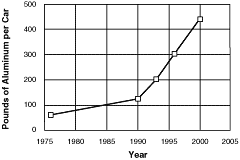 Figure 3: The projected growth of aluminum content in American automobiles over the next five years bodes well for diamond cutting tool demand. | |
The world market for CVD diamond-coated inserts, based on estimates from large tool manufacturers, is $5 million per year. The current PCD world market is $250 million per year. Perhaps the fastest growing demand for diamond tools comes from the automotive sector, which needs the technology for machining hypereutectic aluminum and new brake-pad composites. The projected growth of the aluminum content in U.S. automobiles, shown in Figure 3, is due in part to impending U.S. government regulations concerning fuel efficiency. (More aluminum means lighter cars, which translates into higher fuel efficiency.) Many of the aluminum alloys to be used contain a high percentage of silicon particulates. As shown in Table 1, these particulates may be harder than tungsten carbide and may severely limit carbide tool life. But diamond tools can handle them with comparative ease.
Ultimately, the acceptance of CVD diamond tool products will depend on their performance and price, especially in comparison to PCD tools. The availability of commercial CVD diamond reactors enables both large and small tool houses to compete favorably on both these points with PCD suppliers. For thin-film diamond, the end user now has three options:
1) Buy from one of several tool firms offering diamond-coated tools. These include Crystallume, Kennametal, Norton (Si3N4 tools only), Sandvik, and Teledyne. Typical price for a diamond-coated carbide tool at the IMTS show was $60.
2) Utilize a toll coating service offered by a company that has adhesion technology, such as Crystallume or sp3.
3) Purchase a diamond-coating reactor for in-house coating (ASTeX, Woburn, MA). In terms of profit margin, this option is the most attractive, but it requires access to adhesion technology. Table 3 breaks out the costs for in-house production using a single reactor.
| ||||||||||||||||||||||||||||||||||||||||||||||
| Table 3: Costs for in-house production of thin-film CVD diamond coated inserts using a single reactor. | ||||||||||||||||||||||||||||||||||||||||||||||
The impact of the availability of CVD diamond reactors on the PCD market is large. Toll houses can now replace PCD with their own in-house manufactured thick-film CVD puck. The added control over a critical supply is a welcome change. CVD is much cheaper to make and cuts more parts in many applications. For example, the cost of manufacturing a 2" by 0.5mm CVD puck can be $300, depending upon sales volume. This represents a significant savings over PCD, which costs about $900 for an identical piece.
The commercial availability of CVD diamond coatings for carbide tools is great news for end users, offering them a chance to cut challenging materials more economically than ever before. Even better news may be the development of inexpensive turnkey diamond-deposition reactors that may permit users to coat their own tools.
About the Author
Roy Gat is a research scientist in the diamond and process products group at ASTeX. He is responsible for tool-coating-process development. Stacy Swider is lead reliability engineer, and Edward Kelly is marketing manager at ASTeX.