CVD Diamond Inserts Stick
CVD Diamond Inserts Stick
The development of the CVD thick-film diamond process has made it possible to produce tools that can machine abrasive work materials without losing their cutting edge. In this article, the technology for producing the diamond film and the brazing of these thick-film chips onto inserts is described.
CVD thick-film diamond tools have become a commercial reality in the cutting tool marketplace. Improved deposition and post-deposition technologies have made it easier for tool fabricators to make and sell CVD thick-film diamond tools and for users to reap the tools' benefits.
First commercialized in the late 1980s, chemical-vapor-deposited (CVD) diamond for cutting tool inserts has had a hard time entering the mainstream of nonferrous metalcutting. Difficulties such as braze failures, low diamond production, and low insert-production levels accounted for the technology's slow start. However, new processing techniques are providing tooling engineers and tool fabricators with a CVD diamond product they can readily incorporate into their product lines without having to purchase specialized processing equipment. As a result, the end user can buy more reliable, more readily available thick-film diamond inserts for the consistent production of highly accurate, high-volume parts.
CVD diamond tools cost more than polycrystalline diamond (PCD) tools. But, in some applications, CVD diamond offers significantly longer tool life and increased machining productivity. This is because, compared to PCD, CVD diamond is purer, making it harder and more rigid and giving it a lower coefficient of friction, greater abrasion resistance, higher thermal conductivity, and better chemical and thermal stability (Figure 1). CVD diamond's lower coefficient of friction and higher thermal conductivity allow it to run at higher speeds than PCD or tungsten carbide without generating harmful levels of heat. In turn, running at higher speeds limits the chipload on the tool while maintaining high material-removal rates. Their hardness and abrasion resistance allow CVD diamond tools to maintain a fine cutting edge much longer than PCD tools can, an important asset in precision production machining operations. These properties give end users the opportunity to realize improved machining productivity and profitability from longer tool life, higher permissible speeds and feeds, and improved part quality.
Both PCD and CVD diamond are best suited for the machining of aluminum and other nonferrous alloys such as copper, brass, and bronze, plus highly abrasive advanced composites such as graphite, carbon-carbon, glass-fiber reinforced plastics, and carbon-filled phenolics. Many of these metals and materials quickly wear out tungsten-carbide inserts. No diamond tool can cost-effectively machine ferrous materials.
But while PCD and CVD diamond can be used in many of the same applications, PCD traditionally has been better suited than CVD diamond for rough turning and for machining materials that require a tool with high fracture toughness. CVD diamond tools are superior to PCD tools when it comes to finishing, semifinishing, and continuous turning applications because of CVD diamond's superior wear resistance (Figure 2). CVD thick-film diamond tools are now being tested for new applications such as milling and rough boring.
CVD diamond first found its niche in the cutting tool market as a thin-film coating (less than 50µm) on silicon-nitride substrates and, more recently, for tungsten-carbide substrates. CVD thin-film diamond has the same physical and machining properties as CVD thick-film diamond, but unlike thick film, thin-film diamond can be applied to such complex tool geometries as inserts with chipbreakers, endmills, routers, and drills.
CVD thick-film diamond is limited to flat inserts, because it's not a coating. Thick-film diamond is grown as 0.5mm-to-0.6mm-thick free-standing blanks, which are cut, polished, and brazed to a tungsten-carbide substrate. Thick-film tools currently find use in piston turning, the finish turning of cams, and the finish boring of aluminum alloys. In these applications, the CVD diamond tool's wear resistance allows it to withstand the abrasiveness of high-eutectic aluminum alloys, and its hardness allows it to maintain a fine cutting edge.
Commercializing CVD Diamond
For CVD thick-film diamond usage to spread, CVD diamond must be readily available in plentiful supply. Until recently, it was not. CVD thick-film diamond's traditional drawback has been the difficulty that tool fabricators have had working with thick-film blanks, because the task required special equipment and expertise in handling CVD diamond. Unlike PCD, CVD diamond cannot be cut with wire EDM, because it lacks PCD's metallic binder and, hence, its conductivity. Instead, special laser equipment must be used to maintain the consistency and reliability of the process. Attaching the CVD diamond to the tool substrate also required special skills and braze processing that maintained rigorous controls to optimize adhesion and minimize braze-material degradation. This added cost had to be passed on to the end user, and the time needed to produce such tools limited their supply.
It was to solve these problems that Norton Diamond Film developed its DiamaPak™ tool tips, which are delivered to tool fabricators in a precut, prebrazed form that they can readily incorporate into their tools. These tool tips contain CVD diamond with a nominal thickness of 500µm. The blanks are reactively brazed to tungsten-carbide substrates in several standard cutting tool tip geometries and finished to a uniform thickness consistent in form with other brazable tool tips. The resulting tool tips enable the tool fabricator to braze CVD diamond tips onto carbide inserts in a traditional manner, and the fabricator can finish-grind the insert much the same way he handles other diamond inserts. The tool tips are the same thickness as PCD blanks.
CVD Diamond Growth
Manufacturing a successful CVD thick-film diamond tool requires a complete understanding of the manufacturing system needed to grow and process CVD diamond. In both the diamond deposition and post-deposition processing, there lies the potential for introducing residual stresses that could cause the tool to chip or break during fabricationor in use.
| |||||||||||||||||||||||||||||||
| Figure 1: | Because of its superior purity, CVD diamond compares favorably with other forms of diamond and with tungsten carbide. | ||||||||||||||||||||||||||||||
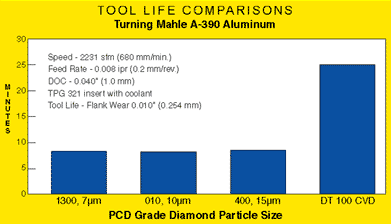 | |
| Figure 2: | DT 100 CVD diamond film from Norton Diamond Film lasted longer than various PCD grades in the turning of Mahle A-390 aluminum. The thick film wafers and PCD blanks were used on TPG 321 tungsten-carbide inserts. The following parameters were used for all tools in the tests: a speed of 680mm/min., a feed of 0.2mm/rev., and a DOC of 1.0 mm. For this test, tool life ended at 0.254mm of flank wear. |
Although researchers have been able to make diamond from gases for several decades, low-pressure diamond synthesis has just recently become commercially viable. CVD diamond is grown by reacting hydrogen and a hydrocarbon gas, such as methane, in a plasma and depositing carbon in a diamond structure to form a continuous film. Unlike the more familiar PCD, which is formed by heating and pressurizing diamond pArticles along with a metallic sintering aid, CVD diamond has no metallic phase in its structure. This enhanced purity accounts for its superior resistance to wear and corrosion.
Today, CVD thick-film diamond can be grown via a DC arc-jet plasma that creates free-standing diamond wafers at higher deposition rates than ever before possible. Process parameters can be adjusted to create a range of desired characteristics. For a CVD diamond thick-film cutting tool, the "recipe" produces a blank that has characteristics ideal for cutting metal: hardness, a low coefficient of friction, and thermal conductivity.
One of the inherent challenges of manufacturing CVD diamond is that the high temperatures involved in diamond deposition can create high residual stress in the film. This stress literally "bows" the diamond, giving it a slightly convex or concave profile. Residual stress must be controlled to produce reliable cutting tools with consistent performance. For example, Norton's current techniques control the film's bow in its deposition process to 1.3µm/mm or less. This is critical to tool performance, because high residual stress can result in cracks in the diamond tool tips during post-deposition processing. Also, higher levels of bowing can make the diamond more difficult to polish.
Post-deposition processing is as important to the final product as the diamond deposition itself. Laser cutting and polishing of the diamond film must be controlled carefully to produce stress-free and geometrically accurate tool tips. Laser systems can control the diamond-cutting process to produce tool blanks with minimal chipping (less than 0.05mm). This ensures that stress risers, or minute fractures, will not cause the diamond to crack when the tool fabricator performs final grinding on the tool.
Polishing the top of the cutting tool blank is also critical. The highly polished rake face of the thick-film diamond tip contributes to the fine edge finish produced during the final grinding of the cutting tool. A well-polished surface also ensures that the tool cutting edge will prevent the tool from galling along the cutting edge, which would cause material to build up on the edge. Ideally, the top of the cutting tool blank should be polished to a surface finish of 0.05µm Ra or better before it is sold to the end user.
Brazing the CVD thick-film diamond onto the substrate presents its own challenges for the diamond-film producer. Once again, stress in the tool can be a problem. The brazing process must produce a reliable bond that minimizes the stress at the tool's cutting edge.
Early versions of CVD thick-film diamond tools were plagued with inconsistent braze quality. This was primarily due to the sensitivity of diamond to variations in the brazing process. Equipment-design, gas-quality, and process-control problems led to contamination and oxidation of the braze material. While the original brazing process produced tools that demonstrated the potential of CVD diamond tools, it could not provide proper adhesion and the predictable, reliable performance that end users need. "Pop-off," or delamination of the diamond blank or tip during processing or use in the field, was a common problem.
It's been discovered that contamination problems can be eliminated through the combination of tightly controlled brazing temperatures, new brazing techniques, the use of vacuum furnaces, and extreme cleanliness of the process.
State-of-the-art thick-film-diamond brazing techniques utilize reactive metal brazes to create both a chemical and a mechanical bond between the CVD diamond and the carbide backing. This provides a high level of shear strength at the braze interface without creating high residual stress at the diamond cutting edge. Brazing-process control is maintained by evaluating the shear strength of this bond layer. At Norton Diamond Film, shear-test specimens from each furnace run are loaded to failure in a specially designed fixture. Diamond-film shear strength should exceed 35,000 psi.
Vacuum furnacing alone cannot ensure a reliable product. Control of the entire process - from the furnace cycle to cleaning the thick-film blank itself - is necessary to avoid contamination that could affect the film's adhesion to the substrate.
A Hard Sell
Thick-film diamond tools are currently finding use among end users who machine highly abrasive materials, such as high-eutectic aluminum alloys, that simply can't be cost-effectively machined with anything but a CVD diamond or PCD tool. For these users, CVD diamond often gets the nod because of its longer tool life.
Many end users who could profit from CVD thick-film diamond's benefits are hesitant to try this relatively new technology because of the larger initial investment. However, if the start-up cost is amortized over the life of the tools purchased, CVD thick-film diamond inserts prove to be more cost-effective than PCD or tungsten-carbide tools given proper application.
About the Author
Andrew Johnson is a process engineer at Norton Diamond Film, Northboro, MA.