


Demanding optical load: General Industry Coverage
To effectively activate its adaptive spindle load function, an adaptive machine tool control must know the exact cutting tool position and feed before the tool enters the cut. That's because there is no load when the tool is not cutting, and, if activated early, the adaptive feed rate will increase until the spindle load increases, or, if activated late, the tool will have already engaged the part.
To effectively activate its adaptive spindle load function, an adaptive machine tool control must know the exact cutting tool position and feed before the tool enters the cut. That’s because there is no load when the tool is not cutting, and, if activated early, the adaptive feed rate will increase until the spindle load increases, or, if activated late, the tool will have already engaged the part.
“Either way, you’re not in the best position unless the control has some load at the time the adaptive control system is turned on,” said Jerry Scherer, application engineer for FANUC Factory Automation (FA) America.
That’s where the control manufacturer’s recently patented CNC adaptive control for on-demand integrated adaptive control comes into play, which it developed to increase machine tool productivity with the FANUC iAdaptS adaptive control.
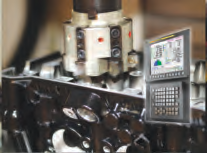
Courtesy of FANUC FA America
FANUC FA America developed the on-demand system for use with its iAdaptS adaptive control.
On-demand’s main benefit is the user does not need to know where the part is nor the feed rate to activate adaptive control, Scherer noted. In other words, on-demand automatically turns on the adaptive control when needed. It does this by measuring the current value of the spindle load during machining, and when it is greater than the current value of the target spindle load, it will automatically turn on the adaptive control, according to the company. Conversely, when the spindle load drops below the target spindle load, it will automatically turn off the adaptive control.
“On-demand allows you to set a threshold load on the tool that will automatically activate the adaptive control system,” Scherer said.
He noted determining the target load is often a collaborative effort between the end user and toolmaker. Toolmakers provide a tool’s rated maximum load, or maximum amount of energy they want transferred into a tool. End users then fine-tune a particular process based on variables such as the machine tool, coolant and workpiece material. Scherer said: “The CNC, at that point, knows what the optimal speed is to move the axes about. We lock the feed rate control to 100 percent, meaning the operator cannot adjust it. The adaptive control does the rest.”
On-demand technology also extends tool life by enabling a smooth engagement with the workpiece and adjusts the machining parameters to prevent the tool from rubbing and failing prematurely. Scherer noted one aerospace company prolonged tool life and tripled its output with an on-demand adaptive control when producing titanium engine casings. The aerospace workpieces have a variable silica layer on them that’s hard to break through, and tool breakage occurred after the tool completed only about 15 percent of a part. After integrating FANUC’s CNC adaptive control system, the end user successfully machined three casings.
“The on-demand adaptive control very quickly senses when the tool is coming up on a hard, brittle surface and immediately adjusts the feed rate down to a region where you’re not overloading the tool,” Scherer explained.
For more information, please contact FANUC FA America, Hoffman Estates, Ill., at (888) FANUC-US or www.fanucfa.com.
Related Reading
- Related guide: Optical Resources.
Related



Subscribers can use MFGAxis notes, saves and discussion tools with their innoNET account.