

Designing diamond: General Industry Coverage
Like the substance itself, developing new synthetic diamond supermaterials is extremely hard. When reviewing its new product development performance a few years ago, Element Six determined it wasn't effective and efficient enough and the company needed to increase its innovation performance, according to Steve Coe, executive director of group innovation for Element Six.
Like the substance itself, developing new synthetic diamond supermaterials is extremely hard. When reviewing its new product development performance a few years ago, Element Six determined it wasn’t effective and efficient enough and the company needed to increase its innovation performance, according to Steve Coe, executive director of group innovation for Element Six.
To do so, the synthetic diamond manufacturer consolidated its four R&D centers spread around the world and officially opened the 60,000-sq.-ft., $32 million Global Innovation Centre, Harwell, U.K., in early July. “The idea was that for a company of our size, we needed to consolidate into one center so we could have much better communication between our R&D teams and much better coordination of our activities,” Coe said, noting 114 people work at the GIC.
Coe added that the country’s strong science and engineering talent base enables Element Six to better attract the best and brightest workers, and being less than an hour from Heathrow Airport makes it more convenient for customers to visit and interact with the company’s scientists. “We do a lot of product development in collaboration with our customers,” he said. “It gives us the opportunity to better understand their needs and ultimately develop diamond products that better meet their requirements.”
In addition to being used to make PCD, PCBN and single-crystal diamond tools and abrasive products, Element Six’s products are found in a multitude of applications. Recent examples include a diamond road pick that lasts 40 times longer than a conventional road pick, sensors in the Large Hadron Collider particle accelerator and tweeter domes for Bower & Wilkins 800 Series Diamond loudspeakers.
Courtesy of Element Six
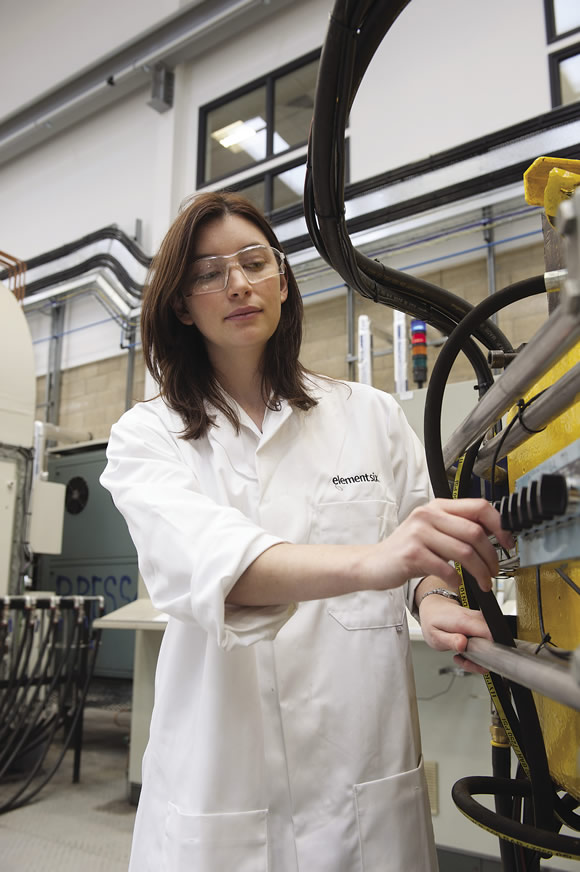
An Element Six scientist uses a high-pressure, high-temperature press at the company’s Global Innovation Centre to create synthetic diamond.
Review the print ads from this magazine to continue
This quick advertiser review unlocks the rest of the article and keeps the full-screen reader focused on the ads instead of the page chrome.
Advertisers included in this article experience
Print placements connected to this article
Pctcutters
Scan this code
and browse through our Newly Redesigned Specials. General Purpose Available in: 3xD - 12xD Receive a Guaranteed Test Tool including our standard end mills, drills, routers and chamfer mills! We have great confidence in our tools; try them yourself! For more information contact: 24/48 hr. Turnaround.
Scan this code and browse through our Newly Redesigned Specials. General Purpose Available in: 3xD - 12xD Receive a Guaranteed Test Tool including our standard end mills, drills, routers and chamfer mills! We have great confidence in our tools; try them yourself!
Visit Pctcutters View this placement in the issue recordPrint ads from this magazine
and browse through our Newly Redesigned Specials. General Purpose Available in: 3xD - 12xD Receive a Guaranteed Test Tool including our standard end mills, drills, routers and chamfer mills! We have great confidence in our tools; try them yourself! For more information contact: 24/48 hr. Turnaround.
Scan this code and browse through our Newly Redesigned Specials. General Purpose Available in: 3xD - 12xD Receive a Guaranteed Test Tool including our standard end mills, drills, routers and chamfer mills! We have great confidence in our tools; try them yourself!
Continue reading
August 2013
Facilities at the center include ones for modeling and design, materials preparation, materials analysis/characterization and post-synthesis processing, such as polishing, cutting and shaping. The GIC also houses high-pressure, high-temperature synthesis presses and chemical vapor deposition reactor synthesis labs.
“We also do all of our application testing on-site,” Coe said. “We can take the diamond we make into cutting tools and test it in real-life applications. So we design, do R&D, make prototypes and test them all under one roof, with the driver being that we could use that capability to accelerate the development process.”
The mechanical presses are about the size of a three-story building and produce the temperatures and pressures needed to convert graphite into diamond. According to Element Six, the presses create the equivalent conditions of the Eiffel Tower turned upside down on a soda can. “We are creating pressures on the order of 6 to 8 GPa,” Coe said.
The company typically invests more than 7 percent of its revenue in R&D, according to Coe. “That’s a fairly high investment. Innovation is really at the core of Element Six.”
For more information about Luxembourg-headquartered Element Six, visit www.e6.com.
Glossary terms in this article
Related



Subscribers can use MFGAxis notes, saves and discussion tools with their innoNET account.


