Developing tools for cutting composites
Developing tools for cutting composites
YG-1 Tool developed its line of D-Power diamond-coated carbide endmills for machining graphite and composite materials.
Machined parts made from carbon-fiber-reinforced plastic (CFRP), a type of composite material, are used by a host of industries, including the automotive, power-generation and sporting-goods.
One industry, however, stands out, according to Dr. Abdelatif Atarsia, the Charlotte, N.C.-based composites global product manager for YG-1 Tool Co. Ltd., Vernon Hills, Ill. "When I say 'composite,' it's mainly for the new generation of aircraft."
Before joining the toolmaker a few years ago, he earned his Ph.D. studying composite materials and worked in the aerospace industry. Therefore, Atarsia understands the challenges of cutting CFRP. "We needed a different tool to machine composites," he said.
According to Atarsia, the most-common part defect when machining CFRP is delamination. When drilling, for example, delamination occurs when the axial force exceeds a material-specific level.
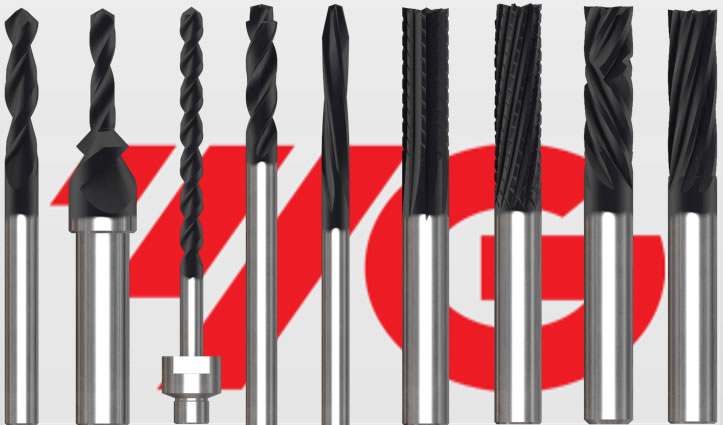
YG-1 Tool developed its line of D-Power diamond-coated carbide endmills for machining graphite and composite materials. Image courtesy of YG-1 Tool.
Another significant problem when drilling, which is typically done dry, is resin burn, he said. "Drilling dry generates a bit of heat. If the tool is not well-designed, the heat will stay with the tool, the tool will make a lot of friction, and friction creates resin burning inside the hole."
Moreover, there isn't a single composition of composites, Atarsia emphasized. "It's a layup of different layers, and each layer is put at a special angle."
In addition, different composite types are available, such as unidirectional (UD), bidirectional and three-directional composites. The UD composite is the most prone to delamination, he said, because, unlike the other types, the fibers in the UD type don't support each other as effectively.
When selecting a cutting tool for a composite application, Atarsia said the choices are a CVD-diamond-coated carbide tool or a PCD tool, including tipped, brazed and veined varieties. CVD diamond adheres best to a low-cobalt-carbide substrate, he said. "The lower the cobalt content, the better the deposition process."
Neither type of tool is universally suitable to achieve the lowest-cost-per-part goal. "Nobody can tell if CVD diamond or PCD is better," Atarsia said. "It's case by case."
The application also dictates the appropriate geometries for a tool, including the number of margins, tip angle and chisel size. "All of these are related to the composite section that we are going to machine with the tool," Atarsia said.
As a result of the numerous variables involved in machining composites, YG-1 produces many specials, he noted. However, the toolmaker developed its line of D-Power diamond-coated carbide endmills for graphite and composite materials, making the tools suitable for as many applications as possible.
As the production rate of composite parts increases drastically, so too does the end user's focus on achieving the lowest cost per part. "In any type of industry," Atarsia said, "this is the end of the story: How much does it cost to machine this part?"