

Don’t hold the onions
A "nano-onion" sounds like a topping for the world's smallest pizza. In reality, it's the core constituent of the Tool-X nanofluid that's added to oil- and water-based metalworking fluids, noted Jim English, president of Nano Synthetics, which makes the additive that also contains deionized water.
A “nano-onion” sounds like a topping for the world’s smallest pizza. In reality, it’s the core constituent of the Tool-X nanofluid that’s added to oil- and water-based metalworking fluids, noted Jim English, president of Nano Synthetics, which makes the additive that also contains deionized water.
According to the company, the nano-onions are particulates that measure about 10nm in diameter and are created through detonation synthesis, a process that transforms explosives into carbon-based nano-onions, which can absorb lubricants. The structure consists of a hard diamond-like core and an outer shell of amorphous carbon and graphene.
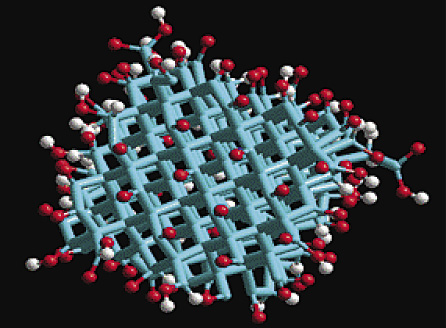
Courtesy of Nano Synthetics
The Tool-X nanofluid additive from Nano Synthetics contains trillions of carbon nano-onions.
English explained that nano-onions are excellent lubricants because they remove heat from the cutting tool and don’t break down in the high temperatures found at the cutting surface. “Graphene is the most thermally conductive material known to man, and Tool-X conducts heat from the coolant and tool, minimizing the need for chillers,” he said. “Graphene technology is the future of lubrication.”
Review the print ads from this magazine to continue
This quick advertiser review unlocks the rest of the article and keeps the full-screen reader focused on the ads instead of the page chrome.
Advertisers included in this article experience
Print placements connected to this article
PI411 please contact us directly at [email protected]
a New Generation
of PVD Coatings QUADCoatings4® The PI411 is the largest member of our "11" machine series and is designed for companies that wish to produce high-performance coatings with high productivity and round-the-clock production. Important features include Easy Tool Loading, the ability to coat 504 cutters with 10mm diameter in 3.5 hours.
a New Generation of PVD Coatings QUADCoatings4® The PI411 is the largest member of our "11" machine series and is designed for companies that wish to produce high-performance coatings with high productivity and round-the-clock production. Important features include Easy Tool Loading, the ability to coat 504 cutters with 10mm diameter in 3.5 hours and the especially ingenious, strong adhesion procedure, the so-called LGD Visit us at etching, while even tolerant of cleaning errors. For more information on the PI411 please contact us directly at [email protected]
Visit PI411 please contact us directly at [email protected] View this placement in the issue recordPrint ads from this magazine
of PVD Coatings QUADCoatings4® The PI411 is the largest member of our "11" machine series and is designed for companies that wish to produce high-performance coatings with high productivity and round-the-clock production. Important features include Easy Tool Loading, the ability to coat 504 cutters with 10mm diameter in 3.5 hours.
a New Generation of PVD Coatings QUADCoatings4® The PI411 is the largest member of our "11" machine series and is designed for companies that wish to produce high-performance coatings with high productivity and round-the-clock production. Important features include Easy Tool Loading, the ability to coat 504 cutters with 10mm diameter in 3.5 hours and the especially ingenious, strong adhesion procedure, the so-called LGD Visit us at etching, while even tolerant of cleaning errors. For more information on the PI411 please contact us directly at [email protected]
Continue reading
October 2013
English added that, as a result of better lubrication and lower temperatures, the product extends tool life and allows end users to boost machining parameters 10 to 20 percent and impart finer surface finishes, eliminating the need for secondary operations. For instance, Ron Wellington, president of Bernal Products Inc., Romeo, Mich., reported that tool life tripled for the shop after adding Tool-X to its semisynthetic cutting fluid and enabled it to machine unattended without breaking a tool.
And in a high-volume application cutting 4140 steel with a Promax ½ ” carbide endmill on a horizontal machining center, spindle loads were reduced up to 75.1 percent by using the nanofluid additive, according to the Nano Synthetics.
Instead of depositing a coating on a cutting tool, the nanofluid additive enables the coolant to coat a tool. According to Nano Synthetics, research it conducted with Drexel University found that the nanoparticles shot peen the surface of a cutting tool, smoothing it and filling surface micropores. The repeated shot peening under the cutting process’ high pressure and high temperature impinges the lubricious nanoparticles into the tool surface, thereby reducing friction during cutting.
In addition to using Tool-X in wet machining and through-coolant applications, English noted the company is working on minimum-quantity lubrication applications, as well as developing an additive for synthetic fluids.
For more information about Nano Synthetics, Rochester, Mich., call (248) 495-4367 or visit www.tool-x.net.
Glossary terms in this article
Related




Subscribers can use MFGAxis notes, saves and discussion tools with their innoNET account.


