



Don’t Let Milling Make You Cranky
Deep milling, whether it is in pockets or slots, can be a task that quickly ages even some of the most skilled machinists.
Deep milling, whether it is in pockets or slots, can be a task that quickly ages even some of the most skilled machinists. This is regardless of the material being cut — although the tougher the material, the sooner trouble could rear its ugly head — because deep mill work has the compounding hazards of longer tools sticking out of the spindle, less coolant penetration, higher potential of recutting chips, increased heat, and the list goes on. These factors alone are enough to spell trouble for your tools and parts.
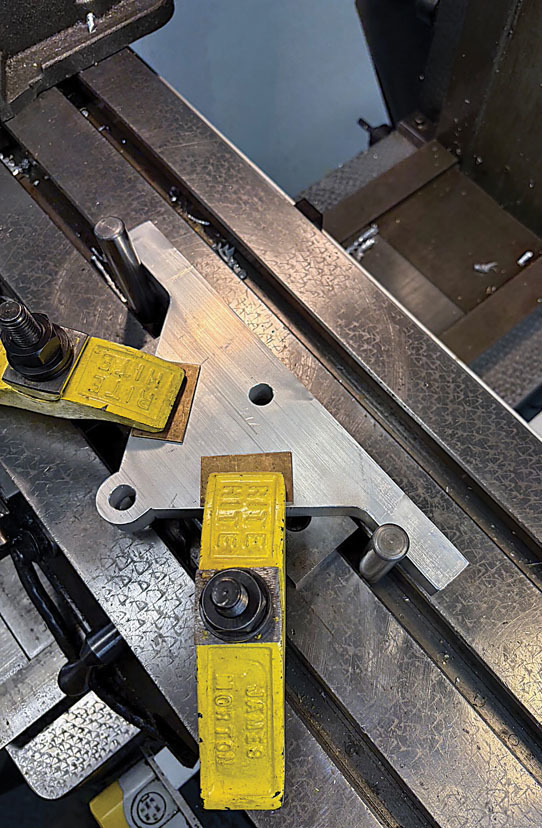
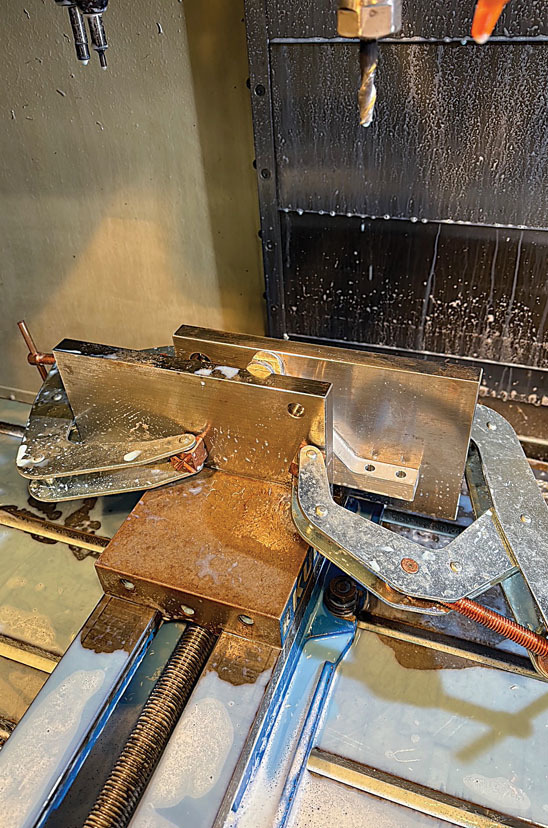
Recently, when finishing a set of bell cranks for a student’s design project (see figure 1), we needed to sink a clearance slot for a rod end to nest inside. Not having a slitting saw that was thick enough or of a large enough diameter to hob the slot while laying the part flat, I decided to stand the part up in tall vice jaws backed up by a couple of C-clamps (see figure 2), and use a long-reach end mill to do the job (see figure 3).
As you all know, tools sticking way out of a mill’s spindle tend to make an awful racket, even when all the cutting parameters are correct, at least on paper, that is. A screaming cutter is a product of large amounts of localized vibrations, which lead to chatter which feeds back into the harmonic imbalance faced by the cutting tool. If left unchecked, you end up with only a shank locked into your toolholder and the cutting end either lodged into your part or free to explore the inside of your machine at a high rate of speed. Neither of which is an acceptable result.
In the spirit of full transparency, I share my experiences through the lens of a prototype shop that does not directly make money on the parts we machine. (Frankly, very few even leave our building, let alone campus.). So, getting parts off the machines and out the door only serves us to help in the completion of Engineering’s various projects. All this to say time is not nearly as much of a factor for us as it is for shops trying to make a profit. The advice I give may or may not serve your company, yet I share it freely in the hopes it does help you.
When we have deep milling to do, and a limited amount of endmills with which to do it, we partake in a healthy diet of Cheaties, and rough out as much as we can with either a stubbier endmill (as in the case of these bell cranks) or we drill out as much as we can (as in the case of deep slots or pockets with side walls). The caveat being that stubbier endmills and drills are, by comparison, much cheaper to replace than specialty tools like longer reach endmills.


In the case of these parts, we needed a 0.501″/0.502″ wide slot at 2.250″ deep across the top of the part. This would allow the crank to crush down onto the rod end when the cross bolt was tightened (see figure 4).
The way we were able to complete this part was by taking an endmill with a cutting length half that of the finish depth. We hogged out as much as we could with the full reach of that cutter, leaving about 0.0625″ per side for the finishing cutter to clean up. We then switched to the long reach endmill and ran that cutter along both sides of the desired slot, leaving about 0.010″ per side until we reached finish depth. We then ran the cutter along both walls at finish width. Thankfully no chatter and no screaming cutter, just a nice finish and a completed slot in two parts.
I hope these tips and tricks help you stave off any crankiness when milling.
Introducing a new podcast
Be sure to catch me live on CTE’s newest podcast, “The Daily Grind™,” where we talk about machining topics just like this — and so much more — with a new topic each week. The show is live on Mondays at 8 a.m. Eastern time, with a recorded version airing Tuesday mornings across a wide array of podcast channels.
Related



Subscribers can use MFGAxis notes, saves and discussion tools with their innoNET account.


