



Dust not in the wind
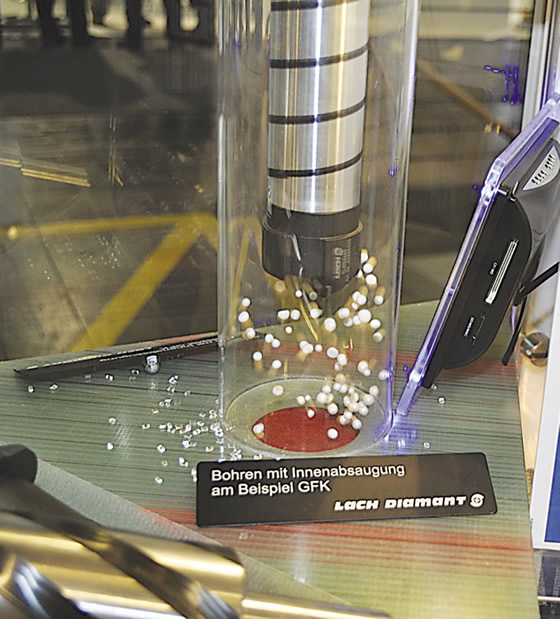
A PCD drill with an internal extraction system for removing workpiece dust when drilling carbon- and glass-fiber composites.
Drilling carbon- and glass-fiber composites, as well as graphite carbon, thermosetting plastics, green ceramics and green carbide, generates dust that poses a health hazard to workers. Vacuuming it through a hood assembly placed over the drill is a possible solution, but it is difficult to correctly position the hood and avoid interfering with the tool while effectively removing the particles, according to Randy Prafke, operations manager at Lach Diamond Inc.
The situation becomes more problematic as the drill diameter increases. “Those bigger drills produce so much dust that a standard vacuum system can’t handle it,” he said, adding that the dust pours across the workpiece. “When you get into this kind of material, you don’t want that dust flying around all over the place.”
To effectively suction and remove the dust particles, the toolmaker’s German parent company, Jakob Lach GmbH & Co. KG, developed a PCD-tipped drill with an internal extraction system through the center of the tool body. Because part manufacturers generally dry-machine these types of workpiece materials, coolant doesn’t need to be delivered through the drill, Prafke noted. “It’s basically the reverse of supplying coolant.”
Courtesy of Lach Diamond
Lach Diamond’s PCD-tipped drill with an internal extraction system through the center of the tool body is demonstrated at EMO.
He explained that Lach engineers specials based on an end user’s application requirements, which can vary significantly depending on the workpiece material and part configuration and requirements. Even different carbon-fiber composites can require unique tool designs based on the direction the material is drilled and its structural characteristics, such as the fiber-weave pattern. “About 99 percent of what we do are special applications,” Prafke said.
The abrasiveness of the composites often dictates the use of PCD drills instead of carbide ones, he added. “Go to a PCD drill and you go from 50 finished holes to 4,500 finished holes.”
Users of the internal-extraction PCD drills require custom-designed machine tools to apply the tools, and an existing machine can be modified to run the drills, Prafke noted.
For additional information about Lach Diamond Inc., Grand Rapids, Mich., call (616) 698-0101 or visit www.lach-diamant.de. CTE
Related



Subscribers can use MFGAxis notes, saves and discussion tools with their innoNET account.


