


Easy to be hard: Medical Manufacturing
Milling plastics is just easy enough to be difficult.
Milling plastics is just easy enough to be difficult.
Milling plastics might at first thought seem to be a snap, but the variety of available plastic materials and their differing physical characteristics can make the task more complicated than it first appears.
Many plastics offer ease of fabrication, low weight, strength and the ability to hold close tolerances, which make them excellent for use in for many structural, wear and bearing applications. Although injection molding is arguably the most common way to form plastics, in some cases milling plastic parts is more cost effective or is simply necessary (see sidebar on page below).
Milling can be employed to make prototypes or short production runs of plastic parts without the expense of creating a mold. Implementing engineering changes for a milled part requires only changing a CNC program rather than reworking a mold. And milling can achieve tight tolerances and contours not possible via molding, making it possible to complete some parts in a single operation rather than a two-step mold-and-secondary-machining process.
Plastic Basics
While milling may be the best way to manufacture a particular part, machining plastic workpieces presents several challenges. Chief among them is controlling and dissipating the heat machining produces because plastics generally have much lower melting points than metals. For example, the acetal plastic Delrin has a melting point of about 350° F, while the melting point of aluminum is 2,000° F. Plastics also lose heat more slowly than metals, and, when heated, plastics expand up to 10 times more than metal alloys, according to Quadrant Engineering Plastic Products, Reading, Pa.
The variety of plastic material compositions presents a range of machining characteristics that basically defy generalization. For example, the Hytrel thermoplastic elastomer from Dupont Engineering Polymers, Wilmington, Del., is available in more than 50 grades. The selection includes “soft grades” with a flexural modulus below about 240 MPa as well as hard grades with higher flexural modulus values. There is no sharp transition point; machining conditions will vary gradually from type to type, according to Dupont.
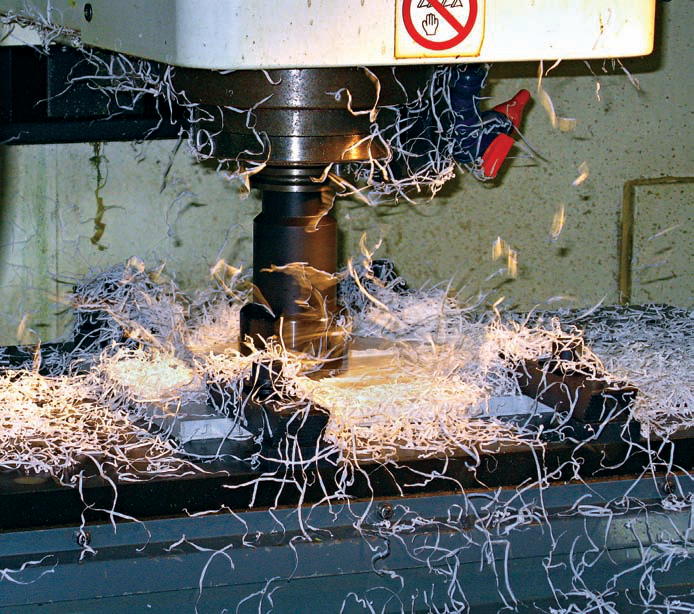
Courtesy of Quadrant EPP
A 3 “-dia. cutter, tooled with six inserts and running at 2,500-rpm and a 10-ipm feed rate, mills a sheet of Quadrant Ertalyte TX PET-P.
Application support from plastic material suppliers is a starting point for developing milling processes. Quadrant, for example, has outlined basic plastic material characteristic information in its Quadrant Materials Triangle, available on its Web site. Intended to help designers pick the right plastic for their products, the matrix groups thermoplastic materials by material and performance criteria, including hardness, strength, heat resistance and dimensional stability.
Higher-performance materials have higher heat deflection temperatures and lower coefficient of thermal expansion rates and therefore are less affected by heat generation during machining, according to Quadrant. Machining parameters, however, reflect the advanced materials’ additional strength. Typically, with general engineering plastics, the company recommends the use of more aggressive feed rates than those applied with advanced materials. Cutting speeds can vary widely, as well. For example, Quadrant recommends starting-point milling speeds of 200 to 500 m/min. for some polyvinylidenefluoride (PVDF) and nylon (PA) plastics with melting points under 350° F, but suggests speeds of just 25 to 75 m/min. for polybenzimidazole (PBI) materials, which can perform reliably at temperatures well over 400° F. Quadrant added that PBI materials may also require the use of CVD diamond-coated or PCD tools for optimal tool life.
Fill It Up
As is the case with advanced metal alloys, increasing the performance capabilities of a plastic generally increases machining difficulty. One example is plastic filled with glass or carbon fibers, which increase strength, insulation abilities and dimensional stability. Lance Nelson, president of tooling and workholding manufacturer 2L Inc., Hudson, Mass., said the filled plastics are “wicked abrasive and chew up cutting tools,” and slower cutting speeds may be required to conserve tool life. “Glass is almost as hard as carbide,” he said. “If you run a very high surface speed, you will generate heat and the carbide tools will break down.”
Ed Padgett, co-owner of Padgett Machine Inc., Tulsa, Okla., which focuses on defense products, said his shop cuts a variety of plastics, but stays away from filled materials. In many cases, machining filled plastics requires special biohazard handling techniques. “From the envelope in which these plastics are being machined, that air has to be evacuated because it has glass particles in it,” Padgett said. He noted that shops may machine the filled materials on one or two dedicated machines in an enclosed room with its own circulatory system.
The Right Tool
Top efficiency in any machining scenario requires tools that are engineered in response to the material’s specific characteristics. Jeff Davis, vice president of engineering at carbide tool maker Harvey Tool Co. LLC, Rowley, Mass., said specialty shops that process only plastics typically use machining processes and tools developed to maximize productivity in those materials. “Then, there are also plenty of shops that do plastics occasionally, and they are not looking to optimize—they are just looking to get through the job,” he said. That may involve applying a 2-flute, general-purpose HSS mill to cut plastic. “In many cases that works, but very often, the geometry, relief or the flute depth isn’t right.” That can produce poor surface finish, chipping, chatter, melting and even burning.
According to Davis, a fine surface finish is crucial in most plastic parts. As a result, cutters designed to mill plastic have geometries engineered that cut cleanly and minimize heat generation, including sharp edges, acute relief on the back side of the cutter and flute depths much larger than those common in metalworking.
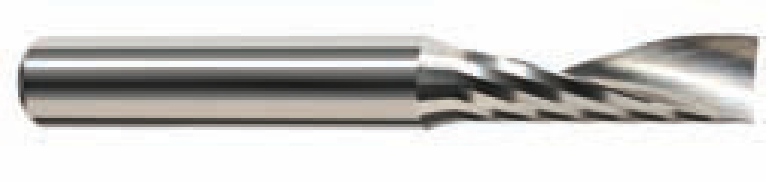
Courtesy of Harvey Tool
The extreme flute depth of Harvey Tools’ single-spiral “O” flute tool provides maximum room for a large plastic chip to flow cleanly from the cut and carry away heat with it.
As an example, Davis cited Harvey Tools’ plastic-focused single-spiral “0” flute tool, which “almost looks like a corkscrew.” Depending on the individual tool, the flute depth extends to the center or past the tool’s core, eliminating the core diameter typical of a metalcutting tool. “The flute depth is gigantic, so there is plenty of room for the chip to exit,” Davis said.
The configuration is weaker than a tool with a large core diameter, but a tool for milling plastic generally isn’t subjected to the power and torque experienced by a metalcutting tool. When machining plastic, “The cutter can be more sleek and dynamic. It doesn’t have to be beefed up with corner radii, edge prep and special coatings.”
Harvey also polishes the tool’s large flute valley “to give the chip very little to stick to. We don’t want to have any texture or hangups that might keep the chip from being thrown,” Davis said. “If you can cut [the workpiece] solidly and cleanly [to create a big chip] you get the finish you are looking for and any incidental heat ends up in the chip.”
The differences in application requirements and of the machining characteristics of different plastic materials may prompt the use of different tool designs, according to Davis. For example, a tool with two straight flutes would be more appropriate than a single-flute, high-helix tool for milling abrasive-filled plastics. The dual flutes share abrasive wear and minimize fraying of fiber strands by cutting the workpiece without the upward or downward pull that a helix/spiral produces. Or, in an application where surface burrs are undesirable, a “downcut” tool with a right-hand cut/left-hand spiral design would force the chip, and the burr, down through the bottom of a through-hole so that they are not on the part surface.
The cutting strategies employed in plastic milling also differ from those employed in metalworking. On a typical metal workpiece, it is normal to rough a contour and leave a few thousandths of an inch excess material for a finishing pass. “You cannot do that in plastics, because in the finish cut you are taking very little material, and most of the heat either stays in the tool or the part because the chip can only absorb so much,” Davis said. “You want to take as big a chip as possible with the most feed and the least speed.”
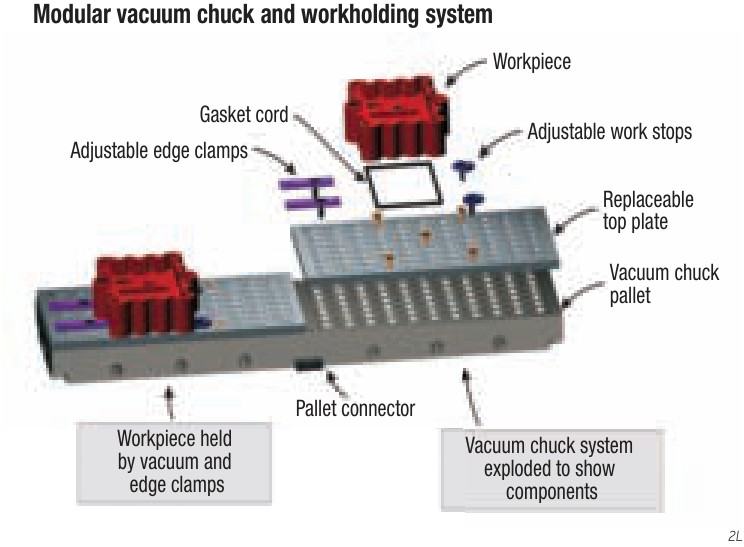
Courtesy of 2L
Vacuum systems can help firmly locate plastic and oddly shaped workpieces.
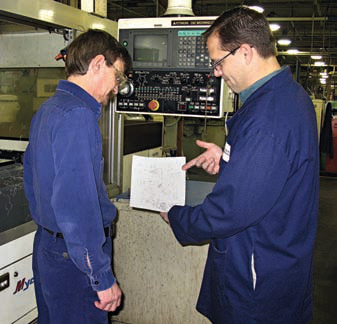
Courtesy of Quadrant EPP
Vic Maturi, machinist (left), and Jim Hebel, manager of technical services and application development, for Quadrant Engineering Plastic Products discuss milling of a plastic workpiece at the company’s North American headquarters in Reading, Pa.
Quadrant’s Hebel concurred with this strategy, saying DOC is critical, and lighter is not better. “Too light of a pass will cause the cutter to essentially rub the surface. For finish cuts, we recommend a minimum of 1⁄32 ” DOC,” he said.
Steven Lawver, prototyping machinist and CAD technician at experimental P/M lab Matsys Inc., Sterling, Va., uses a variety of machining technologies to process plastic materials for both professional and personal projects. Regarding a basic approach to milling plastic, he said, “Feed rates and speeds similar to those used for milling aluminum are a good starting point for most plastics. But if you have some scrap to work with, adjust the feed rates up from zero to find the point at which the bit will cause the material to climb, catch or chip on the bit,” and then back off. Some plastics are more forgiving than others. But the rule of thumb is that chip clearing and cooling are far more vital with plastics than would be otherwise.
Coolant Controversy
Suppliers and end users agree that it is crucial to keep the plastic milling operation as cool as possible, but they don’t always agree on how to do it. 2L’s Nelson acknowledged that there is divergence of opinion on the use of coolant. “Some people say never use coolant, while some say you have to use coolant. As far as the cutting tool end of it, you should always use coolant. That is the bottom line answer,” he said.
But those promoting dry machining of plastics using air-jet cooling point out that some plastics are hydroscopic: they absorb water. “Nylon is very hydroscopic, and some people don’t want to use coolants with nylon because it causes it to swell and change dimensions,” Nelson said.
While it is true that some materials absorb moisture, Quadrant has found that components are not on a machine long enough for this to be a factor, according to Jack Sharp, toolroom/machining manager. “The only time this may be an issue is if a part were to sit in a puddle of coolant overnight or during an off shift,” he said.
The company always recommends the use of a water soluble coolant to keep the part cool and reduce the effects of heat generation, noting that coolant also helps clear chips. Water-soluble products are specified because some plastics with lower chemical resistance can be discolored or cracked by the rust inhibitors in oil-based coolants.
While plastic milling generally is best performed with coolant, Nelson agreed there are specific applications, such as medical parts, that must be run dry to avoid the chance of contamination of a component that may later be implanted in a patient.
Workholding Challenges
Plastic’s relative softness and flexibility, combined with the need to maintain a rigid machining system to assure fine surface finish and dimensional accuracy, dictate special workholding considerations.
One solution is vacuum workholding. Nelson of 2L said the vacuum workholding equipment his company offers is an outgrowth of the company’s original business of providing solid-carbide and spring-loaded engraving tools. When end users sought ways to hold unevenly shaped items for engraving, 2L developed vacuum workholding systems as a way to immobilize a workpiece without clamps.
The systems are based on plates with horizontally gundrilled passages connected to the plate surface via holes blocked by removable screws. A vacuum pump is attached to the passages, and taking out a screw creates a vacuum at the plate surface.
The strength of the suction on a part is directly proportional to its surface area, so “if you have small parts, you are not going to be able to use a 3 “-dia. facemill and take a ¼ ” DOC; the part will just slide,” Nelson said. As a result, the plate surfaces feature rows of threaded and tapped holes that enable users to bolt work stops or adjustable edge clamps to grip the side of a part.
Vacuum systems provide strong grip on nonporous plastics, but because their effectiveness is based on surface area of the part, machining small parts requires other methods, such as using vacuum to hold a single large sheet of plastic, then applying gang or nesting machining techniques to cut a large number of parts in the sheet. “So the parts don’t go flinging around inside the machining center when they are making them, a shop will often cut three sides of the part and on the fourth side leave a very small web of material,” Nelson said. “When machining is completed, the sheet is taken off the chuck and the parts snapped off of it like you do on a kid’s model set.”
For simple or low-volume part applications, some shops use two-sided tape to hold plastic parts. Nelson said the special engraving tape is sticky on one side and not as much on the other side. To ease part removal after machining, the tape sticks strongly to the table but not as strongly to the part.
Machine Selection
Machines typically used in metalcutting can be used to mill plastics, but shops that make plastic parts need to select machines that are most appropriate for the application. Bill Howard, vertical machining center product manager for Makino Inc., Mason, Ohio, said the company’s machine tools are employed in many plastic-milling applications. One major application is milling acetal resins, such as Delrin and Celcon, for use in wear components between the metal elements of artificial knees. The cutting forces when milling those plastics are minimal compared to metalcutting, and the knee components usually have complex, 3-D shapes. Therefore, the machines used for the knee components generally are high-speed units with 4- or 5-axis capabilities.
Virtually all medical parts are cut dry so a coolant or a lubricant doesn’t migrate into the material. “We recommend through-spindle air and air nozzles that move the chips from the cutting area down into the chip handling systems of the machine,” Howard said.
Howard pointed out that machining graphite EDM electrodes is somewhat similar to plastics in that it typically is performed dry, and removal of finely cut material can be an issue. As a result, “graphite” versions of its V-22, V-33 and other VMCs, featuring systems that pull cut material out of the work area, can be used in milling plastics. “We actually are pulling a slightly negative pressure on the work zone of the machines,” he said.
Hard to Mill Well
While plastics generally cut easily, there are other factors that raise the machining difficulty factor. A tool may fly through a plastic workpiece but leave a melted mess behind. Or a glass-filled plastic material may produce tool wear at unexpected levels. The key is to be aware of the varying machining characteristics of different workpiece materials, proceed carefully and don’t hesitate to consult experts, according to Harvey Tools’ Davis. “It’s more complex than one thinks, but it’s not difficult to understand.” CTE
bout the Author: Bill Kennedy, based in Latrobe, Pa., is contributing editor for Cutting Tool Engineering. He has an extensive background as a technical writer. Contact him at (724) 537-6182 or by e-mail at billk@jwr.com.
Courtesy of Padgett Machine
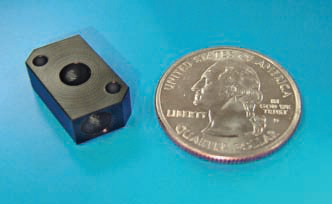
Rather than mold a part, Padgett Machine milled this 5⁄8 “-long × ½ “-wide × ¼ “-thick high-grade Delrin-polymer aerospace electronics insulator because its ±0.002 ” tolerance and squareness requirements didn’t allow for the taper that would be required to remove the part from a mold.
Mill or mold?
Ed Padgett, co-owner with his brother, Randy, of Padgett Machine Inc., mills parts from plastics because “sometimes plastic injection is not the answer. Sometimes a part has to be machined.” He cited a 5⁄8 “-long × ½ “-wide × ¼ “-thick high-grade Delrin polymer insulator for aircraft electronics equipment. The part was not a candidate for injection molding because a molded part “has to have a taper on so it can be pulled out of the die; this part had a ±0.002 ” tolerance that didn’t allow for taper on the edges.”
And even if the part’s features were compatible with the injection molding process, it wouldn’t have been cost-effective to mold. “The application, just 6,000 parts over 3 years, didn’t warrant building an injection die. Normally, if you’re going to build an injection die, you’d be running 40,000 to 50,000 parts.”
Padgett milled prototypes on a Haas VF-2 vertical machining center. Then, after receiving approval for production, switched to a Daewoo Puma 2000 SY 4-axis lathe, which permitted milling and drilling features that are not parallel or perpendicular to the spindle center. Padgett said Delrin is abrasive, so the shop applied coolant intermittently when machining the parts to extend the life of the carbide tools.
—B. Kennedy
Milling tips and hints
Quadrant Engineering Plastic Products patented the first process for extruding nylon stock shapes for machining in 1946 and has become a global manufacturer of cast, extruded, compression-formed and molded engineering plastic shapes intended to be machined. Its tips for machining plastics includes the following:
Part tolerance. Depending on the part and plastic involved, machining can typically achieve tolerances of 0.1 to 0.2 percent of the nominal part size. For tighter tolerances, consider rough machining to within 0.030 ” of final size, then allow the part to stress relieve for 24 to 48 hours before final machining.
Cutter size. Use the largest cutter possible, because more passes over a surface result in machined-in stress. Note that the manufacture of thermoplastic materials produces a degree of internal stress; be sure stock is stress-relieved by the plastic shape provider.
Part flatness. When flatness is critical, start with a flat plate; don’t use a vacuum table to suck a bowed plate flat prior to machining. The plastic has a memory and will spring back to the bowed condition when released from the vacuum. Instead, place the material belly up, hold it on the edges, and machine the top surface flat. That surface now is truly flat and can be flipped over and fixtured or held via vacuum for further operations.
Climb milling. Maintaining sharp cutting edges, providing plenty of chip clearance and employing climb milling can help control heat.
Hard plastics. When milling hard plastics, avoid generating sharp internal corners. The radius of curvature should be at least 1mm. Chamfered edges are also helpful in preventing chipping of part edges during milling by providing a smoother transition between the cutting tool and the plastic workpiece.
—B. Kennedy
Contributors
Dupont Engineering Polymers
(800) 441-7515
www2.dupont.com/Plastics/en_US
Harvey Tool Co. LLC
(800) 645-5609
www.harveytool.com
Steven Lawver
captainslg@aol.com
Makino Inc.
(513) 573-7200
www.makino.com
Padgett Machine Inc.
(918) 438-3444
www.padgettmachine.com
2L Inc.
(978) 567-8867
www.2linc.com
Quadrant Engineering Plastic Products
(800) 366-0300
www.quadrantepp.com
Glossary terms in this article
Related




Subscribers can use MFGAxis notes, saves and discussion tools with their innoNET account.