

Explosive deburring ideal for complex parts
Machining manifolds generates numerous burrs, and removing them is no simple task. Basin Precision Machining attempted a variety of deburring methods, including waterjet, kinetic energy and the thermal energy method (TEM).
For hydraulic manifolds, a burr isn’t a problem until it’s no longer a burr but a loose piece of metal.
“If a burr worked its way loose into the system, it could cut seals, block valves and do all sorts of things that will cause problems,” said Erik Anderson, president and CEO of Jefferson, Wis.-headquartered Basin Precision Machining LLC. “It’s generally the single biggest failure mode for any hydraulic system.”
The machine shop generates about $10 million annually in hydraulic manifold sales, Anderson said. Some manifolds weigh up to 500 lbs. (227kg) and have 1,200 features. Basin Precision produces 200 different manifolds for one customer alone at its Whitewater, Wis., facility. About 60 percent of the manifolds the company produces are made of aluminum, with the remainder made of ductile iron.
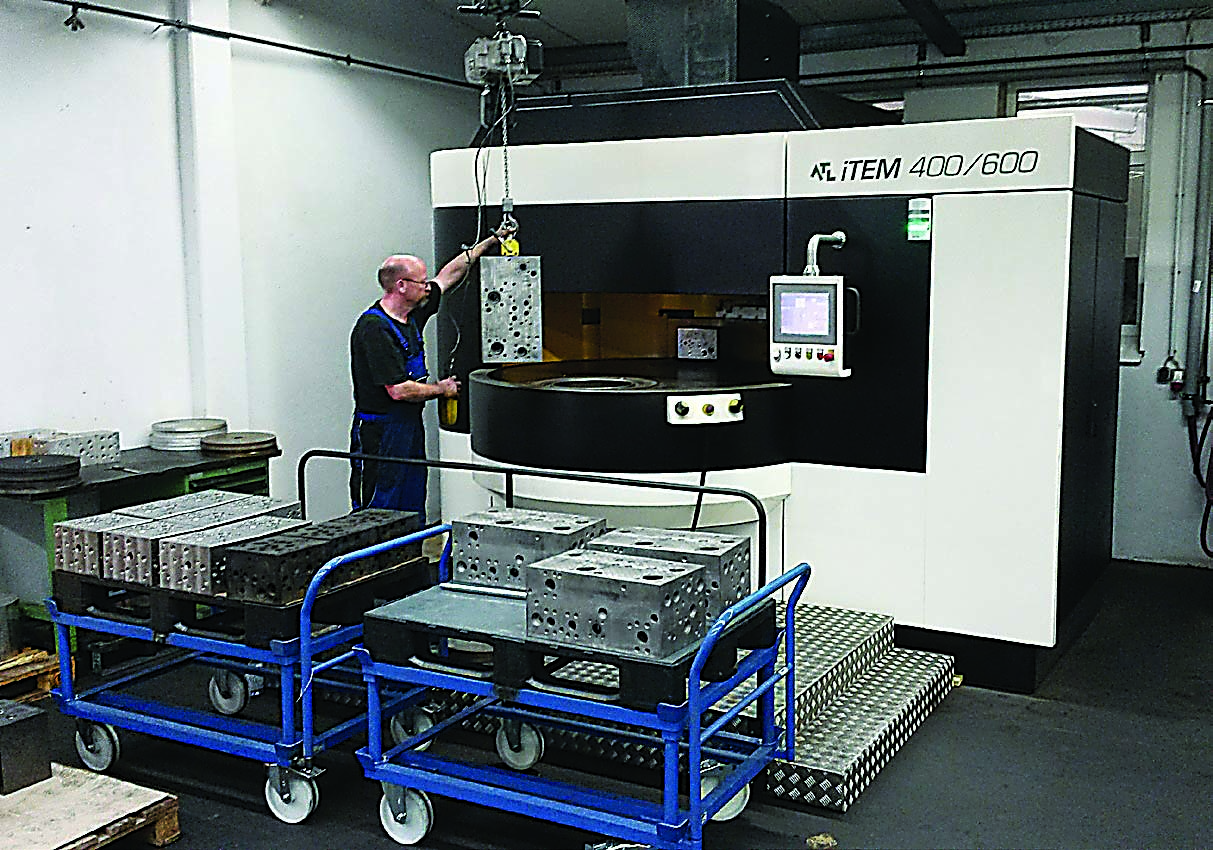
The iTEM400/600 thermal deburring machine from ATL is suitable for processing complex parts, such as hydraulic manifolds. Image courtesy of Anlagentechnik Luhden.
Machining manifolds generates numerous burrs, and removing them is no simple task. Anderson said most shops manually deburr parts, which relies on operator skill. But asking Basin Precision’s operators, who often run multiple machines, to try not to miss a burr on complex manifolds isn’t reasonable. Therefore, the shop attempted a variety of deburring methods, including waterjet and kinetic energy, but found they were not fully effective.
In addition, the shop tried the thermal energy method (TEM) with equipment from other suppliers but had mixed results, Anderson said. For example, one method caused ferrous parts to rust, which required acid etching to remove. “We started researching [TEM] more thoroughly because we thought maybe it was just the sources that we were dealing with weren’t capable of handling our requirements.”
That research led the company to the iTEM400/600 thermal deburring machine from Germany-based Anlagentechnik Luhden GmbH (ATL). The machine performs thermal-chemical deburring that burns away material via a chemical reaction between the material and gas mixture, ATL reports. The machine shoots a ductile iron part to be deburred with two gas mixtures. The first one deburrs the part by igniting the mixture with a spark in which the combustion temperature ranges from 2,500° to 3,300° C (4,532° to 5,972° F). The burr reaches its ignition temperature and reacts with the excess oxygen inside the deburring chamber, leading to a complete combustion of the burr within 20 milliseconds.
Review the print ads from this magazine to continue
This quick advertiser review unlocks the rest of the article and keeps the full-screen reader focused on the ads instead of the page chrome.
Advertisers included in this article experience
Print placements connected to this article
Us Sales Network Now Forming
US STOCKED
STANDARD TOOLING COMING OCTOBER 2017 REQUEST YOUR FREE TEST SAMPLES TODAY CBN Inserts PCD ROUND TOOLS PCD INSERTS Solid, Brazed, Pitted, Stock standards in Brazed, Chipbreakers, Chipbreakers, Coatings common sizes Geometries, Edge Preps WHY "PICK 2" WHEN YOU CAN HAVE ALL 3? ISO 9001, ISO 14001 & BS OHSAS 18001 Funik Ultrahard Materials (US), Inc
US SALES NETWORK NOW FORMING US STOCKED STANDARD TOOLING COMING OCTOBER 2017 REQUEST YOUR FREE TEST SAMPLES TODAY CBN Inserts PCD ROUND TOOLS PCD INSERTS Solid, Brazed, Pitted, Stock standards in Brazed, Chipbreakers, Chipbreakers, Coatings common sizes Geometries, Edge Preps WHY "PICK 2" WHEN YOU CAN HAVE ALL 3? ISO 9001, ISO 14001 & BS OHSAS 18001
Visit Us Sales Network Now Forming View this placement in the issue recordPrint ads from this magazine
STANDARD TOOLING COMING OCTOBER 2017 REQUEST YOUR FREE TEST SAMPLES TODAY CBN Inserts PCD ROUND TOOLS PCD INSERTS Solid, Brazed, Pitted, Stock standards in Brazed, Chipbreakers, Chipbreakers, Coatings common sizes Geometries, Edge Preps WHY "PICK 2" WHEN YOU CAN HAVE ALL 3? ISO 9001, ISO 14001 & BS OHSAS 18001 Funik Ultrahard Materials (US), Inc
US SALES NETWORK NOW FORMING US STOCKED STANDARD TOOLING COMING OCTOBER 2017 REQUEST YOUR FREE TEST SAMPLES TODAY CBN Inserts PCD ROUND TOOLS PCD INSERTS Solid, Brazed, Pitted, Stock standards in Brazed, Chipbreakers, Chipbreakers, Coatings common sizes Geometries, Edge Preps WHY "PICK 2" WHEN YOU CAN HAVE ALL 3? ISO 9001, ISO 14001 & BS OHSAS 18001
Continue reading
August 2017
Anderson explained that the second shot is a stoichiometric gas mixture that knocks the iron out of the iron oxide. “You wind up with a part that is black, but it’s not rusting and the oxidation is not progressing,” he said. “You can wash the black off with an aqueous solution.”
The cycle time for the two-shot deburring process is about 5 minutes, and ultrasonic cleaning consumes about 18 minutes, he noted. As long as the parts are about the same size, as many as 20 or more can be washed at once.
Aluminum manifolds, however, require only the first deburring shot, which consumes 2 minutes, and do not need any post-treatment washing, Anderson added.
He pointed out that the TEM machine, which is ATL’s largest and the only one installed in the U.S. to date, can’t remove large extruded burrs. It will just remove those burrs’ sharp edges. “On the other hand, a burr like that is very unlikely to get loose in the system,” Anderson said.
The machine excels at removing burrs that form when an oil hole, for example, intersects with a threaded hole, with burrs potentially appearing in every thread crevice. “Those are the ones that are likely to get knocked off and
contaminate a hydraulic system. Those are the ones that are the most difficult to see and find.”
In addition to deburring manifolds for two customers, Basin Precision deburrs parts for a competitor, Anderson said. “If that gains popularity, we may just jump into the deburring business and add a couple more machines.”
Glossary terms in this article
Related




Subscribers can use MFGAxis notes, saves and discussion tools with their innoNET account.


