


Fastening methods: Turning Performance
Shop Operations column from January 2010 issue of Cutting Tool Engineering magazine.
Most machine shop time is spent turning raw materials into parts, but the next manufacturing step is often assembling and fastening those parts together. Cost, weight, strength, availability, reliability, corrosion resistance and simplicity are some of the many factors that influence the fastening method. There are more than 100 different fastener designs and tens of thousands of variations when size, finish and material are counted.
Three factors determine whether a fastener is a screw or bolt.
• Size: Screws are typically under ¼ ” in diameter; bolts are larger.
• Mating threads: Screws fit threads tapered into a workpiece; bolts fit into a mating nut. This is usually, but not always, true.
• Head design: Screws are often slotted; bolts often have square or hex heads.
In connection with the difference between drive and head design, drive design is the external or internal shape on the fastener head that couples the screwdriver, socket wrench or other driving tool to turn the fastener. The head design is the overall shape of the head that makes the fastener better suited to a particular application, such as a round, flat, oval or fillister head. However, there is some overlap: All external hex drives are hex heads, but internal hex drives, all called Allen heads, may take various shapes even though they are commonly called hex or Allen heads. Therefore, these two terms are imprecise.
There are four common screw drive designs.
• Slot heads have a single slot and are driven by a flat-bladed screwdriver. Their main drawback is that they do not work well with power screwdrivers because flat blades have a tendency to come out of the slot and damage surrounding work. Slot heads are used on screws and small bolts.
• Phillips heads, sometimes called cross-head screws, have a “+”-shaped slot. They were originally designed for use with power screwdrivers in production. The rounded corners in the tool recess make the driver “cam out” when the fastener is tight and also makes unscrewing difficult. Phillips heads are used on screws and bolts.
• Combo heads accept either a Phillips screwdriver or slot-blade driver. Combo heads are used only on screws.
• Pozidriv heads are similar to Phillips heads but have more metal-to-metal contact to permit higher torque application without camming out. Phillips screwdrivers will usually work in Pozidriv screws, but Pozidriv screwdrivers are likely to slip or tear out the screw head when used in Phillips screws. It is a growing practice to put Phillips heads on inch-based fasteners and Pozidriv heads on metric ones.
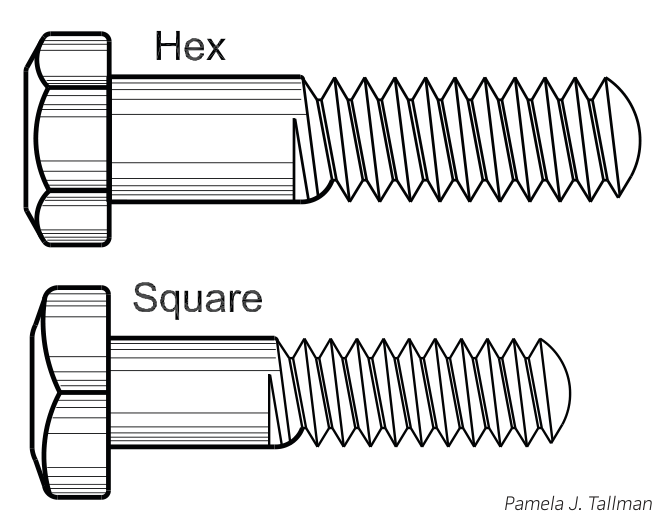
Courtesy of Pamela J. Tallman
Machine bolts.
A variety of threaded fasteners are available, including machine screws, machine bolts, socket head cap screws and bolts.
• Machine screws are made in a variety of head shapes, drive styles and materials. They are available as small as 0.021 ” in diameter to ½ ” in diameter and in lengths from 1⁄8 ” to 3 “. Many people call bolts from ½ ” to ¾ ” in length screws, but that is technically incorrect.
• Machine bolts are most often available in hex or square head styles in diameters from ½ ” to 30 “. Mating nuts are available for them. Dimensional control on machine bolts makes them suitable only for rough work.
• Socket head cap screws and bolts are similar to machine screws and machine bolts, but are of higher quality. They usually have a distinctive cylindrical head, a semifinished bearing surface under their heads and are made to higher dimensional standards. They are heat treated, making them stronger than machine screws and bolts of the same diameter, and are available from No. 0 through 2 ” in diameter and from ¼ ” to 10 ” in length. Although they come in several different lengths within a given diameter, their minimum and maximum lengths are proportional to their diameters.
Cap screws with drives other than hex and Phillips head shapes are available. They are most commonly available with a black oxide finish, but stainless steel is also available. Socket head cap screws are the most readily available quality fastener because most industrial tool supply companies stock them. CTE
About the Author: Frank Marlow, P.E., has a background in electronic circuit design, industrial power supplies and electrical safety and has worked for Avco Missile Systems, Boeing, Raytheon, DuPont and Emerson Electric. He can be e-mailed at orders@MetalArtsPress.com. Marlow’s column is adapted from information in his book, “Machine Shop Essentials: Questions and Answers,” published by the Metal Arts Press, Huntington Beach, Calif.
Glossary terms in this article
Related


Subscribers can use MFGAxis notes, saves and discussion tools with their innoNET account.