

Fill in the gaps: Drilling Performance
Tapered-pipe tapping is a way of threading pipes that, when assembled, do not leak, even under pressure. Because important safety and performance issues exist when assembling pipes tapped via this method, tapered tapping processes are governed in the U.S. by two key standards.
Tapered-pipe tapping is a way of threading pipes that, when assembled, do not leak, even under pressure. Because important safety and performance issues exist when assembling pipes tapped via this method, tapered tapping processes are governed in the U.S. by two key standards.
National Pipe Thread Taper (NPT) is the American National Standards Institute (ANSI) standard for tapered threads on threaded pipes and fittings. NPT threads require a sealing agent, such as Teflon tape, to complete the assembly. At some point in the service life of the assembly, parts with NPT threads will be taken apart and reassembled.
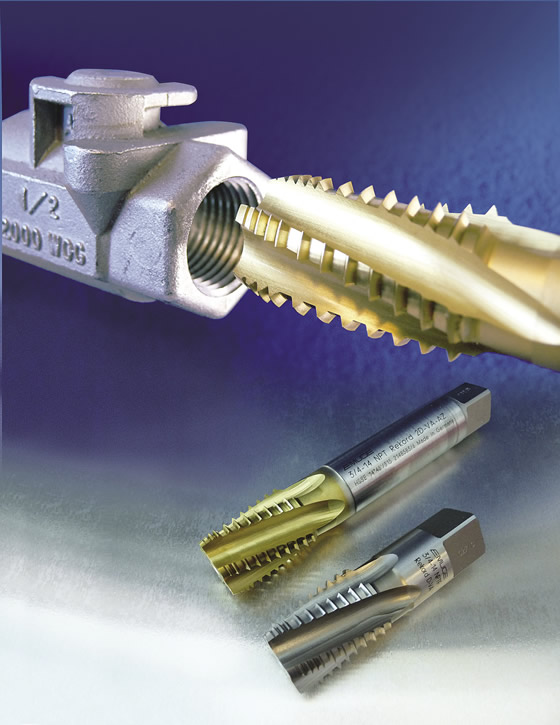
Courtesy of Emuge
Emuge says its NTP tapered-pipe taps feature a newly developed flute form with a variable skip-tooth geometry and are recommended for materials that produce long, stringy chips, such as aluminum, carbon steels, stainless steels and mold steels.
The ANSI dry-seal pipe thread standard, National Pipe Taper Fuel (NPTF), does not require a sealant and is for applications where the part assembly will most likely never be taken apart.
NPTF threads have the same basic shape as NPT threads but with asymmetrical crest and root truncation, according to a video report by cutting tool manufacturer Emuge Corp., West Boylston, Mass. The crest and root heights are adjusted for an interference fit, allowing a dry seal. Truncation is the bottom of the root or tip of the crest that is not produced during the tapping process.
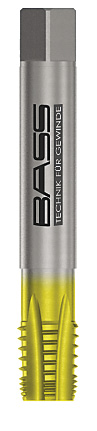
Courtesy of KOMET of America
KOMET offers Vario HZ interrupted-thread pipe taps in North America with its partner BASS GmbH.
“The difference is where the male and female threads engage. On the NPTF thread, both sides of the flanks and the root and crest are all engaged, so it creates a complete seal,” said Tim Holmer, application engineer at toolmaker OSG Tap & Die Inc., Glendale Heights, Ill. “The NPT thread is not engaged on the full crest or root. The NPTF thread has 100 percent engagement.” He added that an NPT tap cannot be used for NPTF applications, as it can produce a thread that could leak, but an NPTF tap is acceptable for NPT applications.
The difference when machining NPT and NPTF threads is in the details. “NPTF threads are not necessarily more difficult to machine, as it takes roughly the same amount of torque and load on the tool,” said Cullen Morrison, threading business development manager for toolmaker KOMET of America Inc., Schaumburg, Ill. “But they are more difficult to produce accurately because they have a much tighter tolerance. With a tighter tolerance, you have less wear time on the tools before they need to be replaced, and be- cause tool consumption is higher, the quality of the tool and gaging is critical.” Because thread quality is crucial, NPTF threads typically require various gaging processes.
Creating the Taper
The taper on the hole to be threaded is created by drilling a straight hole followed by a tapered-pipe tap or by reaming to create the taper, followed by the tap.
A straight-drilled hole that has not been taper-reamed has a much higher volume of chip removal during tapping. “That tap has to not only cut the thread but shape the hole to the correct taper, so more material is removed in the process,” Morrison said. “This creates a higher load and more torque on the tool, which greatly reduces tool life and can lead to tool breakage. While using a reamer is not necessarily required, shaping the hole to the correct taper first will always provide better tool life and thread quality.”
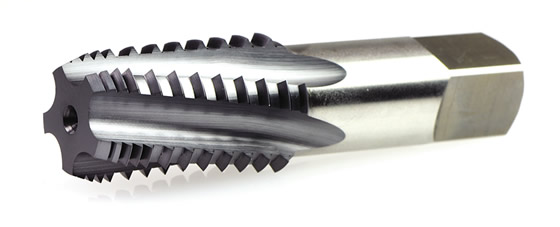
Courtesy of OSG Tap & Die
OSG’s Hypro List 12053 interrupted-thread pipe tap is available from 1/8″ to 1″. The tap is recommended for carbon steels, alloyed steels and die steels.
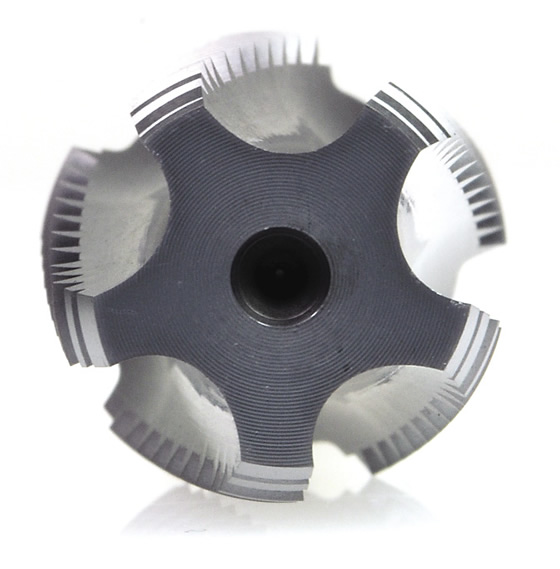
Courtesy of OSG Tap & Die
The face of an interrupted-thread tap shows the rake angle and enlarged size of the flutes for enhanced chip evacuation.
The downside to reaming first is the additional tool cost, setup and cycle time. “And it can be a slow operation, depending on the quality of the reamer,” Morrison added.
Review the print ads from this magazine to continue
This quick advertiser review unlocks the rest of the article and keeps the full-screen reader focused on the ads instead of the page chrome.
Advertisers included in this article experience
Print placements connected to this article
Nortonindustrial
DIAMOND WHEELS
A PARADIGM SHIFT IN CUTTING TOOL MANUFACTURING Paradigm diamond wheels double machine throughput and produce cutting tools with superior edge quality. #8,715,381 VISIT US AT IMTS #N-7051 Contact your local Norton Sales Representative or Distributor to experience the Paradigm shift today!
DIAMOND WHEELS A PARADIGM SHIFT IN CUTTING TOOL MANUFACTURING Paradigm diamond wheels double machine throughput and produce cutting tools with superior edge quality. #8,715,381 VISIT US AT IMTS
Visit Nortonindustrial View this placement in the issue recordNanomech
Technology too small to see.
Results too big to ignore. T Leading the Nano-Revolution with inserts that last twice as long as nearest competitor*. Only our patented nano-composite and nano-structured solutions can achieve these results. Put our award-winning inserts to the test. Call today. Nano-manufactured cutting tool solutions A Creation of 1.855.3.
Technology too small to see. Results too big to ignore. T Leading the Nano-Revolution with inserts that last twice as long as nearest competitor*. Only our patented nano-composite and nano-structured solutions can achieve these results. Put our award-winning inserts to the test. Call today. Nano-manufactured cutting tool solutions A Creation of 1.855.3
Visit Nanomech View this placement in the issue recordPrint ads from this magazine
A PARADIGM SHIFT IN CUTTING TOOL MANUFACTURING Paradigm diamond wheels double machine throughput and produce cutting tools with superior edge quality. #8,715,381 VISIT US AT IMTS #N-7051 Contact your local Norton Sales Representative or Distributor to experience the Paradigm shift today!
DIAMOND WHEELS A PARADIGM SHIFT IN CUTTING TOOL MANUFACTURING Paradigm diamond wheels double machine throughput and produce cutting tools with superior edge quality. #8,715,381 VISIT US AT IMTS
Continue reading
August 2014
Depending on the material and the design of the reamer, workhardening can occur when using a tapered reamer. This makes tapping more difficult in most instances. “Conversely, in soft, gummy materials, having a slightly workhardened workpiece can actually improve cutting as the chips tend to break instead of tear and create long stringy chips, which can be detrimental to a tap,” Morrison said.
Interrupted Tooling
Gradual thread engagement occurs when making a tapered thread because each time the tap revolves, the taper of the tap drives deeper into the hole, making shallow DOCs with low chip load on all of its cutting edges. “Because an NPT tap is tapered, basically every tooth is its own cutting edge,” Morrison said. “Every tooth is cutting a new chip like the chamfer of a cylindrical tap.” With a cylindrical tap, only the chamfer section is cutting at any given time; the remaining teeth are only for guiding and stability.
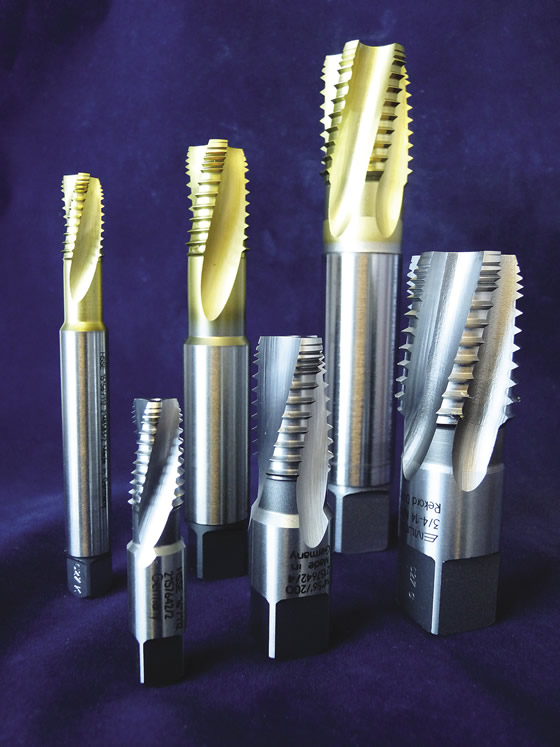
Courtesy of Emuge
Taps are available with interrupted threads in straight- and spiral-flute designs, and with a variety of tap coatings.
Morrison said: “If we have a 4-flute tool with 12 teeth engaged, we actually have 48 engaged cutting edges taking very small cuts. Low chip load and shallow DOCs are a problem because the tool is basically rubbing against the material. Increasing the DOC by reducing the amount of cutting teeth allows for much better chip formation and the chips will break easily.”
Another challenge is high flank, or part-to-tool, friction that results from the cutting edges being actively engaged throughout the tapping cycle. This additional friction means more machine torque is required, which produces more heat and causes poor tool life or tool failure. “Tapered taps by design will always have more friction and heat problems than cylindrical taps. Torque that is too high is the main cause of tool breakage, so we want to keep the torque as low as possible while still being able to form a good chip,” Morrison said.
Interruption to the Rescue
Interrupted-thread, tapered-pipe taps can combat these problems because they reduce flank friction, permit better lubrication and allow more room for chip removal.
To create the interrupted thread, the toolmaker removes every other thread profile behind the chamfer on the tap, creating big gaps on the tool. “Interrupted-thread taps reduce friction and increase chip load because every other tooth is removed axially along the length of the tool,” Morrison said. “This causes each tooth to create a chip roughly twice as thick as it would be before, which typically creates better chip formation conditions in softer materials. Chip removal also is usually better due to the creation of a short, broken chip.”
The chamfered portion is left with full threads to ensure the tap starts accurately and guides the rest of the tool along the correct path in the hole.
“The skip-tooth geometry is suited to materials that have a compressive force, elastic memory or gummy condition,” said Mark Hatch, product director of taps and threads mills at Emuge. “These tend to be sticky materials that clog the tool flute, like low-carbon steels, 1018 steels, 1020 steels and 300 series stainless.”
When these materials are being tapped with a full-form tap, so much material is compressed into the cutting area that large sections of the land actually break away and the cutting teeth start breaking because they are overloaded, he added.
Shops might use interrupted-thread taps in high-hardness materials and where reduced cutting torque is required. “But, as a general rule, the taps are ideally suited for low-tensile materials because the tap provides more space for chips and, in particular, more space for lubricant,” Hatch said. “If the material has a higher tensile strength and no problems with chip evacuation, then a full-form tap would give a better result.”
Interrupted-thread, tapered-pipe taps are effective, but Hatch said it is their design that is critical for tool performance. “The skip-tooth idea has been around for a long time, but it is how the tapmaker combines all the other attributes of the tap geometry—the profile angle, the rake and relief angles—along with this skip-tooth configuration that gives additional performance in materials where a full-form tap will typically fail.” CTE
Contributors
Emuge Corp.
(800) 323-3013
www.emuge.com
KOMET of America Inc.
(847) 923-8400
www.komet.com
OSG Tap & Die Inc.
(800) 837-2223
www.osgtool.com
Glossary terms in this article
Related




Subscribers can use MFGAxis notes, saves and discussion tools with their innoNET account.


