


Fine Form: Medical Manufacturing
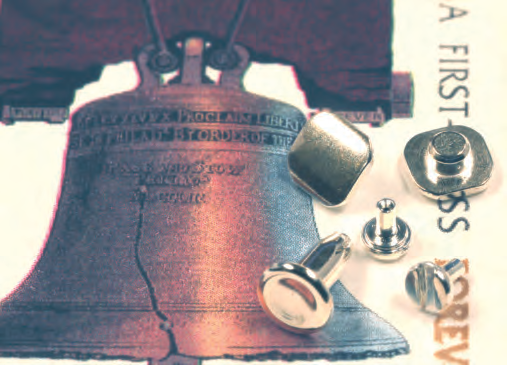
Courtesy of Deringer-NeyCold-formed electrical contacts made from silver alloys and silver-plated copper.Cold forming is a fast, chipless way to make parts.Clack-tick-clack-tick-clack-tick-clack-tick. That's the sound of a six-die, cold forming machine spitting out parts at rates up to 200 pieces per minute.
Courtesy of Deringer-Ney
Cold-formed electrical contacts made from silver alloys and silver-plated copper.
Cold forming is a fast, chipless way to make parts.
Clack-tick-clack-tick-clack-tick-clack-tick. That’s the sound of a six-die, cold forming machine spitting out parts at rates up to 200 pieces per minute. In addition to being quick, the process imparts a fine surface finish, meets tight tolerance requirements and produces parts that are often ready to ship. And there’s no wasted material because cold forming doesn’t produce chips.
Courtesy of Bigelow
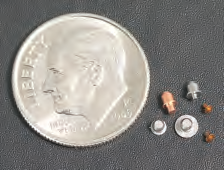
Examples of cold-headed parts.
Cold-formed parts are common. A visit to a hardware store’s fastener section reveals numerous examples, including screws, nuts, bolts, rivets and nails. But far more than just fasteners are cold-formed. The process is pushing the manufacturing envelope for creating parts that are impractical or nearly impossible to make by other methods.
Round Stock
Cold forming involves feeding wire or round stock, typically from a spool, into a high-speed, single- or multiple-station, automated reciprocating machine. The machine shears off a small portion of the raw material to create a blank with the same volume as the finished part. Then, via a set of feed fingers, a pick-and-place attachment or a die, the machine feeds the blank into a series of horizontal punch and die sets, which progressively “spank” it—at a rate of one hit per station—into the correct shape.
This multistep process can involve numerous operations, such as coining, piercing, extruding, shearing, trimming, threading and knurling. With a few exceptions, any operation that can be performed on a lathe or mill can be cold-formed.
Similar to squeezing toothpaste from a tube, cold forming forces brass, copper, steel and even difficult-to-machine materials such as Inconel, tantalum and molybdenum into each successive die cavity. At each step, the material takes the mirror shape of the station’s die before moving to the next station.
Because virtually no material is wasted, cold forming is especially beneficial when manufacturing parts from precious metals. Your scrap man might not be happy, but because there are no chips, it’s easier to find microparts on a cold former than in a lathe’s chip pan.
Another advantage is that cold-formed parts are stronger and more durable than machined parts, because there’s no interruption of the material grain flow as there is with traditional machining processes like milling and turning. This makes it possible to create complex shapes while holding close tolerances. For example, one manufacturer of cold-formed parts holds tolerances of ±0.0005 ” on a 0.010 “-dia. part.
However, despite the benefits, cold forming does have limitations. It’s challenging, for example, to cold-form parts with long length-to-diameter ratios, undercuts or “choke” diameters, and complex parts with multiple features.
Want to Cold-Form?
If you’re looking to purchase a cold-forming machine, your options range from breaking open your kid’s piggy bank to buy an old, used machine for as little as $500 to groveling for a bank loan to buy a new machine with all the bells and whistles, which can cost upwards of $500,000.
The reality for most shops is probably somewhere in between. Cold-forming machine builders offer various versions. For instance, Tiffin, Ohio-based National Machinery LLC’s offerings range from its new Microformer machine with a wire diameter capacity of 3mm to a six-die monster capable of processing 34mm-dia. stock with forming pressures up to 600 metric tons. National equips its machines with features such as quick-change tooling, CNCs, zero-clearance slide mechanisms and linear feeds.
Needless to say, effective cold forming requires more than just buying a machine. Cold forming is an art. Be prepared to develop your own tooling, processes and possibly your own equipment.
That’s what leading medical-component manufacturer Deringer-Ney Inc. does. The 200-year-old company, headquartered in Vernon Hills., Ill., performs stamping, machining and insert molding, and develops custom precious-metal alloys.
Microforming, however, is the company’s sweet spot. “A 5mm part is huge for us,” said Tom Schieber, product development engineer. ” ‘Micro’ to us means anything under 0.5mm.”
Courtesy of Deringer-Ney
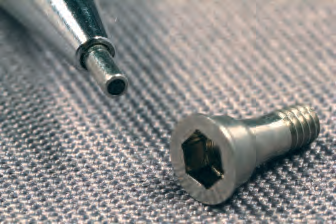
A cold-formed dental screw.
At its Marshall, N.C., plant, Deringer-Ney specializes in forming microparts, including antenna leads; actuator pins; medical-grade, implantable, radiopaque markers; and miniature screws for medical and electronic devices. It forms standard and high-value work materials, including gold, platinum and tantalum.
Deringer-Ney regularly cold forms parts with dimensions down to 0.25mm—only three times the width of a human hair.
“The rules change when you move into the microworld,” said Garth Boyd, the company’s vice president of marketing. “For example, during a normal cold-forming operation, a stock diameter reduction of up to 75 percent might be possible. But when you’re below 0.5mm, that size reduction might be limited to only 55 percent due to constraints, such as material ductility, tooling accuracy and workpiece grain structure.”
Tolerances also shrink with part size. Boyd noted that a standard tolerance might be ±0.002 ” on a 0.5 “-dia. part, but a 0.5mm (0.02 “) part might have a ±0.0002 ” tolerance. This tolerance reduction means tools must be more accurate and be better aligned, and surface finish and tool wear become bigger factors. Deringer-Ney monitors dimensions when microforming far more frequently than for macroscale work, and replaces microtools more often.
View print ads from this spread
Review the ads on this magazine spread to continue reading. Each ad takes two seconds; a two-page ad counts once.
Advertisers on this magazine spread
Print placements on this magazine spread
800.521.9520 | mscmetalworking.com
Available exclusively at MSC Industrial Supply Co.®
IS #42.
Available exclusively at MSC Industrial Supply Co.® IS #42 800.521.9520 | mscmetalworking.com
Visit 800.521.9520 | mscmetalworking.com View this placement in the issue recordPrint ads from this magazine
IS #42.
Available exclusively at MSC Industrial Supply Co.® IS #42 800.521.9520 | mscmetalworking.com
Continue reading
May 2011
Courtesy of Deringer-Ney
An insert-molded nickel pin (note the retention groove).
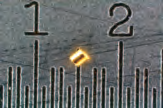
Courtesy of Deringer-Ney
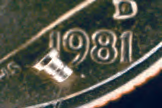
A 24-karat gold medical stent radiopaque marker lying on a machinist’s scale (the small marks are 0.010 ” apart).
Equipment is another challenge Deringer-Ney faces. “Commercially available equipment frequently doesn’t cut it,” said Dana Dubuc, vice president of business development. As a result, Deringer-Ney sometimes modifies standard equipment to meet tighter tolerances and process requirements—in effect, turning a Chevy into a Ferrari. And if that’s not possible, the company designs and builds machines to meet challenging customer requirements.
High-volume part runs are desirable from the standpoint of amortizing tooling and equipment, of course, but that doesn’t preclude Deringer-Ney from scheduling short runs. “Our minimum lot size is one piece,” Schieber said. The reason is that when working with exotic materials and precious metals, sometimes it’s not possible to conventionally machine a micropart. “That’s because some materials, while perfect for cold forming due to their ductile nature, are just plain tough to machine,” Scheiber said. “These include nickel alloys and molybdenum. But with microforming, we can spank out parts like that all day long.” Sometimes by the millions.
As an example, Deringer-Ney was approached by a medical device company to help design a part and produce several million of the parts annually. Deringer-Ney’s designers got involved early in the process to create part features conducive to cold forming.
“We spent a week on the part design and then they asked us to make a dozen prototype parts from two raw materials,” Scheiber said. “We designed tooling for a 1mm (maximum wire), two-die cold former. The midsection of the part was only 0.030 “, so the wire diameter was slightly smaller—0.0275 “. We built punches and dies in-house and delivered two dozen parts in 6 weeks. The customer tested the parts, settled on the material and decided to make a few minor dimensional changes. We tweaked our process and sent them another thimbleful of samples in a week. We later added a textured surface finish for cosmetic reasons.” Deringer-Ney then received an order for 250,000 parts, deliverable in 2 weeks.
Staying In-house
Another company specializing in microforming is Bigelow Components Corp. The Springfield, N.J., company has a department dedicated to developing tooling and processes for efficient microforming.
“We design, produce, heat-treat and maintain all tooling in-house,” said Brett Harman, company president. “Most of the parts we produce are components that go into a bigger assembly. They may be electronic, electrical or mechanical in nature. On the heading side, we can produce parts from wire diameters down to 0.018 “.”
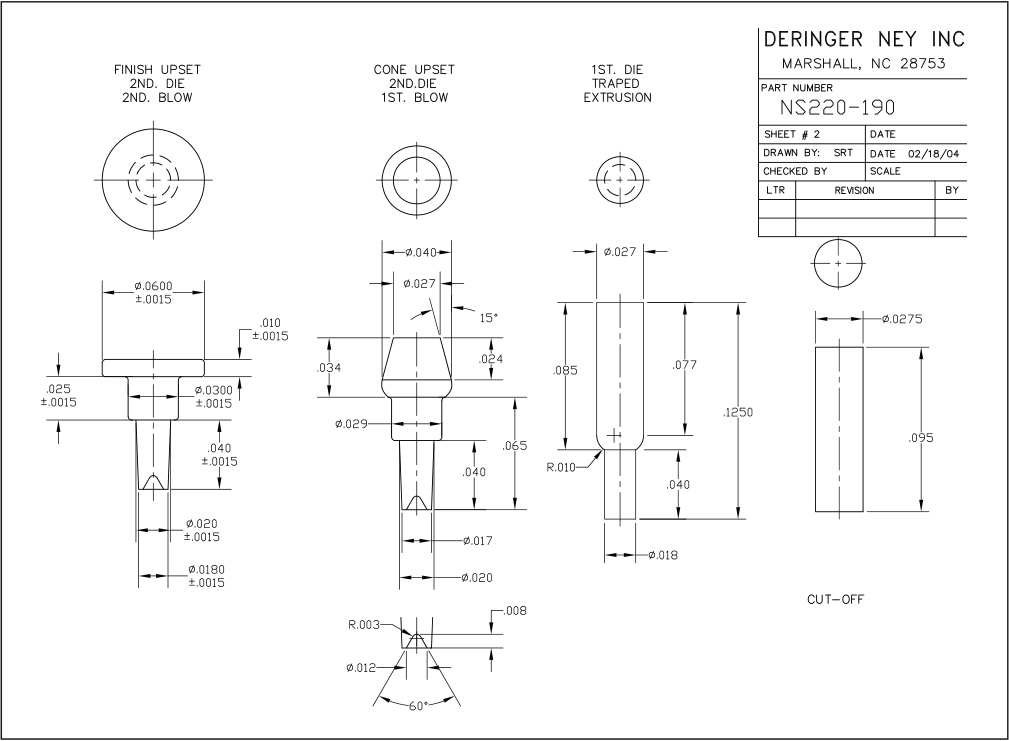
Courtesy of Deringer-Ney
A blueprint of a cold-formed part made by Deringer-Ney shows the sequence of operations.
Why not use a screw machine? “Cold forming is a scrapless process, can typically be run faster [than screw machines] and tooling is less expensive,” Harman said.
In addition, many of Bigelow’s customers require products made from lead-free and sulfur-free materials. It would be difficult to process such parts on multiple-spindle equipment because the material additives that promote free machining have been eliminated.
 “One of our customers was machining a lead-based material to produce an integral part that required magnetic properties for the end product to function correctly,” Harman said. “The machining process they were using was slow, expensive and left a cutoff mark that caused defective components. We changed theraw material to low-carbon steel, because of its superior magnetic qualities, and produced a component that was more stable, defect-free and cost-effective to produce and assemble.” CTE
About the Author: Kip Hanson is a manufacturing consultant and freelance writer. Contact him at (520) 784-4961 or kipatron@msn.com.
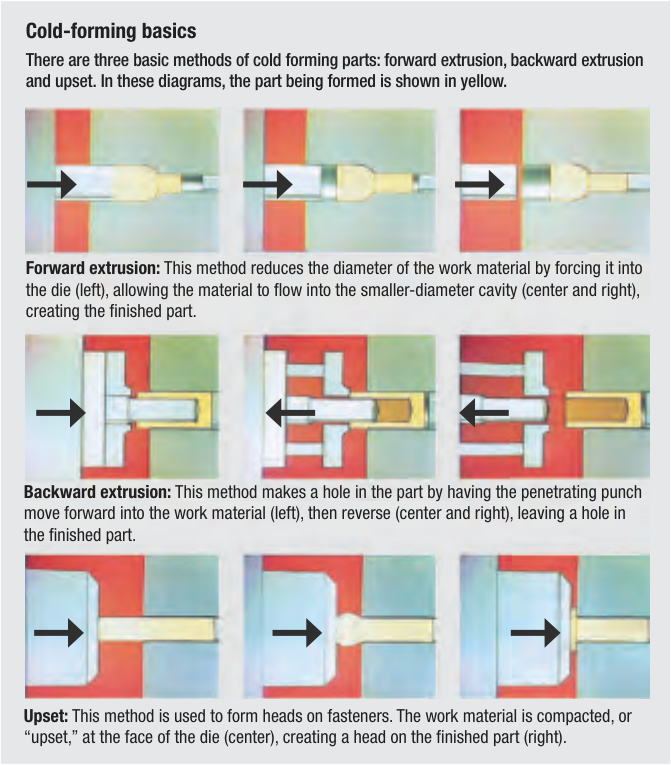
Cold-forming basics
There are three basic methods of cold forming parts: forward extrusion, backward extrusion and upset. In these diagrams, the part being formed is shown in yellow.
Courtesy of National Machinery
Tool life and other advantages of cold forming
Tool life when cold forming depends on several factors, including materials, tolerances and force and die complexity, but is typically measured in weeks rather than in number of workpieces. This is because material is deformed rather than removed—normal cutting problems such as built-up edge, chipping and cratering of the tool tip are avoided.
And tool wear, especially on difficult-to-machine materials such as Inconel and tantalum, is insignificant when compared to conventional machining.
Cold forming of parts has other advantages:
- Parts otherwise impossible to manufacture can easily be cold formed, and can be made to tight tolerances and fine finishes.
- There’s little or no waste with cold forming, which is vital when working with precious metals like gold and platinum.
- Cold forming is fast, with production rates upwards of 200 pieces per minute.
—K. Hanson
Contributors
Bigelow Components Corp.
(973) 467-1200
www.bigelowcomponents.com
Deringer-Ney Inc.
(847) 566-4100
www.deringerney.com
National Machinery LLC
(419) 447-5211
www.nationalmachinery.com
Related



Subscribers can use MFGAxis notes, saves and discussion tools with their innoNET account.