



Fine-tuning alloys for high temps
Breakthrough research promises to advance the design of high-temperature alloys with exceptional mechanical stability.
Superalloys that withstand extremely high temperatures soon could be tuned even more finely for specific properties, such as mechanical strength, as a result of new findings.
A phenomenon related to the invar effect — which enables magnetic materials like nickel-iron alloys to keep from expanding with increasing temperature — was reported to have been discovered in paramagnetic, or weakly magnetized, high-temperature alloys.
Levente Vitos, professor at KTH Royal Institute of Technology in Stockholm, said the breakthrough research, which includes a general theory explaining the new invar effect, promises to advance the design of high-temperature alloys with exceptional mechanical stability. The research team was led by him and composed of KTH Royal Institute of Technology researchers Zhihua Dong, Wei Li and Stephan Schönecker.
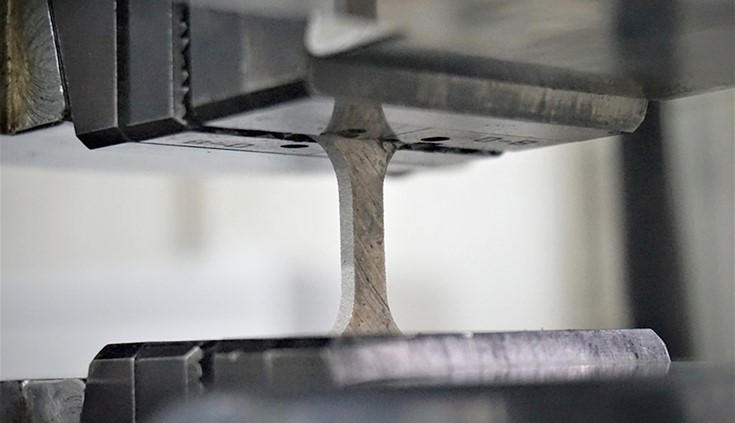
A piece of alloy is stress-tested at a lab at KTH Royal Institute of Technology. Image courtesy of L. Vitos
Short for “invariant,” invar plasticity allows magnetically disordered nickel-iron alloys to show practically invariant deformation behavior over a wide temperature range, making them ideal for turbines and other mechanical uses in extremely high temperatures.
The invar effect, however, never has been fully understood, and Vitos said these new findings help explain the peculiar high-temperature properties of special alloys used in jet engines, such as nickel-base superalloys.
Invar has two known effects: thermal expansion and elasticity — for instance, the ability to spring back after bending. Because both effects are linked to the interplay between temperature and magnetic order, they are considered to be specific to magnetically ordered alloys.
Using first-principles quantum mechanical modeling, the researchers identified how invariant plasticity also occurs in nonmagnetic alloys when a structural balance exists at the atomic level between cubic and hexagonal close-packed structures.
The new discoveries emerged from a long-term collaboration with industry to find alternatives to carcinogenic cobalt in hard metals, such as cutting tools. Vitos said the revelations broaden the palette of invar phenomena and material compositions, with clear implications for new applications.
“Our findings create a new platform for tailoring high-temperature properties of technologically relevant materials toward plastic stability at elevated temperatures,” he said.
The research was supported by the Swedish Research Council, the Swedish Foundation for Strategic Research and the Swedish Foundation for International Cooperation in Research and Higher Education.
— David Callahan
Glossary terms in this article
Related



Subscribers can use MFGAxis notes, saves and discussion tools with their innoNET account.


