



Finer Finishes, Cleaner Shop: Productivity
Challenge: Overcome coolant odor and skin irritation issues while imparting finer surface finishes. Solution: A water-miscible, semi-synthetic coolant.
Precision is everything at Watchtower Firearms LLC, a Spring, Texas-based manufacturer of rifles and handguns for military, law enforcement and U.S. consumers. The reported mission of the veteran-owned company is to ship products with precise tolerances and flawless surface finishes that are ready to use out of the box. Each component undergoes machining, such as milling gun frames, polishing and hand-fitting at Watchtower’s facility near Houston. Director of Operations Curtis Hearon said he closely monitors every aspect of the manufacturing process looking for improvement opportunities.
He noticed persistent problems that seemed related to the metalworking fluid in the CNC machines, problems such as less-than-optimal surface finishes on stainless steel and wrought aluminum parts. In addition, operators complained about the rancid smell of the coolant and the skin irritation it caused. Both poor finishes and odors can be symptoms of a failed coolant emulsion. When a coolant emulsion becomes unstable, the oil droplets clump together and are no longer uniformly dispersed throughout the water. The result is less effective cooling and lubrication, oil settling to the bottom of the sump or floating on the surface, and unpleasant odors.
Concerned about the impact on productivity and operator satisfaction, Hearon turned to Greg White, area sales manager at Blaser Swisslube Inc. in Goshen, New York, for a full situation analysis.
“Since no two machine shops are the same, we use a four-step process to evaluate the shop environment and application before recommending any metalworking fluid,” White said. The analysis includes testing the local water quality, understanding the types of materials to be machined and the cutting processes, and knowing about specific equipment capabilities. At Watchtower, the CNC machines process a mix of stainless steel and military-grade 7000-series aluminum workpieces.
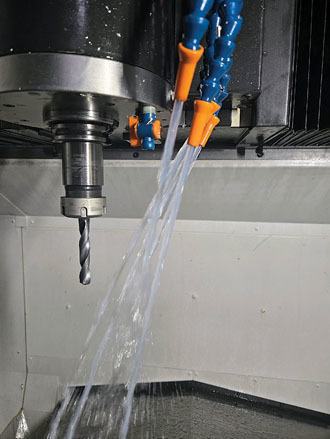
After the analysis, White recommended Blaser’s B-Cool MC 660 based on the material mix, machining processes and the improvement goals outlined by Hearon. “B-Cool MC 660 is a semi-synthetic, water-miscible metalworking fluid that can be used for large or small series production. It performs equally well when machining steel alloys, cast iron or aluminum alloys, or a mix of those materials.”
The formula is low foaming in high-pressure systems, and its effective rinsing behavior keeps workpieces and machines clean, according to Blaser. It can be mixed with all water types and does not contain critical substances such as boron, chlorine, formaldehyde or sulfur.
Watchtower, which asked two other coolant manufacturers to vie for the company’s business, ultimately selected Blaser Swisslube.
“I was able to defeat one of my competitors simply because their coolant turned into slime in the sump and messed everything up,” said White, noting damage to the filters and high-pressure unit. “I still have the photos on my phone.”
The other competitor’s representative dropped off samples at the back door with a business card and instructed Watchtower to let him know the results, White recalled.
On the other hand, White cleaned the machine to be tested with Blaser’s coolant, mixed the coolant with his own mixer and made sure everything was in order. “I gained the trust and loyalty of the shop once the machinists saw I was there not only as a Blaser rep but as a trusted friend and adviser on how to use our product. They said they’ll go with Blaser because this guy put on work clothes and helped clean the machine.”
The transition yielded immediate improvements to the shop environment, he said. B-Cool MC 660 maintained a stable emulsion, reducing bacterial contamination risks and minimizing maintenance time. The new coolant eliminated powerful odors and proved to be gentle on the skin, improving working conditions. Plus, with no residue on the parts, cleanup is easier and part handling after machining is reduced.
In comparison, the previous coolant’s emulsion degraded quickly, required frequent maintenance, increased disposal and top-off costs and contributed to unplanned downtime, Watchtower reported.
The shift to B-Cool MC 660 resulted in measurable financial and operational benefits. Lower top-off rates led to a 15% improvement in tool life, delivering savings of more than $30,000 in the first year. “It’s been in their machines for a year, and they’ve had no issues,” White said.
Due to improved bio-stability and lower consumption, coolant-related waste disposal is projected to drop by more than 50%. With less coolant clinging to the chips, the environmental impact is reduced. Cleaner chips simplify scrap metal disposal while increasing the value per pound.
“The right metalworking fluid does a lot more than you think,” White said. “The cost is a small fraction of the total investment into any machining process. At the same time, coolant has a big effect because it touches virtually everything in the shop, from tools and machines to parts and people.”
As a sales manager, he added that it’s important to get potential customers to look beyond the initial price of the coolant. “If you can sell on performance, you are going to win every time.”
By adopting B-Cool MC 660, Watchtower achieved a breakthrough in its manufacturing process. The switch not only improved part surface finishes and coolant stability but also enhanced operator satisfaction, reduced maintenance efforts and delivered substantial cost savings.
Related




Subscribers can use MFGAxis notes, saves and discussion tools with their innoNET account.


