

Finish Grinding
Dear Doc: We grind nickel-alloy components for the aerospace industry. We typically take a deep cut for roughing and a shallow cut for finishing. For finish grinding, some operators like to use a faster feed rate; some don’t. What’s your take?
Dear Doc: We grind nickel-alloy components for the aerospace industry. We typically take a deep cut for roughing and a shallow cut for finishing. For finish grinding, some operators like to use a faster feed rate; some don’t. What’s your take?
The Doc replies: To avoid burn, finish grinding should be done with a fast feed rate.
Let’s start with some first principles: A smaller depth of cut means a lower material-removal rate, which means less heat. That’s good. However, a faster feed rate means a higher material-removal rate, which means more heat. That’s bad.
But there’s another factor to consider: The amount of time a point on the workpiece spends in the hot zone where it’s in contact with the wheel and absorbing all of that cutting/plowing/rubbing heat from the abrasive grits. We want that time to be short.
Here are the equations we need to use in order to understand temperatures in finish grinding:
- Time in the hot zone (seconds) = Arc length (mm) ÷ Feed rate (mm/s)
- Arc length (mm) = √ Wheel diameter (mm) × √ Depth of cut (mm)
- Time in the hot zone (seconds) = √ Wheel diameter (mm) × √ Depth of cut (mm) ÷ Feed rate (mm/s)
What does all this mean? For a short time in the hot zone we want a small depth of cut and a large feed rate.
I’m working on the accompanying graphs for the next edition of The Book of Grinding.
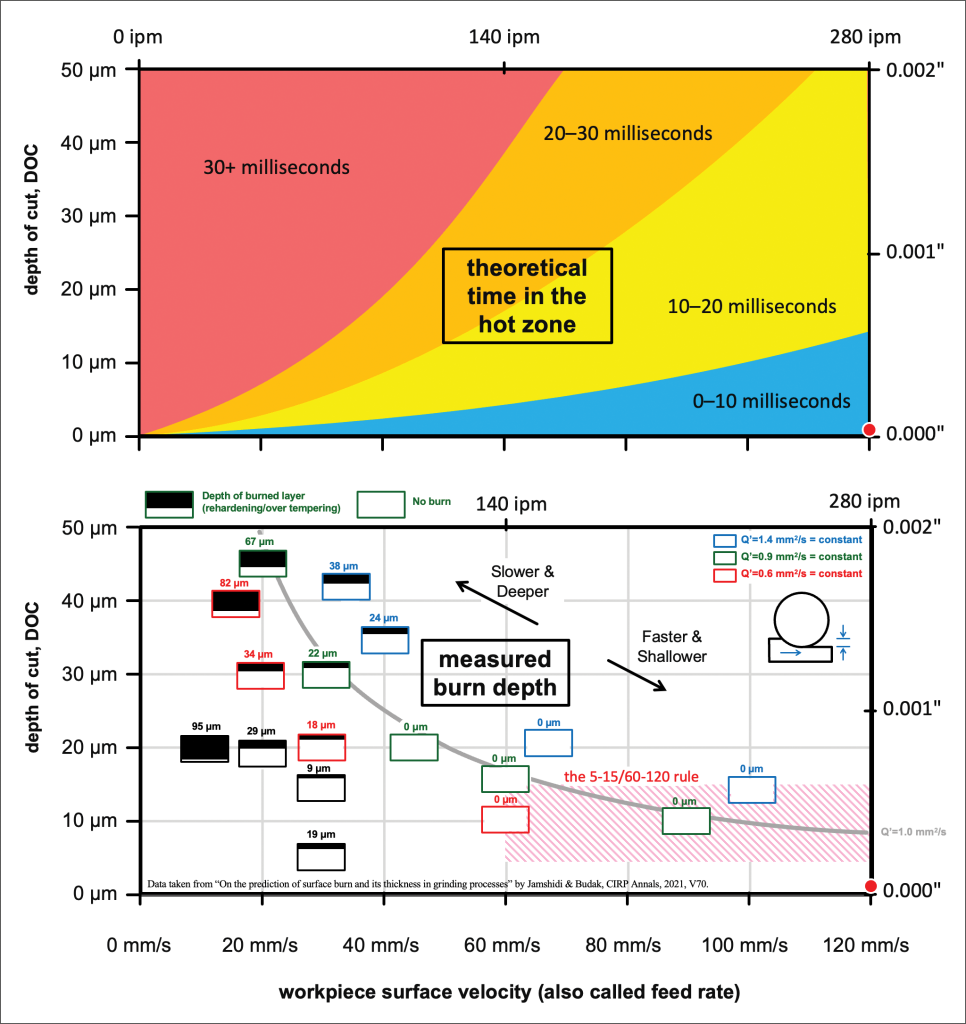
There’s a lot to look at in these graphs, so it may take a few minutes to get your head around everything.
The bottom graph shows work done by Jamshidi & Budak, a grinding research team. The researchers measured the depth of the burned layer for different grinding depths of cut and feed rates. What did they find? Fast feed rates produce no burn. They also found that small depths of cut result in less/no burn, but not to the same extent as fast feed rates.
Review the print ads from this magazine to continue
This quick advertiser review unlocks the rest of the article and keeps the full-screen reader focused on the ads instead of the page chrome.
Advertisers included in this article experience
Print placements connected to this article
Star Cutter
Custom Cutting Tool Solutions
Star Cutter promotes custom cutting tool solutions and grinding systems for precision applications.
Star Cutter highlights custom cutting tools and grinding systems across precision manufacturing applications.
Visit Star Cutter View this placement in the issue recordPrint ads from this magazine
Star Cutter promotes custom cutting tool solutions and grinding systems for precision applications.
Star Cutter highlights custom cutting tools and grinding systems across precision manufacturing applications.
Continue reading
May 2026
The top graph shows the theoretical time in the hot zone. Here, a small depth of cut and faster feed rate took less time. In fact, the relationship is exponential: Time = √(depth of cut) ÷ feed rate. That square root sign means that depth of cut has less of an effect than feed rate.
In other words, a smaller depth of cut will help you a little, a larger feed rate will help you a lot. Hence, always go with a fast feed rate, even if your depth of cut isn’t that small — as the measured burn-depth data points show.
But there’s a problem. A small depth of cut and fast feed rate also gives us a rougher surface finish; a higher risk of chatter and greater waviness from any wheel imbalance and eccentricity. (All wheels have at least a little wheel imbalance and eccentricity.)
Therefore, there’s a limit. Taking a 1 µm depth of cut at a 200 mm/s feed rate (the red dot in the bottom right of the graphs) will give you a super-low time in the hot zone, but it’ll probably create other problems.
I like the 5-15/60-120 rule. Take your finishing depth of cut somewhere within 5 to 15 µm and use a feed rate from 60 to 120 mm/second. This is shown in the shaded red region of the bottom graph.
Unless you’ve dressed your wheel super dull (which happens often), this should keep you out of the burn region and limit your risk of chatter, waviness and bad surface finish.
Unless it doesn’t. In that case, feel free to bend these rules for your situation. After all, these are guidelines. And in the complex world of grinding, general guidelines work — except when they don’t work!
This is the general thinking for finish grinding: smaller depth of cut and faster feed rate, with faster feed rate being the dominant of the two for keeping temperatures down.
Related




 MFGAxis Discussion
Be part of the shop-floor conversation
Like, save, or comment on this CTE story.
MFGAxis Discussion
Be part of the shop-floor conversation
Like, save, or comment on this CTE story.


MFGAxis Discussion