Fixturing a big ring: Turning Performance
Part manufacturer seeks solution to effectively hold a large workpiece on a vertical machining center.
In challenging economic times, part manufacturers typically are loath to outsource a job to a competitor when there’s a way to do it in-house. Akron (Ohio) Gear & Engineering Inc. faced this situation a year ago when COVID-19 significantly reduced the workload at the company. It specializes in machining large parts, including industrial gears, and didn’t want to pass on a project to make a 0.9 metric ton (1 ton) ring made of 4340 steel even though the most appropriate machine for the job was being rebuilt, said Akron Gear & Engineering’s Dennis Miller.
“The expense of the whole job was more than if we would have farmed it out,” he said, noting the high cost for required tooling. “But if we weren’t able to do (it), we may have lost their business. We didn’t want to take a gamble.”
With its largest vertical turret lathe, which has a 3,098.8 mm (122″) capacity, unavailable at the time, Akron Gear & Engineering needed to machine the ring on its Juaristi horizontal CNC boring mill but didn’t have the necessary fixturing. Using the boring mill instead of the VTL required the ring to be held vertically rather than horizontally. The boring mill with 3+2 capability has capacities of 2,997.2 mm (118″) on the x-axis, 2,413 mm (95″) on the y-axis and 711.2 mm (28″) on the spindle.
Miller contacted a familiar workholding supplier for a solution but never heard back. Unwilling to wait any longer, he called industrial distributor Atwood Industries Inc. in Cleveland, which recommended workholding from Mitee-Bite Products LLC in Center Ossipee, New Hampshire. After discussing the job with Michael Witzgall, senior applications manager at Mitee-Bite Products, a modular arrangement mounted on T-slot subplates was recommended. The workholding devices included Mitee-Bite Products’ Heavy Duty T-slot clamps with blunt-edge Pitbull clamps and large multifixture stops for the first operation, then modular XYZ Xpansion pins for ID, OD and facing operations.
“The modular design was vital with this application to avoid distortion from clamping pressure,” said David Bishop, general manager of Mitee-Bite Products. “Large, one-piece runs leave very little room for error. Preventing distortion with this heavy, ring-shaped part required solid communication with the customer, an extensive brainstorming session and CAD simulation software to recommend the best options. Mounting the T-slot plates centered on the ring’s diameter allows placement of all clamps and hard stops into a static position and then applying contact pressure in small increments equally in all directions until sufficient holding force was achieved.”
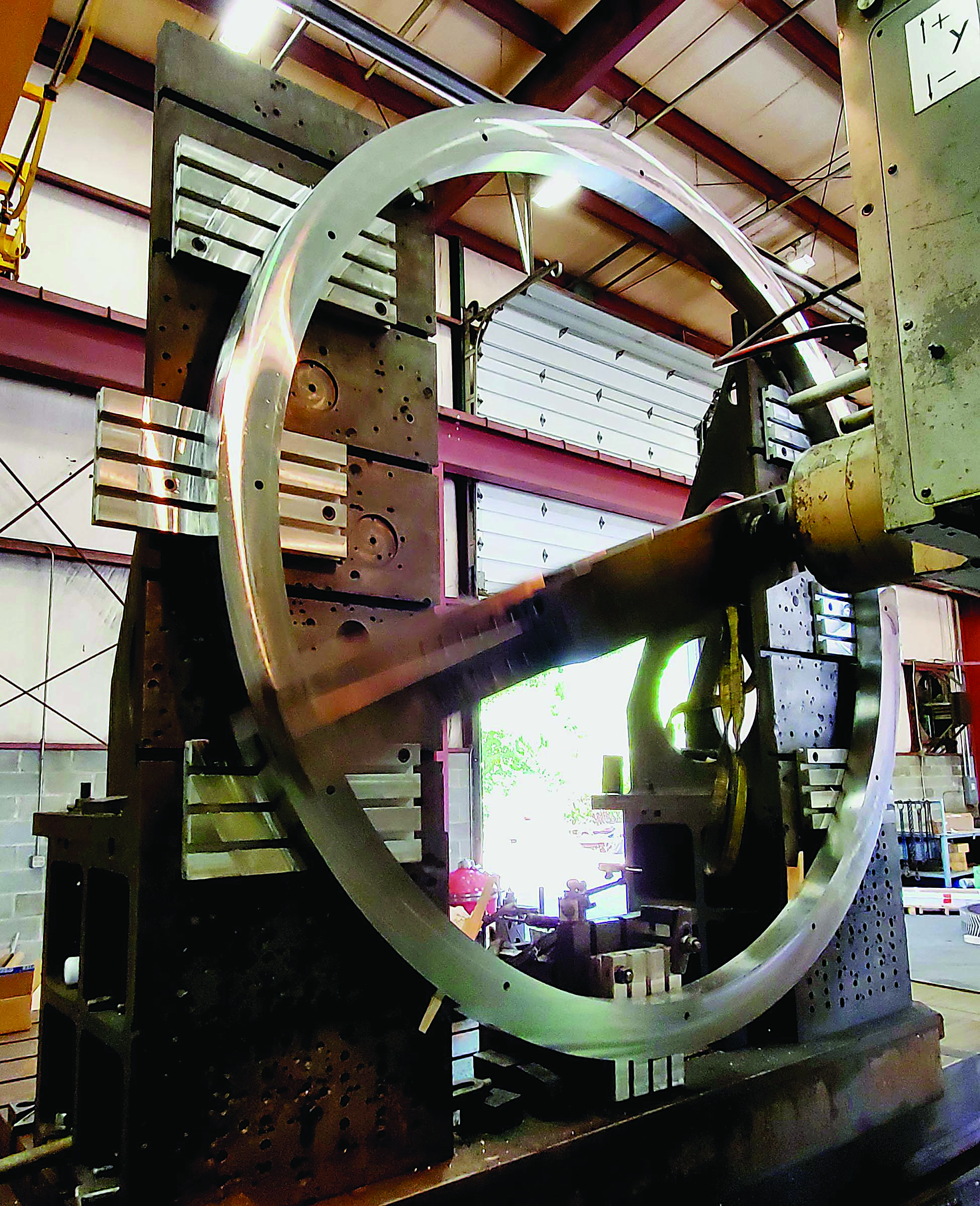
A 0.9 metric ton ring is bored at Akron Gear & Engineering. Image courtesy of Mitee-Bite Products
Lacking experience with goods from Mitee-Bite Products, Miller worried whether its workholders would be up to the task of holding the massive part.
“If the clamps or pins fail,” he said, “it’s coming down on me. You have to put your faith and trust into the salesman who is selling them to you, hoping he is not exaggerating on the quality of his parts.”
Bishop estimated that it would take more than 4,536 kg (10,000 lbs.) of force to shear an XYZ Xpansion pin, which is made of 17-4 PH stainless steel.
“We were not concerned about any lack of strength in the x, y and z directions,” he said.
Miller said the OD of the ring measures 2,247.9 mm (88.5″), the ID is 1,993.9 mm (78.5″) and the thickness is 107.95 mm (4.25″). As it turned out, the part was taller than Akron Gear & Engineering’s angle plates, preventing the top section from being clamped.
Review the print ads from this magazine to continue
This quick advertiser review unlocks the rest of the article and keeps the full-screen reader focused on the ads instead of the page chrome.
Advertisers included in this article experience
Print placements connected to this article
or visit us online at dropsausa.com/MQL
Penn Foster
Penn Foster’s machinist training program offers 89 courses for aspiring apprentices. TWO INNOVATIVE MQL PRODUCT LINES ONE GREAT COMPANY The Miquel is for External MQL Applications The MaXtreme is a new product that is for Through-Tool Applications. Please visit our website showcasing an application utilizing MQL with 3MM.
Penn Foster Penn Foster’s machinist training program offers 89 courses for aspiring apprentices. TWO INNOVATIVE MQL PRODUCT LINES ONE GREAT COMPANY Give us a call at (586) 566-1540 or visit us online at dropsausa.com/MQL The Miquel is for External MQL Applications The MaXtreme is a new product that is for
Visit or visit us online at dropsausa.com/MQL View this placement in the issue recordPrint ads from this magazine
Penn Foster’s machinist training program offers 89 courses for aspiring apprentices. TWO INNOVATIVE MQL PRODUCT LINES ONE GREAT COMPANY The Miquel is for External MQL Applications The MaXtreme is a new product that is for Through-Tool Applications. Please visit our website showcasing an application utilizing MQL with 3MM.
Penn Foster Penn Foster’s machinist training program offers 89 courses for aspiring apprentices. TWO INNOVATIVE MQL PRODUCT LINES ONE GREAT COMPANY Give us a call at (586) 566-1540 or visit us online at dropsausa.com/MQL The Miquel is for External MQL Applications The MaXtreme is a new product that is for
Continue reading
June 2021
“It took a lot longer than what was expected because machining the unclamped area on the top produced a lot of vibration,” he said, adding that the ring took about a week to machine on the vertical turning center. “If we did it on the larger VTL, we could have done the entire job in two days.”
Miller began the work by applying a 152.4 mm (6″) facemill to cover the entire face in one pass. Adding to his concerns about vibration and chatter, the crust of the workpiece material was harder than the subsurface.
“I switched to a 4″ (101.6 mm) facemill to get through the surface,” he said. “Once below the crust, I was able to go back to (a) 6″ mill.”
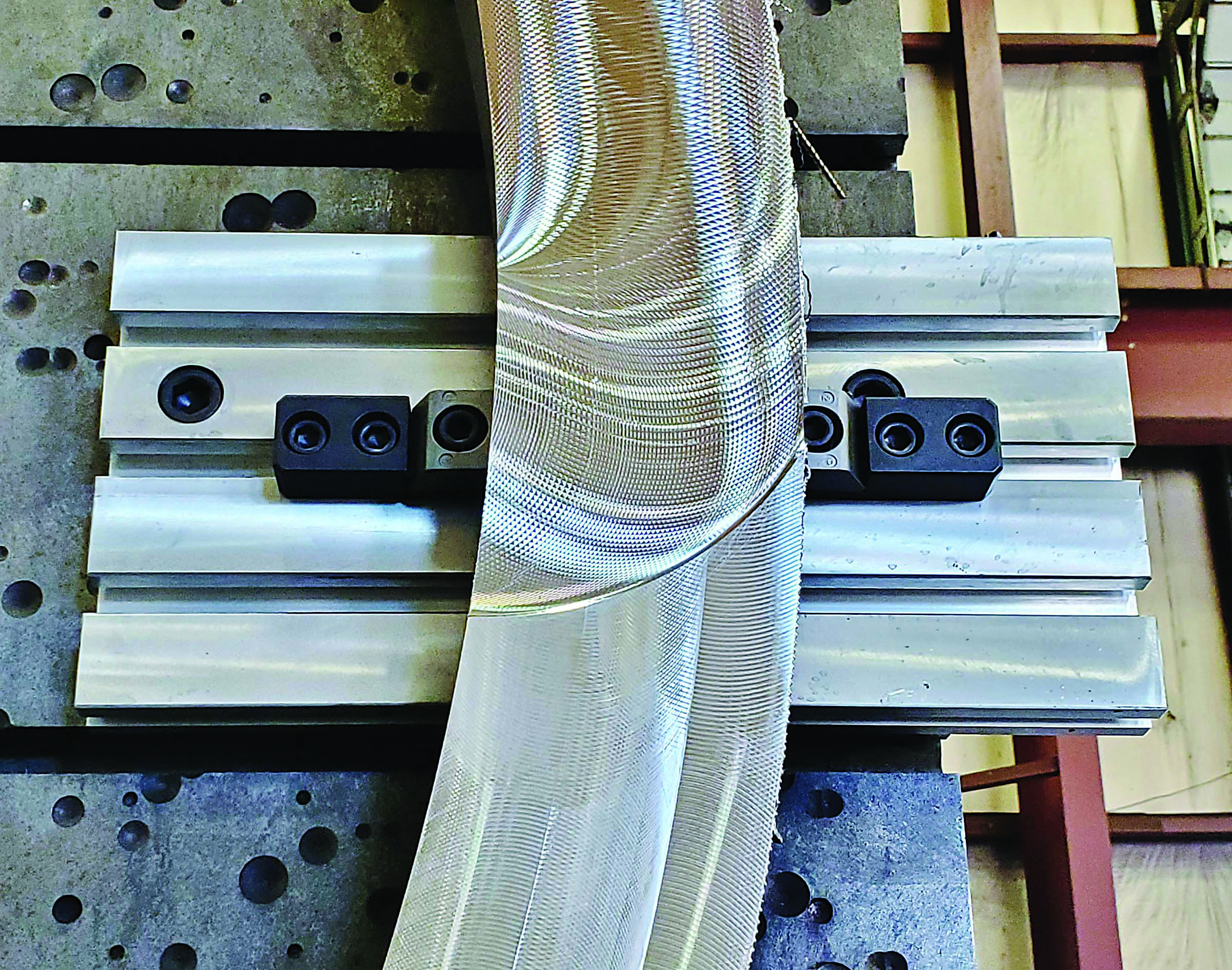
A detail is displayed of Mitee-Bite Products’ fixturing that Akron Gear
& Engineering used to hold a 0.9 metric ton ring. Image courtesy of Mitee-Bite Products
Miller said the larger facemill ran at a 1.524 mm (0.06″) DOC and a 2,286 mm/min. (90 ipm) feed rate to help minimize vibration. A 1.83 m (6′) boring bar from Allied Machine & Engineering Corp. with a single-point insert was used to finish the OD and ID, taking from 0.508 to 0.762 mm (0.02″ to 0.03″) DOC per pass to remove the remaining 3.175 mm (0.125″) of material on both features.
He said the T-slot subplates were machined flat with a recess on both the ID and OD so that when the boring bar cleared the edge, the bar would not contact the subplates. They were bolted or clamped onto the angle plates, and the Pitbull clamps held the part in the first set.
“With this setup, I was able to mill and finish one face and drill and ream the holes in the part,” Miller said. “Once this operation was done, the ring was removed and holes were drilled and tapped into the subplates for the Xpansion pins. Once the pins were tightened down, I started the second side by milling the face and then circle milling the ID and OD to 0.125″ from finish size.”
He said the XYZ Xpansion pins leave the part free from clamp interference.
“We can do three sides in one setup,” Miller said, “saving a load of setup time from moving clamps and indicating the bore countless times. Just goes to show you that you don’t need the biggest clamp to hold the bigger parts.”
After completing the job, he asked the sales representative at the initial supplier that Akron Gear & Engineering had considered why the sales rep never replied.
“He blamed it on COVID-19,” Miller said.
“What really impressed me was how quickly (Akron Gear & Engineering) put the plan in action,” Bishop said. “As the old saying goes, if you’re not making chips, you’re not making money.”