



A flash of ceramic: General Industry Coverage
A fixturing system for enabling ceramic coatings to be efficiently deposited via cathodic arc evaporation.
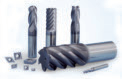
Because they’re quite hard and durable, ceramic coatings effectively protect cutting tools and wear parts. Metals, such as titanium aluminum or titanium, can be reactively deposited with nitrogen to form the ceramic coatings TiAlN or TiN. This can be done by either sputtering or cathodic arc evaporation. To date, the nonreactive deposition of ceramic materials such as tungsten carbide and titanium diboride could only be achieved via magnetron sputtering, in part because of the lack of an appropriate fixturing system for the more efficient cathodic arc evaporation method, according to sputtering target and cathode manufacturer Plansee.
Arc evaporation deposits coatings faster than magnetron sputtering, noted Paul J. Rudnik, who is based in Saline, Mich., and is the company’s sales and marketing manager – hard coating and coating product manager for North America. “In arc evaporation, you have more highly ionized particles and that gives a lot of energy to the coating,” he said.
Courtesy of Plansee
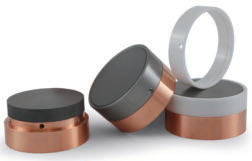
A fixturing system comprised of an integrated carrier plate and cathode ring from Plansee enables efficiently coating cutting tools with ceramic coatings via cathodic arc evaporation.
Rudnik noted puck-like cathodes, or targets, for arc deposition coating equipment need a lip on one end to ensure the arc remains on the cathode material during the coating process—it helps prevent the arc from jumping to the outside—and a threaded hole on the other end to bolt a target into position.
That requires machining a lip and threading a hole, which is time-consuming, expensive and difficult—at best—when the target is a hard, brittle ceramic, which tends to fracture when machined. A target, however, is still subject to being damaged after machining. “A lot of people take a pair of pliers and crank it down onto the bolt,” Rudnik said.
Instead of machining the target, Plansee introduced a reusable fixturing system with a molybdenum or ceramic ring that encloses the cathode to prevent the arc from jumping and a carrier plate to bolt the cathode into the coating machine. Copper is an ideal plate, or base, material for the fixturing system because it transfers heat, is easily threaded and can be grasped by pliers without being damaged, Rudnik noted. Molybdenum is an option for the plate when the cathode material’s thermal expansion coefficient requires it.
According to Rudnik, the cathode fixturing system provides companies depositing via arc deposition with additional coating options. “Before, you couldn’t even try to use these ceramic materials as coatings because we couldn’t manufacture the targets,” he said.
For more information about Plansee USA LLC, Franklin, Mass., call (508) 446-1405 or (508) 553-3800 or visit www.plansee.com. CTE
Related


Subscribers can use MFGAxis notes, saves and discussion tools with their innoNET account.


