


Flexible hones save damaged parts
END USER: Elmar Industries, (716) 681-5650, www.elmarworldwide.com.CHALLENGE: Bring damaged components back into spec.SOLUTION: A flexible cylinder hone.SOLUTION PROVIDER: Brush Research Manufacturing Co. Inc., (323) 261-2193, www.brushresearch.com.
END USER: Elmar Industries, (716) 681-5650, www.elmarworldwide.com.
CHALLENGE: Bring damaged components back into spec.
SOLUTION: A flexible cylinder hone.
SOLUTION PROVIDER: Brush Research Manufacturing Co. Inc., (323) 261-2193, www.brushresearch.com.
Whether for smoothing rough areas and high points, deburring, edge blending, chamfering, polishing, crosshatching or removing cut, torn and folded metal, a flexible cylinder hone can be an indispensable tool for field repairs, according to Brush Research Manufacturing Co. Inc., Los Angeles. Products like BRM’s Flex-Hone allows parts such as carbide bushings, bore sleeves, hydraulic and pneumatic cylinders, and others with cylindrical cavities to be resurfaced using a standard drill.
Characterized by the small, abrasive globules that are permanently mounted to flexible filaments, the Flex-Hone can deburr and clean passages or provide IDs with a smooth plateau finish, according to the company. The tool is ideal for field applications because it is self-aligning and self-compensating for wear, which facilitates close-tolerance finishing.
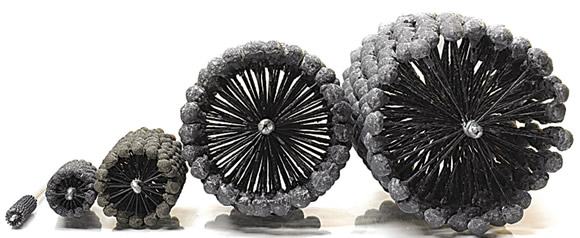
Brush’s Flex-Hone allows parts with cylindrical cavities to be resurfaced using a standard drill. Image courtesy Brush Research Manufacturing.
Elmar Industries, Depew, N.Y., a food processing company that designs and manufactures filling machines for the food, beverage, petrochemical, personal care and pharmaceutical industries, reported that a flexible cylinder hone helped save the day for one of its customers. That customer had purchased one of Elmar’s 45-piston machines but the machine incurred damages prior to production. The rotary-piston models have a large, rotating bowl for product with six to 72 filling stations. Each station is built with a valve housing and rotary valve, which dispenses a metered quantity of product, and the tolerance between valve and housing is 0.001 ” (0.0254mm).
Construction at the customer’s facility one floor above the machine caused some concrete and metal shavings to fall into the filling bowl. When the machine was started, the concrete particles and metal chips moved from the rotating bowl into the rotary valves, scarring the housings and damaging the valve plugs. The estimated replacement cost for the damaged equipment was $60,000.
“In this case, the machine hadn’t even run its first product,” said Thomas Dahlquist, special projects manager for Elmar. “When you have a capital improvement project and the customer is looking at an expensive bill for replacement parts before production even begins, they want a quick, cost-effective solution.”
Unfortunately, the valve plugs were damaged beyond repair, which comprised about half the estimated replacement cost. However, Dahlquist suggested honing each cylinder to remove any raised lips or high points, then inserting new valve plugs, which would save the customer $30,000.
Elmar is familiar with cylinder hones, having previously used them to manufacture valve bodies. Specifically, it used Flex-Hone tools in the field to hone undersized or out-of-tolerance cylinders from time to time.
To assist in the repair, Dahlquist traveled to the customer’s site with several 2.25 ” (57.15mm) Flex-Hones that together cost less than $200. In about 4 hours, Dahlquist honed each of the 45 housings to the appropriate specification, utilizing a dial bore gage to verify the tolerance between valve and housing.
“With the Flex-Hone, a drill and a drill holder, we were able to rework each of the valve housings on the machine by hand,” Dahlquist said. “We were able to smooth out all the high points and insert the new valves.”
As a result, the customer was able to begin production within a few weeks. “This was a unique application that saved a customer a lot of money. They were very happy that they were able to get on with their production,” Dahlquist added.
Glossary terms in this article
Related


Subscribers can use MFGAxis notes, saves and discussion tools with their innoNET account.