

GMN Introduces High-Speed Spindles for Improved Machining
The Look Ahead department in the October issue of Cutting Tool Engineering features a high-speed spindle that reduces natural vibrations.
Spindle manufacturer GMN reports that greater cutting depths, higher material-removal rates and finer surface quality when roughing, finishing and grinding can be obtained with its new range of high-speed spindles.
Standard spindles undergoing high machining forces often lead to “rattling,” caused by insufficient damping of natural vibrations, according to Bernd Möller, head of spindle development at GMN Paul Müller Industrie GmbH & Co. KG, Nuremberg, Germany. These vibrations have serious consequences, including the creation of rough, partly scratched surfaces, uneven cutting tool edges and even spindle failure. “Our analysis was showing that there is a good chance to improve the dynamic behavior by introducing more damping into the spindle with the help of a hydraulic system,” he said.

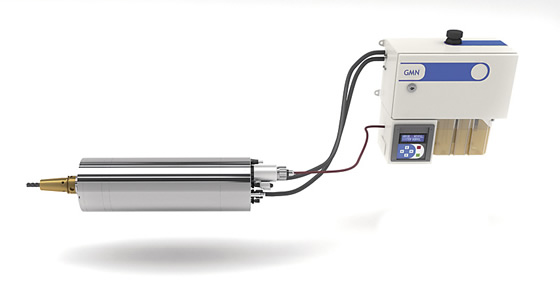
Hydroviscous damping systems are structurally identical to standard models and can be easily retrofitted to existing machines. Image courtesy GMN.
Studies conducted in cooperation with the Laboratory of Machine Tools and Production Engineering (WZL) at the Rhine-Westphalia Institute of Technology Aachen determined it was possible to double the minimum stable cutting depth at speeds from 10,000 to 18,000 rpm with GMN’s HCS 280 high-speed spindle.
In practice, it is almost impossible to select optimal speeds for cutting from a stability chart. Even at slower speeds, Möller said that hydroviscous damping offers good surface results up to a plunge depth of 6mm (0.236 “). A depth of only 3mm (0.118 “) was achieved using a standard spindle under the same conditions. Surface quality also improved for internal cylindrical grinding and surface grinding when performed with a hydroviscously damped spindle, producing a roughness of 0.89µm compared to 2.36µm using a standard model.
Review the print ads from this magazine to continue
This quick advertiser review unlocks the rest of the article and keeps the full-screen reader focused on the ads instead of the page chrome.
Advertisers included in this article experience
Print placements connected to this article
(Rz ≤ 0.01 µm). www.hornusa.com
Quality Taken to the Extreme
Efficiency, polished to perfection. Create brilliant finishes with MCD monocrystaline diamond tools, developed for ultra-precision machining of aluminum, brass, silver, gold, platinum or acrylic glass. Designed with one goal in mind, eliminate secondary polishing operations in non-ferrous materials and HO R N – E X CE L L E N C E I N T E C H N O L O G Y.
Quality Taken to the Extreme Efficiency, polished to perfection. Create brilliant finishes with MCD monocrystaline diamond tools, developed for ultra-precision machining of aluminum, brass, silver, gold, platinum or acrylic glass. Designed with one goal in mind, eliminate secondary polishing operations in non-ferrous materials and precious metals on lathes and mills. Produce highly reflective surfaces down to the nanometer range www.hornusa.com (Rz ≤ 0.01 µm). www.hornusa.com HO R N – E X CE L L E N C E I N T E C H N O L O G Y GROOVING PARTING OFF GROOVE MILLING BROACHING PROFILE MILLING REAMING
Visit (Rz ≤ 0.01 µm). www.hornusa.com View this placement in the issue recordPrint ads from this magazine
Efficiency, polished to perfection. Create brilliant finishes with MCD monocrystaline diamond tools, developed for ultra-precision machining of aluminum, brass, silver, gold, platinum or acrylic glass. Designed with one goal in mind, eliminate secondary polishing operations in non-ferrous materials and HO R N – E X CE L L E N C E I N T E C H N O L O G Y.
Quality Taken to the Extreme Efficiency, polished to perfection. Create brilliant finishes with MCD monocrystaline diamond tools, developed for ultra-precision machining of aluminum, brass, silver, gold, platinum or acrylic glass. Designed with one goal in mind, eliminate secondary polishing operations in non-ferrous materials and precious metals on lathes and mills. Produce highly reflective surfaces down to the nanometer range www.hornusa.com (Rz ≤ 0.01 µm). www.hornusa.com HO R N – E X CE L L E N C E I N T E C H N O L O G Y GROOVING PARTING OFF GROOVE MILLING BROACHING PROFILE MILLING REAMING
Continue reading
October 2015
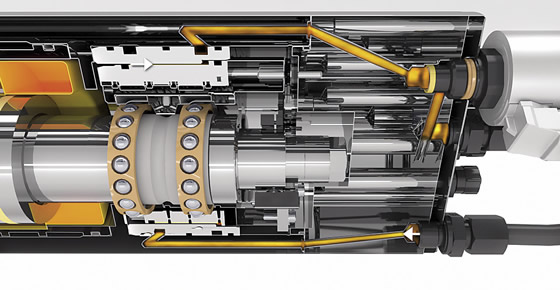
The damping system is fully integrated into the spindle, and the bearing preload can be controlled via oil pressure. Image courtesy GMN.
The high-speed spindles are independently driven by a hydraulic power unit. The bearing preload can be controlled via oil pressure. This way, the rigidity of the spindle can be modified and its behavior optimized, depending on the machining task, spindle speed and tool. An increased preload, for example, can improve spindle performance at lower speeds.
“The target of our development was to combine the advantages of ball bearings and hydrostatic bearings,” Möller explained. “Ball bearings have low-friction, high-speed capability and are insensitive to high overloads, while hydrostatic bearings are used, in some cases, for spindles when very high accuracy and low vibration are needed.”
The hydroviscous damping system incorporates a specially developed linear hydrostatic bearing for the floating bearing to add viscous damping to the ball bearing arrangement.
“Introducing damping often has the disadvantage of reducing system stiffness, but due to the unmodified front bearing setup and stiffness of the hydrostatic bearing (compared to squeeze film or O-ring damping), we can achieve a high rigidity of the spindle with hydroviscous damping,” Möller said. “Our unique linear bearing design allows us to use a compact oil supply with a small flow rate and low power requirement.”
These high-speed spindles will be available in the near future for manual tool changes, automatic toolchanger (ATC) spindles with custom housings and custom spindles for OD grinding and combined grinding processes.
For more information about GMN USA LLC, Farmington, Conn., call (800) 686-1679 or visit www.gmnusa.com.
Glossary terms in this article
Related




Subscribers can use MFGAxis notes, saves and discussion tools with their innoNET account.


