
Grinding steel shafts puts shop in ‘fowl’ mood
Grinding steel shafts puts shop in ‘fowl’ mood
A shop that cylindrically grinds steel shafts is having trouble keeping up with tighter and tighter surface-finish tolerances. Though the shop can hold the finish, roundness and size take a hit. So the shop seeks the Grinding Doc's advice.
Dear Doc: I cylindrical-grind steel shafts. Over the years, the surface-finish and tolerance requirements have been getting tighter and tighter. Tolerances are currently ±0.0001". I can hold the finish, but roundness and size are killing me. What can I do?
The Doc Replies: Holding those requirements is very doable, but only if you have all your ducks in a row. Let's look at these ducks one by one.
Duck 1: Use the right grit size. Finer surface finishes require smaller grits. As surfaces get smoother, operators should switch to finer grits. But typically they don't. Instead, they stick with their big grits—say, 60 instead of 120 mesh—and then dress the wheel dull. This approach results in a finer finish. However, it also creates a large tangential force (the force that resists rotation of the wheel, which is proportional to heat generation), causing burn, and much larger normal forces (the forces that pushes up on the spindle), causing part deflection and burn.
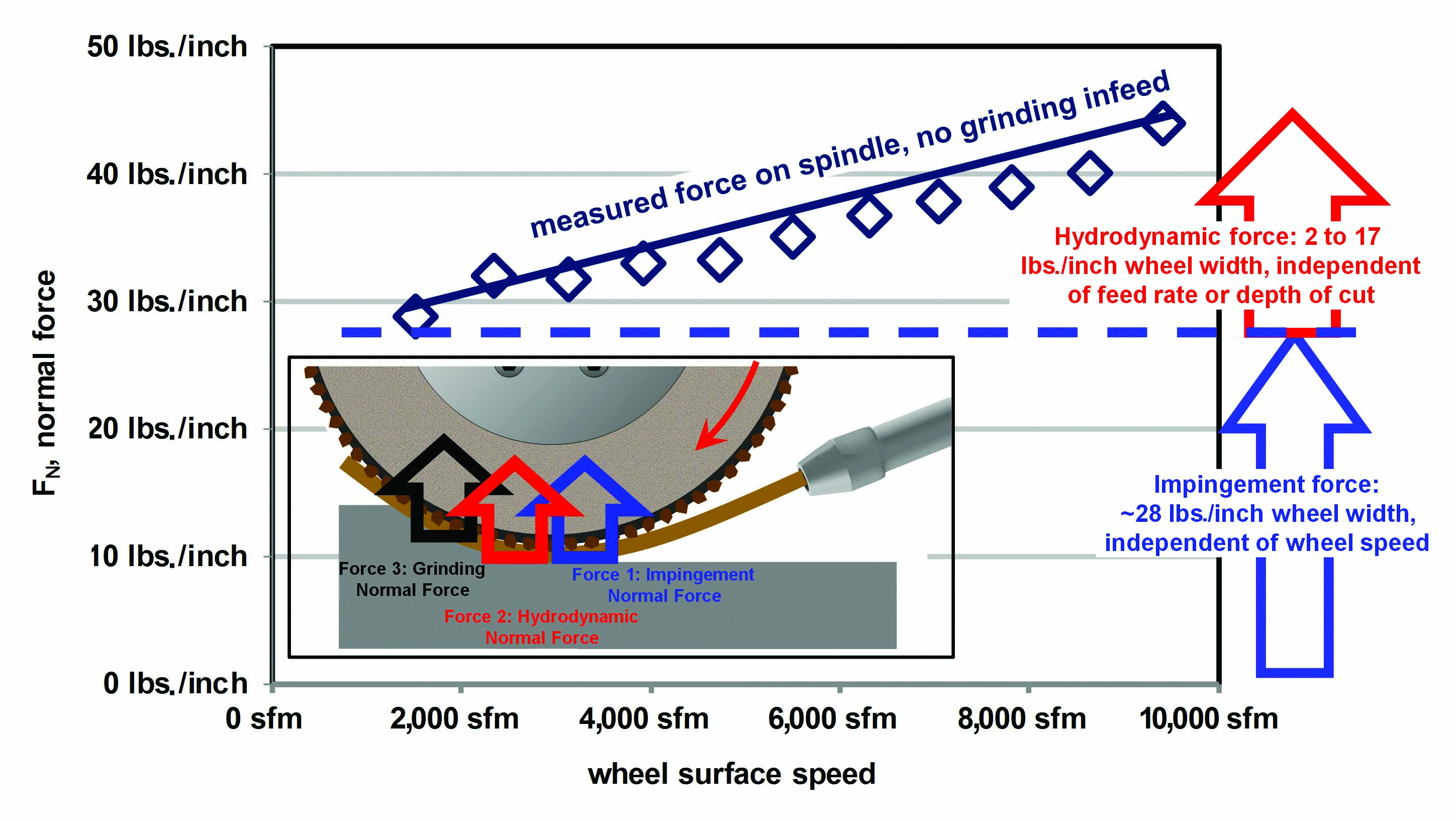
The late grinding guru Stephen Malkin divided coolant forces into the impingement force
and the hydrodynamic force. These forces can become huge and cause serious part deflection.
Image from "Measurement of Hydrodynamic Forces in Grinding" by M. Ganesan, C. Guo and S. Malkin.
Duck 2: Avoid integer values during finishing and sparkout. Divide the wheel rpm by the workpiece rpm. Your answer should be something like 8.4523421 or 11.3962452. You want to avoid 8.00434, 11.003515 or anything close to a whole number.
Duck 3: Avoid hydroplaning. Here things get tricky. During grinding, you want effective cooling. But effective cooling creates hydroplaning forces, which can be as high as 50 lbs./in. of wheel width. During sparkout, that hydroplaning force is much bigger than the grinding force, causing both roundness and size issues. The solution is to gradually throttle back coolant pressure during finishing and sparkout. For tight tolerances, reducing hydroplaning forces helps enormously.
Duck 4: Chill your coolant, not because it helps suck away heat (the difference is minimal), but because hot things like to expand. If the workpiece temperature is 90° F in the machine because the coolant is 90° F, and then the workpiece is sent to the inspection room, which is 70° F, it will shrink. Keep the coolant temperature and inspection room temperature the same.
You'll have to get these four ducks in a row if you hope to hold tight tolerances.