

Height of accuracy: General Industry Coverage
As abrasive waterjet cutting evolved and enabled the production of complex, 3D part geometries, it became critical to accurately and efficiently know and maintain the standoff height, or distance, between the exit of the waterjet nozzle and the workpiece.
As abrasive waterjet cutting evolved and enabled the production of complex, 3D part geometries, it became critical to accurately and efficiently know and maintain the standoff height, or distance, between the exit of the waterjet nozzle and the workpiece. This need becomes more important as the waterjet cutting head tilts to dynamically correct part taper or cut 3D shapes, such as bevels, from a flat sheet, because the standoff distance changes. When this occurs, the waterjet machine must maintain a fixed standoff distance while the jet is tilting to compensate for taper.
Traditional height monitoring methods are mechanical and touch the workpiece to follow the contour and gain the needed information, but the monitoring process becomes more complicated and challenging when waterjetting more intricate geometries, according to Dr. Mohamed Hashish, senior vice president of technology at Flow International Corp. “Originally, we just wanted to follow the shape on the part contour,” he said. “Then, it became important to tilt the jet while maintaining a focal point on the workpiece to produce accurate parts.”
He added that a secondary concern of a tactile method is the height monitoring device can scratch the workpiece.
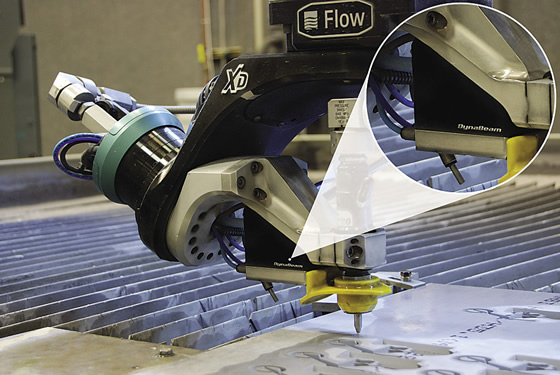
Courtesy of Flow International
The DynaBeam laser sensing system from Flow provides a method for setting the nozzle offset height without contacting the workpiece.
As a result, Flow determined waterjetting needed a noncontact method—a waterjet industry first, according to the company—and turned to laser height sensing because it is an established technology. Flow developed what it calls the DynaBeam laser sensing system.
To determine standoff height, which typically ranges from 0.050 ” to 0.100 ” (1.27mm to 2.54mm), the company uses a diode laser mounted on the cutting head’s end effector, Hashish explained. The laser hits the workpiece and is reflected back at an angle to a sensor on the laser device, which then calculates the distance the beam travels based on the angle. “It’s a very basic principle called ‘laser triangulation,’ ” he said, noting it needs to be performed in a clean environment.
Review the print ads from this magazine to continue
This quick advertiser review unlocks the rest of the article and keeps the full-screen reader focused on the ads instead of the page chrome.
Advertisers included in this article experience
Print placements connected to this article
Uberchuck
marketplace
Cutting EXPERIENCE LUCIFER FURNACES Quality Performance Success Titanium? THE FASTEST MACHINES ■ ■ IN THE UNIVERSE ■ Energy Efficient ■ Electric or Gas Atmospheres Temperatures to 3000°F Runs Faster, Sleeps Less ■ Easy to Operate de Ma USa OIL MIST & SMOKE IN IN YOUR SHOP? We Buy Carbide • Standard marking tools • Customized.
marketplace Cutting EXPERIENCE LUCIFER FURNACES Quality Performance Success Titanium? THE FASTEST MACHINES ■ ■ IN THE UNIVERSE ■ Energy Efficient ■ Electric or Gas Atmospheres Temperatures
Visit Uberchuck View this placement in the issue recordSecotools
CHALLENGE:
Finding optimal tooling for particularly challenging applications VISIT US AT IMTS 2014 IN BOOTH W-1564! SOLUTION: SECO CUSTOM TOOLS • Our team puts limitless expertise at your disposal • Engineers study your application to fully understand your needs • Receive a solution tailored to your specific component, whether an adapted standard or.
CHALLENGE: Finding optimal tooling for particularly challenging applications VISIT US AT IMTS 2014 IN BOOTH W-1564! SOLUTION: SECO CUSTOM TOOLS • Our team puts limitless expertise
Visit Secotools View this placement in the issue recordPrint ads from this magazine
Cutting EXPERIENCE LUCIFER FURNACES Quality Performance Success Titanium? THE FASTEST MACHINES ■ ■ IN THE UNIVERSE ■ Energy Efficient ■ Electric or Gas Atmospheres Temperatures to 3000°F Runs Faster, Sleeps Less ■ Easy to Operate de Ma USa OIL MIST & SMOKE IN IN YOUR SHOP? We Buy Carbide • Standard marking tools • Customized.
marketplace Cutting EXPERIENCE LUCIFER FURNACES Quality Performance Success Titanium? THE FASTEST MACHINES ■ ■ IN THE UNIVERSE ■ Energy Efficient ■ Electric or Gas Atmospheres Temperatures
Continue reading
July 2014
However, with water splashing, abrasive flying and vapor rising, a waterjet machine is not a welcoming place for obtaining accurate distance information from a laser beam. Therefore, Flow shields the laser beam in an air jet to prevent water and debris from interfering with its path.
The DynaBeam sensor has an accuracy of ±0.004 ” (±0.1mm), which Hashish said is suitable for waterjetting.
The laser height sensing system maps the natural, or original, state of the workpiece material prior to machining to obtain its topography, which can change during machining because of warping and stress relieving. This reduces the need for manual adjustment throughout the cutting process and, thereby, increases productivity, Hashish noted. Operators can automatically set the standoff height before every waterjet pierce of the workpiece or premap the entire workpiece.
“You can map the part as many times as needed to maintain cutting accuracy,” Hashish said. “Usually, it’s only required once at the beginning or sometimes before piercing in different locations every time you make a shape.”
The DynaBeam system is available as a standard feature on the company’s waterjet machines. “The noncontact idea is to have less maintenance, no moving parts, use standard tooling technology and allow free access to do 3D cutting,” Hashish said.
For more information about Flow International Corp., Kent, Wash., call (800) 446-FLOW or visit www.flow waterjet.com.
Glossary terms in this article
Related




Subscribers can use MFGAxis notes, saves and discussion tools with their innoNET account.


