


Hexagon Gathering Emphasizes Industry Need For ‘true Autonomy’
For Hexagon AB, Stockholm, Sweden, 2025 marks a quarter century of measurement technology development since acquiring manufacturer Brown & Sharpe.
During the Hexagon Live Global conference held June 16-19 in Las Vegas, Ola Rollén, chairman of the board for Hexagon AB, Stockholm, Sweden, noted that 2025 marks a quarter century of measurement technology development since the company’s acquisition of metrology tool manufacturer Brown & Sharpe.
Although the French invented the metric system, “we invented the cloud point,” Rollén added during his keynote presentation, titled “Beyond Measure – Unlocking the Next Frontier of True Autonomy.”
“All great leaps, all great feats that mankind takes,” he emphasized, “involve some kind of measurement technologies.” For example, traveling to the moon requires knowing the distance to the moon and the size of the fuel tank needed to hold enough fuel to return safely to Earth.
Until about 2010, the company was in Phase 1, focusing on sensor development, Rollén said. Since then, Hexagon has been bridging the physical and digital worlds during Phase 2 to further enhance productivity.
“It becomes an endless feedback loop of digital data going back and forth between the digital world and the real world,” he continued. “Today we call it ‘digital twins.’ And this is a true watershed moment for most industries — from med tech to mechanical engineering, electronics, and so forth.”
Rollén stressed that shops can use the capacities in the software world to simulate and fine-tune their machining operations before ever running an actual job. While many people fear that artificial intelligence and automation will take jobs away from the human workforce, Rollén underscored the importance of true autonomy by noting that populations in the U.S., Europe and China are projected to significantly decline by the end of the century.
“We have a huge problem ahead of us, and we need to address it,” Rollén said. “It’s time to act.”
For his part, Arnaud Robert, president of Hexagon’s Robotics division, outlined what it will take to reach the needed level of autonomy.
“We need to move beyond automation into versatility,” Robert said. “Versatility requires robots to do two things: be multipurpose and adaptable.”
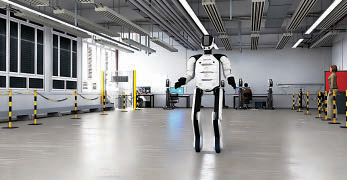
Robert then introduced the Aeon humanoid robot for industrial applications. Inside the robot, which can perform self-swapping of batteries for continuous operation, are three computers: one general computing engine and two AI engines “to do everything we can do from AI at the edge.”
In addition, Aeon has 12 cameras and 22 sensors. “Once you have those sensors,” he explained, “you not only have awareness but — frankly, more importantly — a lot of use cases [that] are unlocked with those sensors: reality capture, asset inspection, and so on.”
—Alan Richter
Related
Subscribers can use MFGAxis notes, saves and discussion tools with their innoNET account.