High Performance at High Speeds
High Performance at High Speeds
The economic benefits of high-speed machining can be lost if the wrong tools are used. This article describes the types of solid-carbide drills and endmills that can ensure long-running performance. It also covers the proper handling and setup of these tools.
How do you determine whether or not a high-speed machining process is successful? If you're a machine operator, success means you were able to run at a rate faster than the current process rate. To a process engineer, success means exceeding the recommended speeds and feeds for the operation and the material being machined. An R&D engineer is satisfied when he breaks new barriers in a machining process. Management appraisals of a high-speed machining process, however, will be based on the bottom line: Does the operation profit the shop by increasing productivity, reducing scrap, and improving quality? If a high-speed machining process fails to meet these criteria, then there is no justification for it. Running at 400 ipm or 2,000 sfm means nothing if you can't do it every day at a lower cost than current conventional processes. But users are finding they can't simply load parts on a high-speed machining center, program higher speeds and feeds, and automatically reap a profit. All other components of the operation must be adapted to meet the special needs of high-speed machining as well. It is especially important that the user selects the right cutting tool for the job. To know which tool will perform best, the user must become better educated in all facets of the high-speed machining process.
Tool Selection
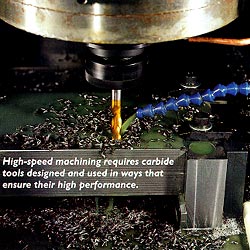
A common myth is that the rotating cutting tool or its design is at fault whenever a high-speed machining process fails. Users must learn that a tool will only perform well if it is used as the designer intended it to be used. Inexpensive HSS tools were not designed to withstand the extreme operating conditions of high-speed machining. For this reason, shops won't get a payback for their $1 million high-speed machining centers if they tool them with inexpensive HSS tools. HSS-tool users won't be able to hold tight tolerances and finishes, and they'll need to change tools too often. Worst of all, they'll have to run at speeds and feeds below the capability of the machine. Solid carbide, on the other hand, offers the strength, rigidity, and wear resistance required to handle the heat and cutting pressures that high-speed machining generates. To maximize high-speed machine investments, cutting tool manufacturers have designed rotating solid-carbide drills and endmills for implementation in high-speed/high-penetration machining processes. These high-performance cutting tools take advantage of modern equipment. Manufacturers charge more for them than they charge for conventional tools because they have to maintain closer tolerances, use premium materials, and perform more process operations to produce them. High-performance tools are only available from manufacturers that have sophisticated capabilities, such as computerized design and modeling systems, to validate designs through a controlled R&D process.
Tool Design
Manufacturers of true high-performance tools use quality solid carbide to ensure consistent tool performance. They maintain stringent metallurgical standards, and they manufacture with full-lot traceability of the raw material and the finished tool to guarantee consistency between product runs. High-performance tools are verified in an R&D laboratory. Manufacturers use CAD/CAM to link these pretested designs to their production machinery. For close-tolerance manufacturing, fixturing and CNC grinding machines control accuracy between pieces and runs. By mathematically defining and controlling wheel forms, the manufacturers ensure that the tools are ground consistently and, thus, perform consistently in the field. Manufacturers use SPC programs to monitor and control the production of their high-performance tools. A total quality program includes machine-capability studies, gage-control studies, in-process and final inspection procedures, and machine setup and run procedures. Smaller tool manufacturers generally do not have the resources to design true high-performance tools. When these companies call their products high-performance tools despite the lack of R&D to justify the label, it may lead end users to misapply the tools. To avoid implementing expensive tools in the wrong environment, users must perform cost analyses to determine the validity of high-performance products in their particular application. However, cutting tool manufacturers still have to be held accountable for the products that they label as high-performance. In high-speed machining, the tool performs under extreme cutting conditions. The manufacture of consistent, high-quality tools held to exact tolerances is paramount.

Conventional Flute Form
4-Facet Point
VS.

High Performance Drill
Rolled-Heel Flute Form
4-Facet Overlapping Radius Split Point
Figure 1: Profiles of a conventional drill and a high-performance solid-carbide drill designed for the high-speed machining of aluminum.
Tool Profiles
With improvements in CNC, grinding machines, and carbide grades, tool manufacturers have begun to produce high-performance designs for the high-speed machining of specific materials. These are expensive tools, but as they become more productive in their proper applications, their price will drop and the market will grow rapidly. Drills for aluminum. Although the proper cutting geometry depends on the application, the key to high-speed drilling is to optimize chip formation and evacuation to prevent welding of the aluminum to the chisel, which is caused by excessive heat generation. One tool design for drilling aluminum at high speeds has a rolled-heel flute form with a 4-facet overlapping radius split point (Figure 1). The flute form provides good chip evacuation by increasing flute volume area and reducing sharp corners. This enables the drill to feed at faster rates without clogged flutes or breakage. The point grind is web-thinned to reduce center pressure and eliminate chip pockets. The shape of the split facilitates chip evacuation away from the point. Helical coolant holes help increase tool life and drilling depths. Drills for steel. In the past, solid-carbide tools were not viewed as cost-effective for the drilling of steel. Poor drill geometries and the brittleness of the carbide often would cause these drills to fail due to excessive heat and poor chip formation. The low speeds and feeds of older machines, inadequate machine rigidity, and poor colleting techniques also limited the use of solid-carbide tools in steel applications. As a result of advancements in drill geometries, carbide grades, coatings, and machines, carbide is now a logical choice for drilling steel. Flute shape, sculptured split points, and honed cutting edges have been applied to carbide drill designs for steel materials (Figure 2). The flute form and the specialized point geometry control chip formation and evacuation, which is essential for drilling at very high speeds and feeds. The drill is designed to create short, curled chips shaped like sixes and nines. With this control of the chip, the user can produce a better finish on the hole wall, which is held to a tighter tolerance. Greater diameter-to-depth ratios also can be achieved. The main problem facing users of this type of drill is that they cannot resharpen it properly when it dulls. Because users lack the knowledge or the grinding technology to recreate the tool's original geometry, their attempts to reuse the drills have been met with only limited success. As a result of education and training by drill manufacturers and improvements in resharpening procedures, this situation is now changing, and users are beginning to get the full value out of their tools. Endmills for aluminum. Endmill designs for machining aluminum incorporate higher helix angles and radial rakes. These higher cutting rakes enable the tool to shear the material rather than plow it. This shearing action helps reduce heat and cutting forces and aids in proper chip formation. With such a geometry, high-speed milling is facilitated. It is not uncommon to see production exceeding 2,000 sfm. Roughing endmills for various materials. Solid-carbide roughing endmills with chipformers also are available for machining common materials. Different flute configurations (2, 3, 4, and 6) and chipformer patterns (U, V, and square) are used depending on the application. By reducing vibration and milling torque, the chipbreakers enable these endmills to be fed at rates up to four times faster than conventional carbide endmills without chipformers.

Conventional Flute Form
4-Facet Point
VS.

High performance drill
Curved edge/Rolled heel/Chamfered flute face
Sculptured S-shape point with honed
cutting edges
Figure 2: Profiles of a conventional drill and a high-performance solid-carbide drill designed for the high-speed machining of steel.
Handling and Setup
No matter how well a tool is designed, it won't perform to its potential if it is mishandled or improperly set up. Unfortunately, in too many shops, poor handling and setup practices that have been entrenched with HSS tools have carried over to rotating solid-carbide tools. These bad habits include using contact gaging for tool presetting, leaving the tools unprotected when not in use, and practicing poor toolholding techniques. High-speed machining requires the use of a noncontact presetting machine. These presetters won't chip the cutting edge when the user sets the tool offset distance. They also enable the operator to monitor and statistically document the tool runout in the holder. Proper handling and storage of carbide tools will help eliminate variables caused by damaged cutting edges. When the tools are not in use, they should be stored, clean and dry, in a sealed container. This reduces damage to the cutting edges. With the tool in a sealed container, it is also less likely that the cobalt binder will leech from the tool's surface. When the binder is removed from the surface, the tungsten-carbide grains are left without support. The resulting dull-gray, gritty surface shortens tool life and reduces the lubricity of the tool. When in use, the tool should be mounted firmly with a positive backstop to prevent the tool from backing up into the holder. Tool overhang should be kept as short as possible for the application. It is recommended that when the tool is at its full depth, its flutes should extend above the part line 1.75 diameters if it is a new tool or 1.50 diameters if it is a resharpened tool. The user should never chuck the tool with its flutes extended into the toolholder, because chips will pack into the holder. This will reduce toolholder life and accuracy. Overtightening the tool in the holder will build stresses in the operation that can cause tool failure. Static runout in the tool assembly should be accurately checked and maintained. Recommended limits are 0.0004" FIM (full indicator movement) for tools 0.018" to 0.125" in diameter; 0.0008" FIM for tools 0.126" to 0.375" in diameter; 0.0010" FIM for tools 0.376" to 0.500" in diameter; and 0.0012" FIM for tools 0.501" to 0.750" in diameter. External coolant should be supplied at the end of the tool and up the side of the flute. Using more than two supply lines can force chips back into the cut, which can shorten tool life or even cause tool failure. Tool performance will also be negatively affected if the coolant pressure or volume is too high. Internal through-the-spindle coolant should have a pressure of 70 to 150 psi with a volume of 0.5 to 1.0 gpm. Exceeding these limits can prevent proper flushing action. The tool user should perform studies to determine optimal settings.
About the Author
Mark McCollom is chief tool engineer at Precision Twist Drill Co., Solid Carbide Division, Crystal Lake, IL.