High-performance tool coatings provide vital protection
Because machine tools repeatedly remove material, frequently at high spindle speeds, to shape a workpiece, carbide cutting tools are often applied instead of HSS ones to retain a sharp cutting edge and extend tool life. However, when machining highly abrasive materials, such as carbon fiber-reinforced polymer, glass fiber-reinforced plastic, graphite, aluminum alloys or ceramics, even carbide tools can rapidly wear.
Because machine tools repeatedly remove material, frequently at high spindle speeds, to shape a workpiece, carbide cutting tools are often applied instead of HSS ones to retain a sharp cutting edge and extend tool life. However, when machining highly abrasive materials, such as carbon fiber-reinforced polymer, glass fiber-reinforced plastic, graphite, aluminum alloys or ceramics, even carbide tools can rapidly wear.
In these cases, further hardening carbide cutters with specialty coatings can significantly improve wear resistance and service life. For extremely expensive cutting tools, this not only reduces costs but shortens cycle times. These coatings come in a variety of types, from physical vapor deposition coatings to proprietary diamond coatings.
Greater Abrasion Protection
In a growing number of industries, including automotive and aerospace, manufacturers continue to place more emphasis on design and weight reduction. Designers subsequently increasingly use composite fiber-reinforced plastics in many parts, but these composites are exceedingly rough on cutting tools.
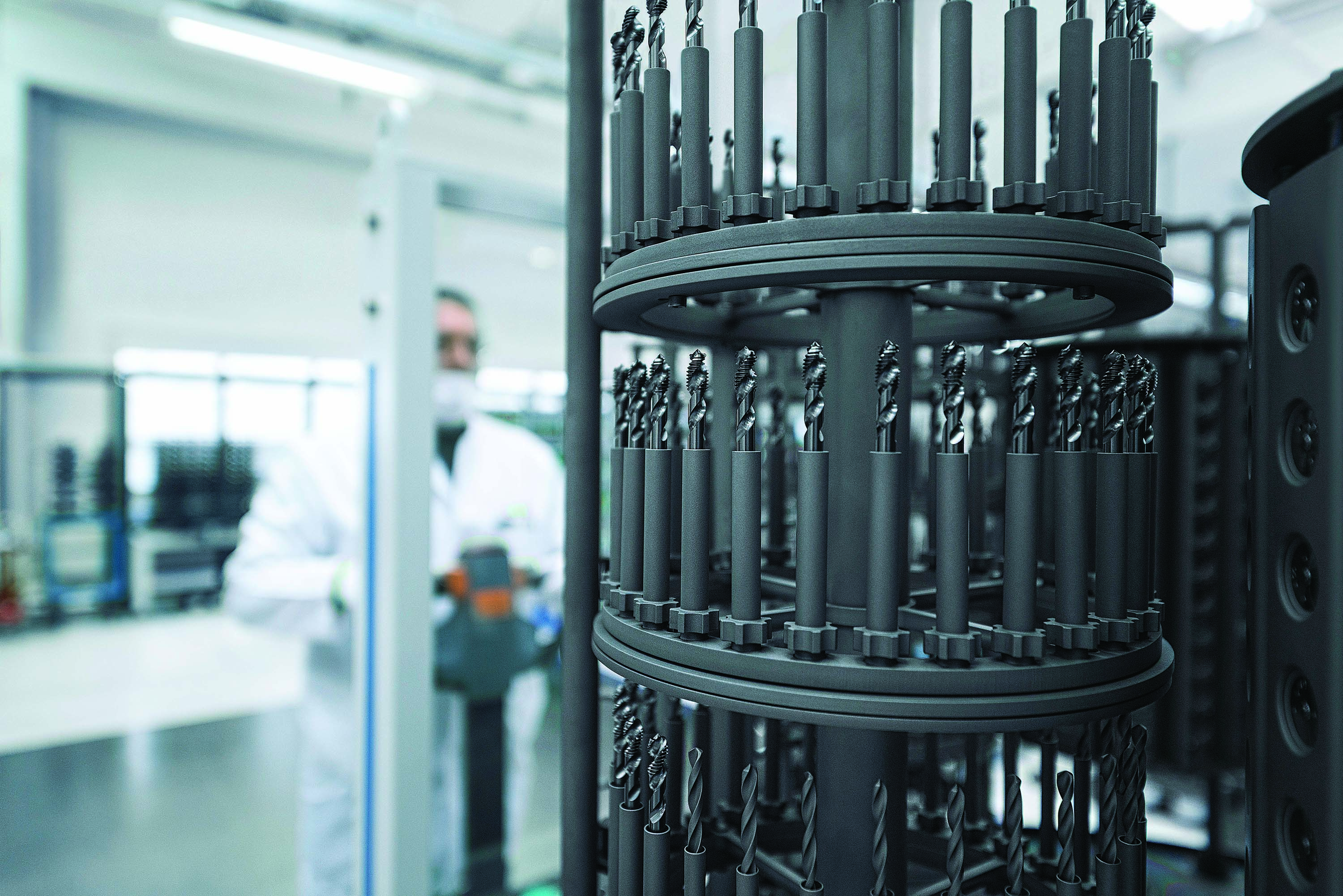
For cutting tools to withstand heavy wear, a specialty coating with a very high resistance to abrasion is needed. Image courtesy of Oerlikon Balzers
“The problem with the carbon and graphite fibers is that they are very high strength and extremely abrasive,” said Volker Derflinger, senior manager at Balzers, Liechtenstein-based Oerlikon Balzers, which has produced coatings for components and tools for more than 30 years. “For cutting tools to withstand heavy wear, it needs a specialty coating with a very high resistance to abrasion.”
In industries like automotive that require strong, lightweight materials, parts are also made of aluminum-silicon alloys. However, the higher the silicon content, the more abrasive the material.
“With aluminum-silicon alloys, there are very hard silicon particles embedded in the aluminum,” Derflinger said. “When you have to cut the material, the silicon content is extremely abrasive and can rip up the carbide tool. Even tooling with typical protective hard coatings can degrade very quickly.”
When it comes to machining very abrasive materials, uncoated carbide tools experience accelerated wear. To increase tool life, high-performance coatings provide a vital protective barrier. He said the ideal coating would have a very hard, protective surface that simultaneously maintains the sharp cutting edges that enable clean, precise cuts while boosting productivity.
PVD Coatings
One coating type increasingly being utilized in these industries is strong, nonhazardous PVD. PVD describes a variety of vacuum deposition methods that can deposit thin coatings. The process typically coats tools and components at relatively low temperatures from 150° to 500° C, which avoids altering the fundamental material properties.
Among the PVD options are several carbon-based coatings that provide a unique combination of extreme surface hardness and low friction coefficient properties. One example, Balinit Hard Carbon by Oerlikon Balzers, is suitable for machining nonferrous materials, including aluminum alloys with up to 12% silicon content.
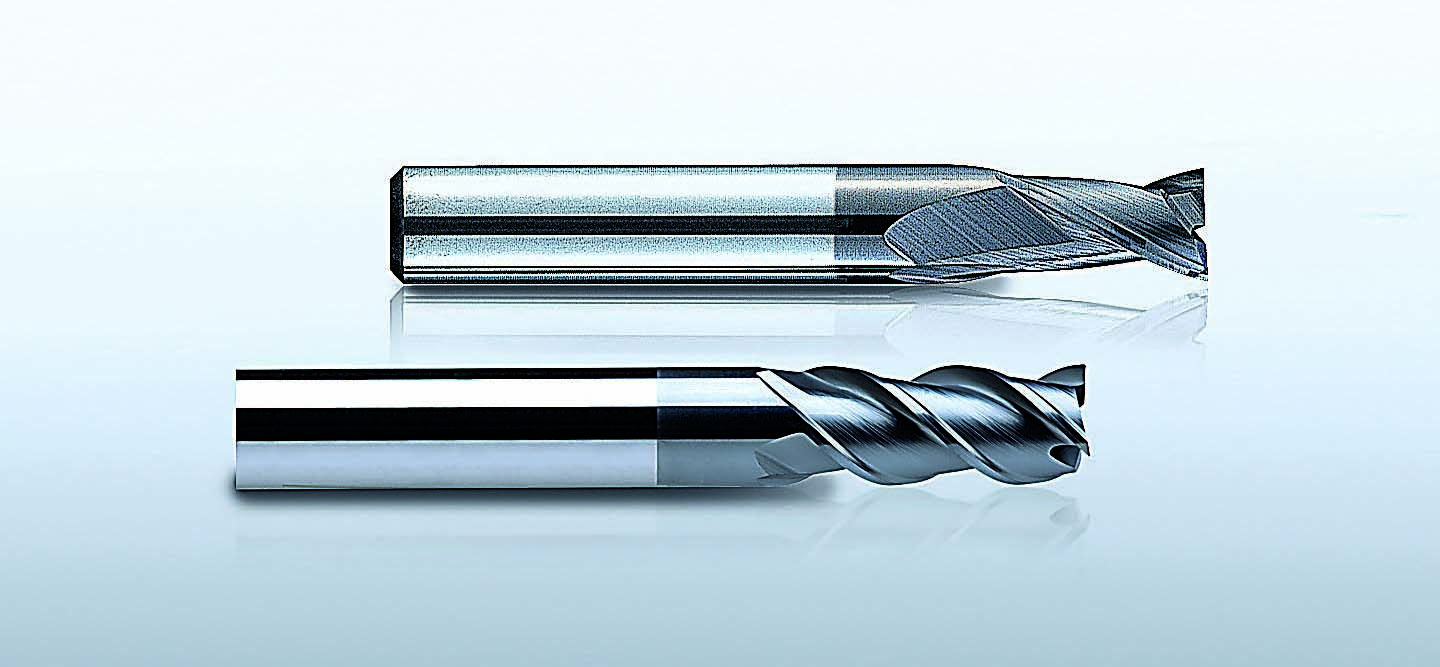
Balinit Hard Carbon by Oerlikon Balzers is deposited on tools to machine nonferrous materials, including aluminum alloys with up to 12% silicon content. Image courtesy of Oerlikon Balzers
“The Hard Carbon coating works on CFRP and GFRP but only when the fiber content is on the lower side,” Derflinger said. “The more fiber content, the more abrasive the material is, and then you need an even harder coating.”
The Balinit Hard Carbon coating has high hardness—40 to 50 gigapascals—making it appropriate for applications that require enhanced wear protection. In addition, the thin, smooth application helps maintain sharp cutting edges. For example, at a Malaysian manufacturer producing aluminum hard disk drive baseplates, a coated carbide endmill exhibited less abrasive wear and produced 95% more parts with 55% lower production costs than an uncoated tool.
The combination of coating hardness and a low friction coefficient can also dramatically improve production even when dry machining. In an application machining CFRP and thermoplastics, for instance, a Balinit Hard Carbon-coated countersink produced 180% more parts than an uncoated tool. In another case, a coated carbide endmill doubled the parts produced when dry machining compared with an uncoated tool using lubricant.
Diamond Coatings
Review the print ads from this magazine to continue
This quick advertiser review unlocks the rest of the article and keeps the full-screen reader focused on the ads instead of the page chrome.
Advertisers included in this article experience
Print placements connected to this article
Toolflo
The Threading Specialist!
FLO-LOCK ON-EDGE CHASERS API Threading chasers! Full line of standard threading inserts • Buttress, WW, NPT, Rounds... and toolholders with chip control! LAYDOWN Wide array of standard thread geometries in both inch and metric sizes! Extensive offering also includes chipbreaker items, multitooth configurations, and pressed.
The Threading Specialist! FLO-LOCK ON-EDGE CHASERS API Threading chasers! Full line of standard threading inserts • Buttress, WW, NPT, Rounds... and toolholders with chip control! LAYDOWN Wide array of standard thread geometries in both inch and metric sizes!
Visit Toolflo View this placement in the issue recordPrint ads from this magazine
FLO-LOCK ON-EDGE CHASERS API Threading chasers! Full line of standard threading inserts • Buttress, WW, NPT, Rounds... and toolholders with chip control! LAYDOWN Wide array of standard thread geometries in both inch and metric sizes! Extensive offering also includes chipbreaker items, multitooth configurations, and pressed.
The Threading Specialist! FLO-LOCK ON-EDGE CHASERS API Threading chasers! Full line of standard threading inserts • Buttress, WW, NPT, Rounds... and toolholders with chip control! LAYDOWN Wide array of standard thread geometries in both inch and metric sizes!
Continue reading
June 2019
When carbon content in composites or silicon content in aluminum alloys becomes too high, cutting tools typically require a diamond coating to minimize wear. Traditionally, PCD-coated cutting tools have been utilized in such instances. PCD is a composite of diamond particles sintered together with a metallic binder. Diamond is the hardest and therefore most abrasion-resistant material.
As a cutting tool material, PCD has good wear resistance but lacks chemical stability at high temperatures and dissolves easily in iron. So PCD tools are usually limited to materials like high-silicon aluminum, metal-matrix composites and CFRP. In addition, PCD tools are geometrically limited in structure and may be too rough or unrefined for optimal machining of the wide range of nonferrous materials. Finally, the initial cost of PCD cutting tools can be quite high.
As an alternative, plasma-assisted chemical vapor deposition can be used to apply crystalline diamond structures in varying thickness and roughness. This can be highly advantageous for machining CFRP, GFRP, graphite, nonferrous materials and ceramics. The diamond coating extends tool life while improving cutting quality and surface finish. With the PACVD process, a carbide cutting tool is sequentially coated by two different gases in a heated vacuum container assisted by plasma. The alternating cycles that built the atomic layer on the surface and the number of cycles thus control the thickness of the final coating.
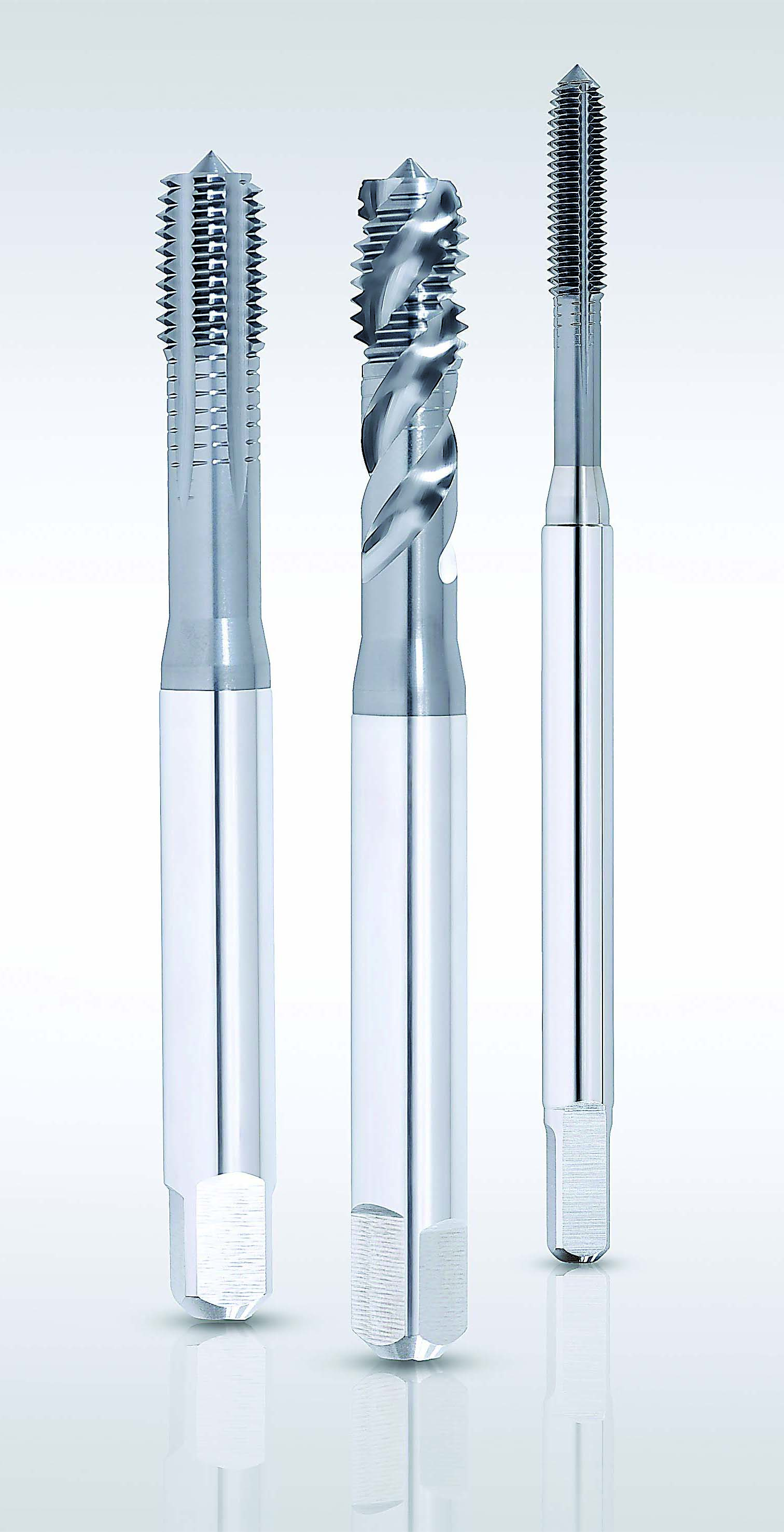
The ideal coating would have a very hard, protective surface that simultaneously maintains the sharp cutting edges. Image courtesy of Oerlikon Balzers
“As a cost-effective, high-performance alternative, specialized PACVD-based diamond coatings can increase the service life of the tool,” Derflinger said.
He said standard PVD-applied metal-doped carbon coatings have a hardness of up to about 15 GPa whereas “diamondlike” carbon coatings range from 20 to 50 GPa. In comparison, a diamond coating reaches a hardness of 80 to 100 GPa.
The PACVD process allows the diamond coating to be applied at thicknesses from 6µm to 12μm, enabling customization to suit the application.
“Within any cutting process, the coating is constantly being removed,” Derflinger said. “The thicker the coating, the longer it takes to wear it off. Once you are into the carbide, the wear is accelerated further. So a thicker coating normally gives a longer tool life, which then lowers manufacturing costs.”
Balinit Diamond Micro and Nano coatings are examples of PACVD-based diamond coatings formulated specifically for the needs of a range of highly abrasive, nonferrous materials. While both are well suited to machine GFRP, CFRP and ceramics, Micro’s formulation is ideal for graphite.
When it comes to machining aluminum alloys, including those with silicon concentrations of 17% or higher and ceramic particles, Nano’s diamond coating can replace more expensive PCD tools. For instance, in an application where a Duralcan composite workpiece composed of ceramic particle-reinforced aluminum materials was drilled, a PACVD diamond-coated cutting tool drilled 20 times more holes compared with even diamondlike carbon coatings.
The Nano coating also works well with abrasive CFRP and GFRP materials. In one example, approximately 380 holes were drilled with a PACVD diamond-coated tool when drilling workpieces made of CFRP and aluminum compared with about 60 holes with an uncoated tool.
Finally, when machining ceramics, which typically occurs in the dental industry, PACVD diamond coatings can substantially boost production and extend tool life while imparting fine surface finishes. As an example, when machining a zirconium-oxide workpiece for a dental application, a microscale PACVD diamond-coated ballnose endmill produced about 900 finished parts compared with about 100 parts for an uncoated tool.
The Bottom Line
Some manufacturers may be inclined to apply uncoated carbide cutting tools or tools with traditional coatings because of familiarity with such methods. However, those who take advantage of the superior capabilities of high-performance PVD and diamond PACVD coatings will improve part quality and lower production costs, improving the bottom line.
“Even if the cutting tool is expensive, you can put a hard coating on it and you will get a much better performance out of it,” Derflinger said. “That is why in the future more and more tools are going to have specialty coatings.”
For more information, contact Oerlikon Balzers at 248-409-5900, ext. 2121, or visit www.oerlikon.com/
balzers/us.