


High-speed holemaking: Drilling Performance
Electron beam drills make short work of microholes.
Electron beam drills make short work of microholes.
If you have a few million tiny holes to drill, you could order up a tractor-trailer’s worth of circuit board drills and get to work. You might be done by Christmas. Or you could contract with one of a handful of shops that owns an electron beam drilling machine and get those holes drilled before lunch. That’s because EBDs are faster than an overachieving woodpecker, punching holes in virtually any metal at speed upwards of 2,000 holes per second.
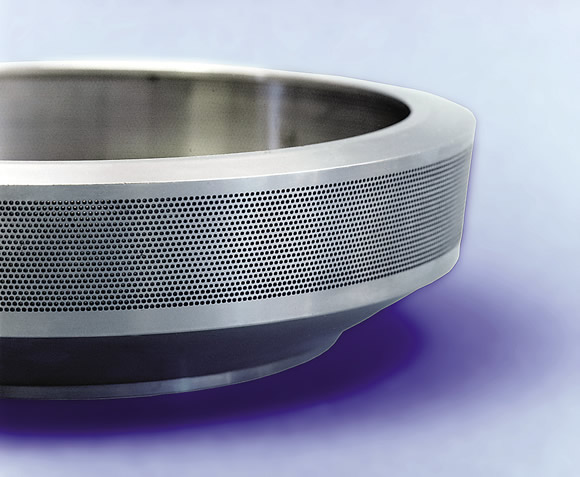
Courtesy of PTR-Precision Technologies
This spinneret, used to make glass fibers, has 25,600 0.55mm-dia. holes made via electron beam drilling.
The science behind electron beam drilling was discovered in 1949 when German physicist Karl Steigerwald inadvertently burned a hole in the lens of his electron microscope. That laboratory mishap has since been turned into an incredibly productive industrial tool. Tobias Boehme, head of perforation at pro-beam AG & Co., Planegg, Germany, a manufacturer of electron beam drilling machines, said the science behind the electron beam drilling process is easy to explain. (The company’s U.S. operation, pro-beam USA, is based in Aurora, Ill.)
“EBDing works off the same principle as an old-fashioned, tube-style television set, using a stream of accelerated electrons to do the work,” he said. This isn’t like watching a “Leave it to Beaver” rerun, however. With a voltage of 120kW, an EBD generates roughly 1,000 times more power than an old black-and-white—a TV like this would cook its audience before the opening scene.
Mojo Working
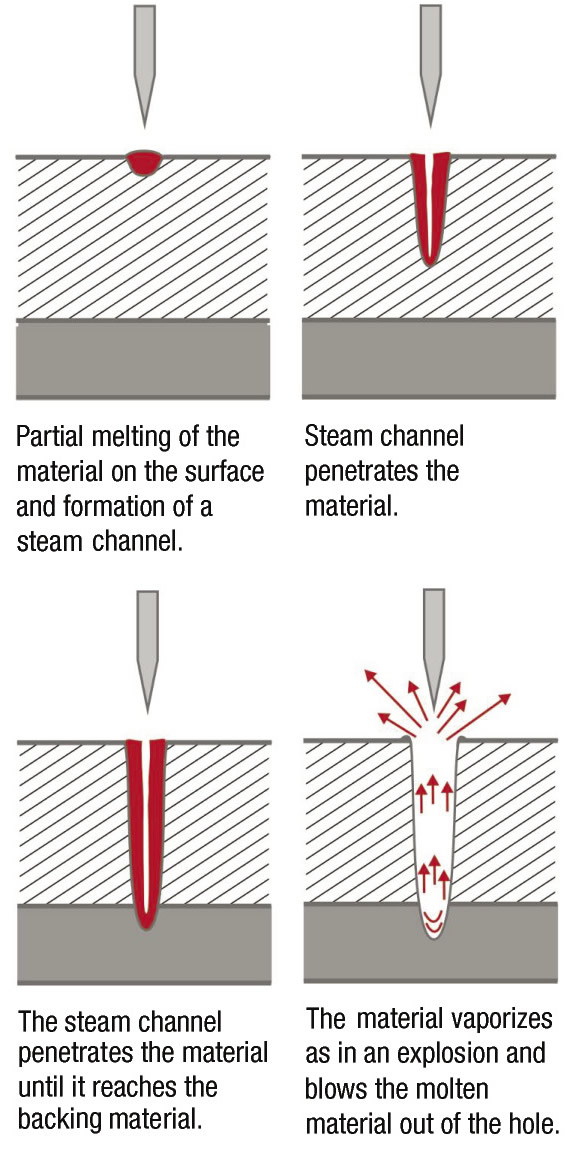
Like the cathode-ray tube in that tired Motorola, an EBD gets its mojo by electrically heating a cathode, which responds by emitting a cloud of electrons. This cloud is then accelerated with a bias voltage and the resultant beam is shaped through a series of electromagnetic lenses and directed at the workpiece (see graphic on page 98). When the beam hits, the atomic particles plow into the workpiece at two-thirds the speed of light, superheating the material to 2,700° C (4,892° F).
The particles don’t stop until they hit a backing sheet—made from a polymer or other relatively low-melting-point material—which is applied to the workpiece prior to machining. This backing material vaporizes on impact, creating a gas bubble at the bottom of the hole.
The result is like Mount Vesuvius on its worst day. A cylinder of molten material is ejected from the workpiece, leaving behind a smooth hole between 60μm and 5mm in diameter, at aspect ratios up to 25:1. The electron beam turns on and off rapidly, or pulses, between holes.
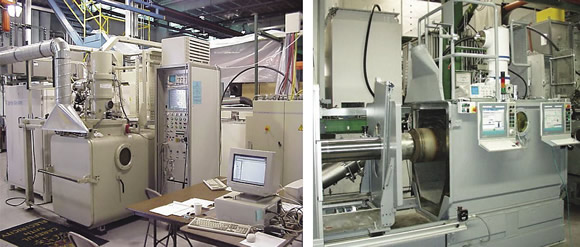
Courtesy of pro-beam
Type PK 14 (left) and Type PK 20-3 electron beam drilling machines from pro-beam.
Boehme said EBD can do far more than just make round holes: “You can influence the shape of the beam by moving it in a helical or oscillating direction. The distribution of power into the workpiece then becomes noncylindrical. The molten material is blown out of the resulting shape in a single pulse, creating ovals, slots and even complex shapes very quickly.”
Quick is an understatement. Boehme cited a 304 stainless steel screen pro-beam makes for the food industry that measures 1,100mm × 500mm × 0.5mm (43.3 “×19.7 “×0.02 “) and contains 6.5 million 110µm-dia. holes (0.0043 “). Drilling consumes about 1 hour.
Another metalworking professional enjoying fast cycle times is Kenneth Norsworthy, manufacturing engineer for Owens Corning Corp.’s Ridgeview plant in Duncan, S.C. The plant keeps five EBDs busy making holes in fiberglass spinnerets.
“Each of these [spinnerets] contains from 30,000 to 70,000 holes, and we drill thousands of them every month,” he said. “No other process can compete. About the only downside is EBDing has to be done in a vacuum.” That vacuum is needed for the same reason cows should be kept off the track of a high-speed train. “If the electrons hit any air molecules, they will be diverted from the correct path. This leads to unpredictable results,” Norsworthy said.
Another limitation is workpiece shape. The majority of end-product candidates for EBDing are cylindrical screens and filters. Flat sheets can be wrapped into a tubular shape for drilling.
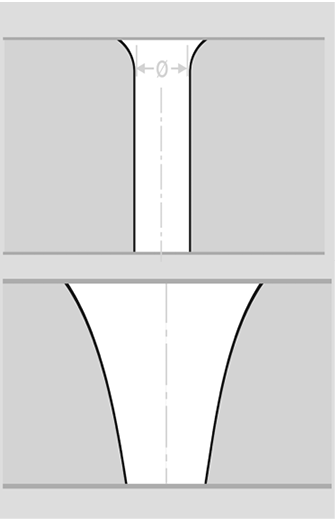
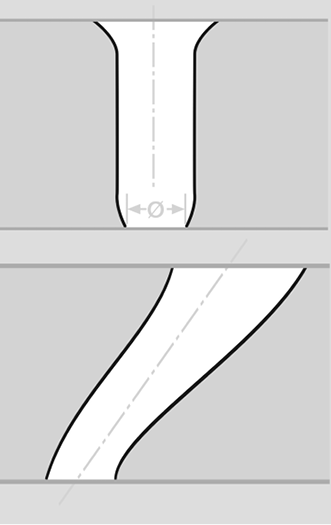
Courtesy of pro-beam
Electron beam drilling can produce holes with a variety of different shapes, such as these examples.
“We spin the workpiece under a stationary beam,” Norsworthy explained. “The holes are drilled so quickly that the workpiece never stops turning. All we need is an X-axis to move the part linearly under the beam.”
Despite the fact that Owens Corning is shooting at a moving target, hole accuracy is good. “It’s a proprietary process, but I can tell you we are drilling aerospace-quality material at aspect ratios of 25:1 and can hold ±0.001 ” tolerances on holes from 0.0024 ” to 0.20 ” in diameter.”
Managing Mishaps
Still, doing anything this quickly can cause errors. “Depending on what kind of holes you are trying to make, it’s sort of like a racecar,” said Greg Albares, owner of Particle Beam Tech Inc., a job shop in Roebuck, S.C. “You can push for a higher speed, but you may lose some handling.”
As Albares explains, making holes this fast and close together is often problematic. EBDs’ high energy can lead to warpage and movement of the workpiece, causing inaccuracy. Flying debris might interfere with the beam, and ejected material can stick to the workpiece surface, affecting adjacent holes.
Courtesy of pro-beam
The electron beam drilling process.
“Sometimes, you have to limit the machine’s power to reduce heat effects or play around with the focus,” he said. “It’s all about optimizing process parameters—such as average power and pulse duration—until you find a robust process. It’s very part specific, but once you find the right mix it’s quite repeatable.”
Albares said there are only 30 EBD machines in the world. As a result, it’s sometimes difficult to get help when you run into problems. “This isn’t like a typical job shop where you can call a fellow shop owner for advice. When you buy a new machine, they’ll give you adequate training, but it still takes a lot of experience to get good at it.”
One company willing to help is PTR-Precision Technologies Inc., Enfield, Conn., which sells the Steigerwald line of equipment. (Steigerwald was founded by the same physicist who accidentally drilled a hole in his microscope.) PTR also does job shop work. John Rugh, marketing and general sales manager, said the nearest competitor to an EBD is a laser. “Lasers give a very nice hole at aspect ratios and diameters similar to an electron beam. But they’re far slower and more difficult to operate. For example, one of our recent customers was able to replace seven laser drillers with one electron beam drill. It is that fast.”
Want to join the elite club of EBD shops? You’ll need some serious cash. “You’re looking at $1.5 to $2 million for a decent-sized driller, which means a vacuum chamber with a couple cubic meters of capacity and 20kW to 30kW of power,” Rugh said. However, these machines are so fast and productive that a shop considering a new EBD might be able to do in a week or so what previously took them a year, leaving the machine idle unless the shop can generate new business. “In that regard, it can be hard to justify the investment,” he said.
But EBDs can be a viable option for companies making multiple parts requiring high hole volumes on a regular basis. And maybe there’s someone out there who needs to make a superprecision screen door!CTE
Contributors
Owens Corning Ridgeview
(866) 927-7176
www.ebdrilling.com
Particle Beam Tech Inc.
(864) 680-1991
pro-beam USA
(312) 953-8083
www.pro-beam.com
PTR-Precision Technologies Inc.
(860) 741-2281
www.ptreb.com
Glossary terms in this article
Related


Subscribers can use MFGAxis notes, saves and discussion tools with their innoNET account.