



Holding firm: Turning Performance
John Prosock Machine Inc. is a Quakertown, Pa., job shop that handles prototype machining as well as production and assembly jobs. Founded in 1982, the 30-employee shop has 10 mills and 13 lathes. Production runs range from 100 to 2,000 pieces for a range of customers.
John Prosock Machine Inc. is a Quakertown, Pa., job shop that handles prototype machining as well as production and assembly jobs. Founded in 1982, the 30-employee shop has 10 mills and 13 lathes. Production runs range from 100 to 2,000 pieces for a range of customers. “We pretty much do anything,” said Claude Farrington, plant manager. “Medical work, driveline components, heavy equipment, parts for remote-control cars, you name it.”
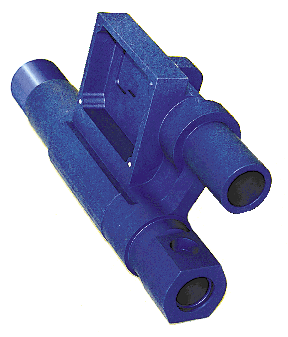
Describing the machining of a prototype aluminum trunnion housing, Farrington said the actual machining of the complex-looking part was not too difficult, but determining how to fixture it was a challenge. The roughly 11½ “-long × 5½ “-wide housing was designed to mount on a boat’s transom and house an electronic linear actuator. It is part of a system that provides instant steering response when activated by controls at the helm, eliminating the slow reactions of a cable system.
Prosock Machine received a DXF file from its customer and loaded it into the shop’s Mastercam CAM software to program milling operations. Turning work was programmed at the lathe.
The housing was machined from a 12 “×6 “×3½ ” 6061-T6 aluminum block. It was clamped with the long dimension standing vertical in a Kurt vise with aluminum soft jaws on an Excel 810 vertical machining center. One end of the finished housing has a single 1.850 “-dia., 3.850 “-long boss, but, to start, two identical bosses were machined side-by-side. “We machined two so when we flipped the part we could use them to align it in the vise. Later we cut the one off that we didn’t need,” Farrington said.
The twin bosses were machined with a 1½ “-dia. HSS endmill, run at 3,000 rpm and a 30-ipm feed rate with a 4 ” length of cut. Farrington described the toolpath as “a figure 8 around the bosses,” stepping down 0.200 ” on each pass.
Courtesy of John Prosock Machine
John Prosock Machine produced this aluminum trunnion housing as a prototype for part of a powerboat steering system.
The housing was then flipped in the vise and one of the twin bosses was located against a stop. On the other end of the finished housing would be two bosses that are not identical, having different diameters and offset 70° from each other. One boss, in line with a boss machined earlier, measures 2.100 ” in diameter. The other boss is 1.514 ” in diameter. Because this second set of bosses was closer together than the first pair, smaller endmills were used. The bosses were roughed with a ⅞ “-dia. HSS hogmill and finished with a ¾ “-dia. HSS endmill, both run at 1,200 rpm and 10 ipm with a 4 ” length of cut. The two bosses are 1.360 ” long, but one is set back 0.600 ” deeper in the part than the other.
Water-soluble coolant was applied throughout the machining process. Farrington described the HSS tools as “generic,” adding that the shop’s solid-carbide tools are from Mill Monster and its inserted milling and turning tools are from Kennametal.
After milling the second set of bosses, the smaller diameter one was drilled and reamed. A 11⁄16 “-dia. HSS drill, run at 600 rpm and a 4-ipm feed and pecking each 0.200 “, drilled to a depth of 7.7 “. A 1.103 “-dia. reamer then finished the hole to a tolerance of ±0.0004 “. At this point, the housing was removed from the VMC and the extra boss machined in the first operation was removed with a bandsaw, leaving a stub to be face-turned away later.
Next, the part was clamped horizontally in the vise and a 3 “-dia. shell mill, run at 2,500 rpm and 20 ipm, facemilled the housing to height of the next feature, a 3.5 “-wide × 2.7 “-long × 0.72 “-deep pocket, which would hold the actuator electronics. A ½ “-dia. carbide endmill run at 3,500 rpm and 25 ipm roughed out the pocket, leaving 0.050 ” of extra stock on the sides and 0.010 ” on the floor. Then, a ¼ “-dia. carbide endmill finished the side profiles and bottom. A small pocket in the bottom of the larger feature required machining with a 1⁄32 “-dia. carbide endmill. Outside each corner of the pocket, a hole was drilled 0.433 ” deep with a 0.114 “-dia. drill and threaded with an M3.5×0.6 tap.
The next operation was milling the back of the housing. The part was flipped in the vise, the 3 “-dia. shell mill removed excess material, and a ½ “-dia. carbide endmill roughed and finished the details. The sharp edges of a lug created in the operation then were rounded with a radius mill.
Next, the housing was moved to a Eurotech turning center for turning, facing and boring. With the 2.100 “-dia. boss clamped in the chuck, the (now) single 1.850 “-dia. boss on the other end of the part was turned to a 1.765 ” diameter for a length of 1.653 “, using a DNMG 431 insert run at 700 rpm and 0.008 ipr. The same tool then faced the remaining stub of the boss removed earlier. Farrington said the part’s eccentric shape posed no problem in the lathe. “It was a pretty good size diameter to hold on to and we didn’t spin it at very high rpm.” A NTF2R threading insert then cut an M45×1.5 thread at the end of the boss.
Next, a 15⁄16 “-dia. drill, applied at 400 rpm and 0.010 ipr with a 0.250 ” peck cycle, drilled the boss to a depth of 9.665 “. A 1 “-dia. KMT boring bar run at 500 rpm and 0.007 ipr finished the bore to a diameter of 1.37 “, ±0.002 “.
The part then was turned end to end in the lathe and chucked on the 1.850 “-dia. boss, gripping behind the thread. A 13⁄16 “-dia. drill made a 2¼ “-deep hole in the 2.100 “-dia. boss at 500 rpm and 0.005 ipr, employing a 0.250 ” peck. Then a 5⁄8 “-dia. boring bar created a chamfer and a counterbore in the hole’s front end and behind that cut a bearing diameter of 1.0004 “, ±0.0004 “.
For the final operation, the housing was clamped horizontally in a Haas indexer mounted on the VMC’s table and again held on the 1.850 “-dia. boss. A ½ “-dia. carbide endmill, run at 2,000 rpm and 18 ipm, milled a series of lengthwise flats, positioned via the indexer at 10° intervals. Then, the same endmill circular interpolated two 0.775 “-dia., 0.354 “-deep counterbores in the end of the 2.100 “-dia. boss. After machining, the housing received a 0.005 “- to 0.010 “-thick blue anodized coating.
Total machining time for each part was about 90 minutes. Farrington termed this five-piece job a typical, small-volume prototype job, involving ongoing consultation with the customer’s engineers as the design evolved during the prototyping process.
For more information about John Prosock Machine Inc., call (215) 804-0321 or visit www.jprosock.com.
Glossary terms in this article
Related




Subscribers can use MFGAxis notes, saves and discussion tools with their innoNET account.


