



Hole in Three: Drilling Performance
Ballizing, lapping with wire and brushing are three simple and economical hole finishing techniques that yield impressive results.
Ballizing, lapping with wire and brushing are three simple and economical hole finishing techniques that yield impressive results.
A large portion of holes require finishing after drilling, EDMing or laser cutting. Size must be improved, surfaces smoothed, residual stresses eliminated, burrs removed, taper eliminated and special edge configurations produced.
As a result, parts manufacturers perform secondary finishing operations—such as reaming, boring, grinding, honing and abrasive flow machining—to finish holes. Most of these finishing processes, however, require special equipment, some of which is relatively expensive.
This article discusses three straightforward processes that do not involve expensive equipment: ballizing, lapping with wire and brushing.
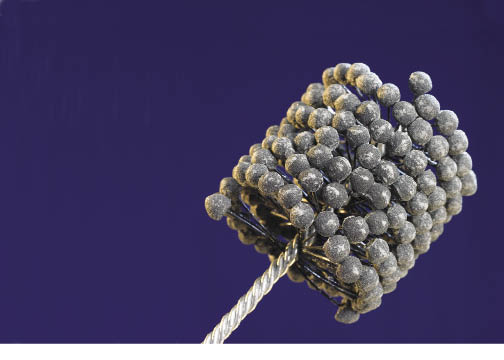
Courtesy of Brush Research Manufacturing
Flex-Hone brushes from Brush Research Manufacturing are brushes tipped with abrasive balls for imparting unique surface textures.
Rapid Finishing
Ballizing, also known as ball broaching, is one of the simplest methods for improving hole finishes while also providing more consistent hole sizes. To finish holes, the user takes a hardened metal ball slightly larger than the existing drilled hole and forces it through the hole using a lubricant brushed in the hole to reduce friction, such as STP oil treatment. Ballizing is for rapid finishing of holes, typically under 1 ” in diameter and more commonly under ¼ ” in diameter.
The ball is typically forced entirely through a hole in a second or less, so the production rate depends on how quickly parts can be loaded and unloaded. After exiting the hole, the ball can be captured in a small cup or a trough below the worktable. Although ballizing can be manually performed in an arbor press, drill press, mill or lathe, automated equipment is available, such as a unit from National Ball-O-Matic, Madison Heights, Mich., that processes up to 5,000 pieces per hour.
Ballizing is not only appropriate for through-holes. Special techniques described later are available for blind-hole applications.
Tungsten carbide is highly incompressible, so it is the first ball material choice for this process. Chrome-alloy steel is another readily available material for ballizing balls. These high-carbon, high-chrome 52110 steel balls have a hardness of 58 to 63 HRC. An AFBMA (Anti-Friction Bearing Manufacturers Association) grade-20 ball has a ball-to-ball size variation of ±0.0001 ” or less, so consistent tool size is ensured. They can be purchased from specialty ball producers such as Bal Tec, Los Angeles. Tungsten carbide lasts significantly longer than chrome-alloy steel, but steel balls may be more readily available for experimentation. Carbide balls can reportedly finish up to a million holes.
Arbor presses are often used for ballizing, but drill presses, mills and lathes can also be used. The push rod should be as short as possible to reduce its tendency to bend. Putting a spherical cavity in the end of the push rod helps keep the ball centered. Sideways forces on the ball center it in the part, so fixturing may not be needed.
For heat-treated 4100 and 6100 carbon steel workpieces with ½ “-dia. holes, parts are ballized 0.0002 ” to 0.0003 ” oversize, and the material spring back causes a hole to shrink 0.0004 ” to 0.0005 “. The needed interference in ball size can be as much as 0.005 ” for a 1 “-dia. hole, while the needed interference for small sizes ranges from 0.0002 ” to 0.0005 ” (Table 1). Users will need to experiment with ball sizes to achieve the correct size for their materials.
Shops can also make a simple, one-piece tool that works the same way as ballizing. The tool presses hole walls as it goes down and as it is retracted. The impact on the hole during withdrawal is negligible because the hole is now bigger and the elasticity in the hole wall is removed during the downward motion. The advantages of this approach are that it does not require a through-hole or capturing a loose ball.
On the other hand, the tool is more expensive to make than a ball broach, so it would only be applied once users know the exact size needed or when there are several different hole sizes on the same axis. For the latter, two or more pressing diameters can be machined on the tool provided the smallest hole is at the bottom of the sequence. The part also must be held when this one-piece tool is retracted from the hole, which is not a requirement when ballizing.
When ballizing a thin-wall part, the OD must be reinforced to prevent it from being expanded. If hole size is the only concern after heat treating, ballizing provides an excellent means to achieve hole tolerance.
Ballizing is tolerant of initial hole-size variations. It improves out of roundness, taper and finish. A smooth, uniform feed is needed to assure that ripples in the wall do not result. National Ball-O-Matic notes that high-speed, through-hole ballizing is necessary for the tightest-tolerance holes and finest finish.
Ballizing is a chipless process, but hole entrances and exits may require chamfering before or after the process because some material can be squeezed out the ends of the hole.
When holes are drilled from both ends, they never quite match at the center. A burr can be produced at the drill’s intersection that ballizing will knock off, smoothing the junction. Ballizing can also be effective for removing loose material at intersecting holes.
Lapping with Wire
Finishing holes with a wire lap has been practiced for centuries. An alternative to lapping with solid mandrels, lapping with wire is suitable for finishing small holes in hard materials. Its use peaked in the 1940s in the fabrication of jeweled bearings for mechanical watches. Typically, many parts are strung on a wire coated with fine diamond abrasive. Moving the wire back and forth through the parts’ holes while the parts rotate smoothes hole walls, increases concentricity and reduces taper. Increasing the wire’s diameter increases hole size.
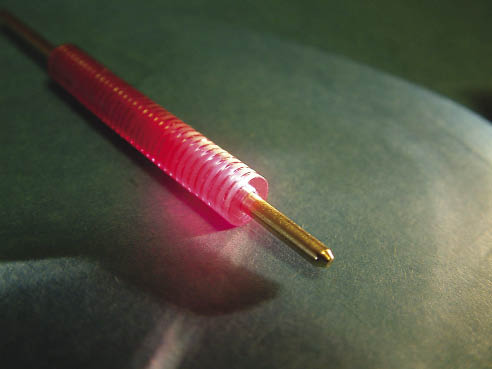
Courtesy of Bird Precision
Bird Precision finishes holes in its ruby blanks by lapping them with an abrasive wire.
In finished parts, the performance of fluids flowing quickly out of orifices depends on exact hole edge conditions as well as hole size and finish. Bird Precision Inc., Waltham, Mass., uses wire lapping to produce straight edges for nozzles used in waterjet machining and other applications. The company’s tapered wires impart surface finishes of 2 µin. Ra or better and achieve diameter tolerances within 0.0001 ” and roundness to 0.000050 “.
For one or two parts, it is usually less expensive to use a lapping mandrel and lapping compound to finish the holes, but when quantities number in the hundreds or the parts are too long (for example, when the aspect ratio is 30:1), this process can be a good choice.
Table 1. Ballizing results.
| Hole Dia. (in.) | Part Material | Specimen size (in.) | Tolerance Maintained (in.) | Surface Finish Produced (µin. Ra) | |
| OD | Part thickness | ||||
|
0.0312 |
17-4PH (heat-treat condition H900) |
0.200 |
0.130 |
±0.0001 |
2 to 27 |
|
0.0312 |
304-L stainless |
0.200 |
0.130 |
±0.0002 |
2 to 27 |
|
0.0312 |
SAE K-95100 |
0.200 |
0.130 |
±0.0001 |
3 to 12 |
|
0.0469 |
304-L stainless |
0.205 |
0.026 |
±0.0001 |
Not measured |
|
0.2412 |
SAE K-95100 |
0.489 |
0.185 |
±0.0001 |
10 to 26 |
SAE K-95100 is a high magnetic-permeability steel containing 40 percent cobalt and 2 percent vanadium.
For production watch applications, 500 ruby or sapphire jewels are strung on a wire lap, clamped or glued together and revolved. In this example, simple, dedicated machines are used. To reach the desired hole size with a 0.0001 ” tolerance, several wire sizes are used.
For low-production runs, a hacksaw frame can be used to hold the wire. Parts are manually slid back and forth across the diamond-laden wire. The hacksaw frame requires end connections to hold the wire ends, and the saw needs a device to add tension so the wire is tight.
High-strength piano wire has been used to lap holes as small as 0.009 ” in metal workpieces. The wire is held in tension and coated with lapping compound. Wire is available in 0.001 “-dia. increments. The wire is normally plated with copper so it can be charged to accept a diamond abrasive coating. Extruded carbide tubes are lapped this way with 1µm to 5µm lapping compound, producing finishes as fine as 1 to 2 µin. Ra.
Some of the largest users of wire lapping are producers of zirconia ceramics ferrule for optical fiber connectors, precision hydraulic orifices and diamond wire drawing dies.
There are few makers of automated wire lapping equipment. Microcut Ltd., Lengnau, Switzerland, provides both long mandrel laps and wire lapping machines. Bird Precision is one of the largest U.S. users of this process. Bird Precision produces ruby blanks and puts thousands of them on a wire at one time. The orifices vary from 0.0016 ” to about 0.250 ” in diameter and are used as measuring restrictions in analytical instruments, gas chromatographs, gas metering, pace makers, ink jet printers, leak detectors and air and hydraulic regulators.
Brushing for Finish and Texture
One of the fastest and simplest approaches for finishing holes is to use off-the-shelf brushes for surface improvement. Commercial abrasive nylon brushes remove burrs and lightly hone surfaces, but brushes tipped with abrasive balls, such as Flex-Hone brushes from Brush Research Manufacturing Co. Inc., Los Angeles, impart the unique surface textures needed for many applications.
Table 2. Surface finishes produced in various metals with 0.031 “-dia. finishing tools.
| Part Material | Surface Finish (µin. Ra)* | |
| Ballizing | Reaming | |
|
SAE K95100 |
2 to 12 |
Not measured |
|
17-4 PH (H900) |
2 to 5 |
Not measured |
|
304-L stainless |
2 to 7 |
Not measured |
|
Phosphor bronze |
4 to 12* |
3 to 6 |
|
7075-T6 aluminum |
4 to 12* |
3 to 7 |
|
Polyimide plastic |
6 to 36 |
3 to 17 |
*Surface finish standard deviation when ballizing was 2.88 µin. Ra while it was 0.85 µin. Ra when reaming with a Microsizer reamer. For aluminum, the standard deviation was 2.43 µin. Ra when ballizing and 0.90 µin. Ra when reaming. For the Vespel polyimide plastic, the differences were 8.52 µin. Ra and 4.12 µin. Ra. A ball 0.00025 ” larger than the final hole was used for aluminum and a ball 0.00035″ larger than the final hole was used for phosphor bronze.
The abrasive globe at the ends of the nylon bristles removes grinding burrs, slivers and smeared and torn metal in automotive cylinders while providing an oil-retaining crosshatch pattern and a finer finish. In addition, the process improves the bearing ratio as it removes the top peaks of surface metal, which helps extend cylinder life.
The Flex-Hone cylindrical brushes have nylon spokes, or bristles, projecting from the center shaft. At the end of each spoke is an abrasive ball. Because the brush diameter is larger than the hole diameter, the abrasive balls are always in contact with the walls. The abrasive force against the walls is a function of spoke diameter and length, brush diameter and brush speed.
The brush is rotated while being driven up and down the hole axially to scrub the entire surface. The resulting surface textures are a function of force, initial hole properties, ball size, grain size and ball composition. The balls are made of silicon carbide, aluminum oxide, boron carbide, tungsten carbide, diamond, levigated alumina or CBN.
Table 3. General comparisons of three hole-finishing processes.
| Part requirement | Process | |||
| Ballizing | Wire lapping | Ball-tipped Brushing | ||
|
Typical hole size (in.) |
0.010 to 0.500 |
0.005 to 0.031 |
0.125 to 24.0 |
|
|
Typical surface finish produced (µin. Ra) |
2 to 8 |
2 to 4 |
16 to 32 |
|
|
Typical material applications |
Any metal |
Hard materials |
Any steel or iron |
|
|
Typical size repeatability produced (in.) |
±0.0001 |
±0.0001 |
N/A |
|
|
Impact on roundness (in.) |
Improves roundness to 0.000050 |
0.000050 |
N/A |
|
|
Does the process reduce taper? |
Reduces taper to 0.0002 ” or better |
yes |
N/A |
|
|
Manual production rate (parts/hr.) |
3 to 30 |
10 to 20 |
20 to 60 |
|
|
Automated production rate (parts/hr.) |
Up to 5,000 |
100 to 300 |
60 to 100 |
|
|
Process deburrs intersecting holes? |
Some |
No |
Yes |
|
|
Impregnates or leaves material on surface? |
No |
Yes |
Most abrasives leave trace amounts |
|
|
Impact on subsurface |
Workhardens the hole |
Removes stresses |
Removes some of the features that reduce fatigue life |
Surface texture is critical for automotive cylinder life. The goal is a crosshatch surface with no torn or folded metal or slivers that can scuff or gall the bores. In addition, a definite value of plateaus is required. Flex-Hone tools should rotate at less than 1,200 rpm, with typical speeds being from 350 to 500 rpm. The longitudinal stroke is from 60 to 120 per minute. For a 3 ” bore, these speeds result in a cutting speed of 275 to 390 sfm. Slower speeds enhance deburring while faster ones improve finish.
On cast iron cylinder liners, a 30-second hone with a 120- to 400-grit abrasive can remove 0.0004 ” of material. The finer abrasive imparts finishes as fine as 4 µin. Ra while the coarser abrasive produces a 16 µin. Ra finish for parts that started with an 80 µin. Ra finish. In addition to cylinder liners, this style of brush finishes brake cylinders, hydraulic valves, disk brakes, valve guides, pipe nipple adaptors, revolver cylinders, shotguns and paintball guns.
While they improve the surfaces, the flexing balls also reach into intersecting holes to provide deburring. They can also be effective at removing entrance and exit burrs in the main bore, depending on their thickness.
This style of tool provides rapid finishing of holes from 0.157 ” to 36 ” in diameter, is readily available, accommodates a variety of hole sizes and can be automated or powered by simple hand drills. For many applications, particularly short-run jobs, these brushes are less expensive than vitrified honing tools. In addition, this finishing process only exerts 5 to 10 percent of the torque and thrust of conventional honing. CTE
About the Author: Dr. LaRoux K. Gillespie has a 40-year history with precision part production as an engineer and manager. He is the author of 11 books on deburring and over 200 technical reports on precision machining. He can be e-mailed at laroux1@earthlink.com.
Glossary terms in this article
Related


Subscribers can use MFGAxis notes, saves and discussion tools with their innoNET account.


